
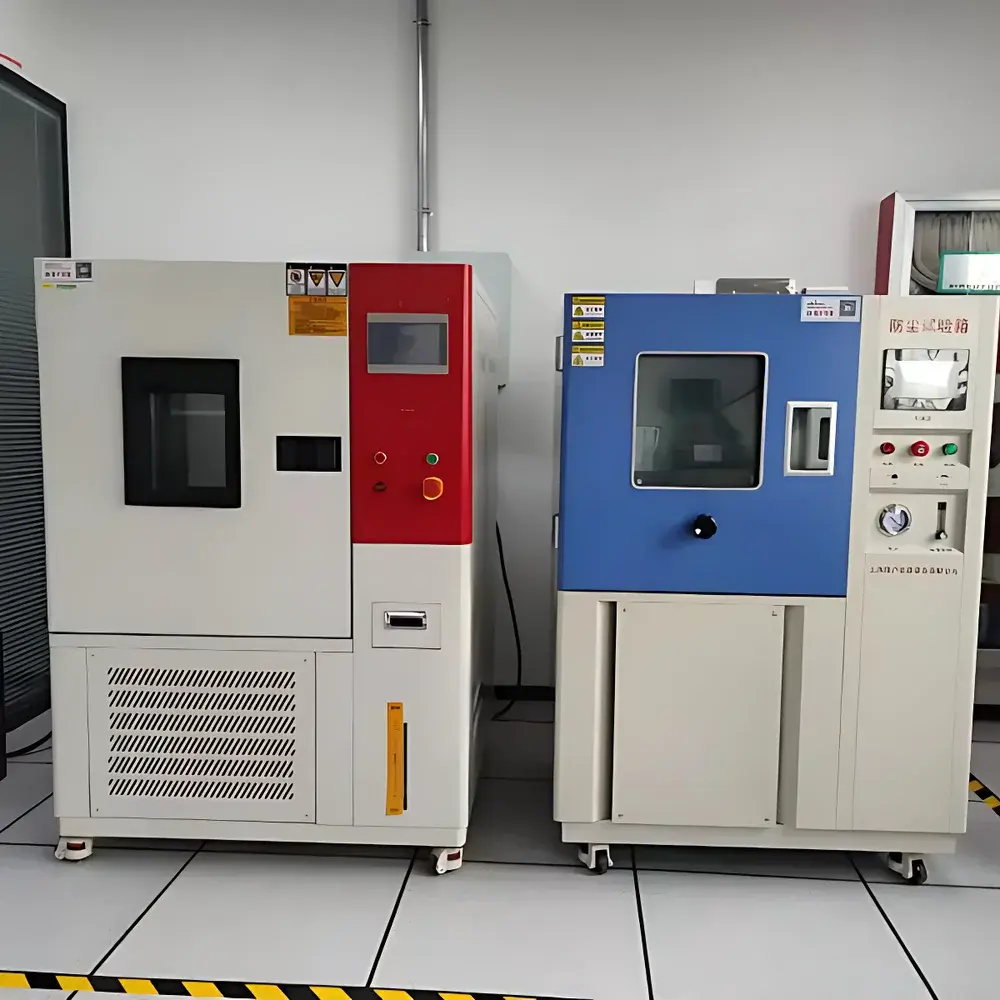
Jianhu JH-TSC Series Chip Thermal Shock Test Chamber
| Brand | Jianhu |
|---|---|
| Origin | Shanghai, China |
| Model | JH-TSC Series |
| Temperature Range | -60°C to +150°C |
| Temperature Transition Rate | Up to 20°C/min |
| Temperature Uniformity | ±2°C |
| Control Accuracy | ±0.1°C |
| Programmable Cycles | Up to 1000 segments |
| Compliance | AEC-Q100, JEDEC JESD22-A104, ISO 16750-4, IEC 60068-2-14 |
| Configuration | Three-zone (Hot / Cold / Test) design with platinum RTD sensors |
| Sample Compatibility | Miniaturized semiconductor packages (e.g., QFN, BGA, WLCSP), display modules (OLED/LCD), MEMS devices |
Overview
The Jianhu JH-TSC Series Chip Thermal Shock Test Chamber is an engineered environmental test system designed specifically for accelerated reliability validation of microelectronic components under extreme and rapid thermal transients. Unlike conventional temperature cycling chambers that operate at ramp rates below 5°C/min, the JH-TSC employs a three-zone (hot / cold / test) architecture with independent high-efficiency heating and cryogenic cooling circuits—enabling controlled transitions between -60°C and +150°C at rates up to 20°C/min. This capability replicates real-world thermal stress profiles encountered during automotive engine start-up, outdoor consumer device operation, or aerospace payload thermal cycling—where differential thermal expansion across heterogeneous materials (silicon die, epoxy mold compound, solder interconnects, substrate) induces mechanical strain sufficient to initiate latent defects such as interfacial delamination, solder joint fatigue, or package cracking. The chamber’s core measurement principle relies on precision platinum resistance thermometers (PT100/PT1000) embedded in the test zone and sample interface, delivering real-time thermal profiling with ±0.1°C stability and ±2°C spatial uniformity—critical for statistically valid failure mode analysis in high-reliability applications.
Key Features
- Three-zone thermal shock configuration: Separated hot chamber (+150°C), cold chamber (-60°C), and neutral test chamber minimizes cross-contamination and ensures repeatable thermal transfer kinetics.
- High-fidelity temperature control: Dual PID algorithms independently regulate heating and refrigeration subsystems, enabling continuous ramp rate adjustment from 5°C/min to 25°C/min without overshoot or dwell instability.
- Miniature sample adaptability: Interchangeable aluminum alloy sample carriers with optimized thermal mass and low-emissivity surface finish ensure uniform thermal coupling for chips as small as 3 mm × 3 mm (e.g., WLCSP, flip-chip BGA).
- Comprehensive programmability: 1000-segment test profile memory supports multi-step cycles—including dwell time, transition delay, and conditional branching—aligned with AEC-Q100 Rev H, JEDEC JESD22-A104E, and ISO 16750-4 Annex D requirements.
- Traceable data acquisition: Integrated 16-channel high-resolution datalogger records chamber setpoints, actual zone temperatures, cycle count, and elapsed time; exportable in CSV and PDF formats compliant with GLP/GMP audit trails.
Sample Compatibility & Compliance
The JH-TSC accommodates a broad spectrum of miniaturized electronic assemblies, including but not limited to: automotive-grade MCUs and power ICs (AEC-Q100 Grade 0–2), mobile display driver ICs and OLED/TFT backplane modules, RF front-end modules (FEMs), MEMS inertial sensors, and optoelectronic transceivers. Its thermal field uniformity (±2°C across 150 mm × 150 mm test area) and rapid transient response meet the stringent spatial and temporal criteria defined in IEC 60068-2-14 (Test N: Change of Temperature) and MIL-STD-810H Method 503.7. All standard configurations are factory-validated per ISO/IEC 17025-accredited procedures, with optional third-party calibration certificates available upon request. The system supports full traceability to NIST-traceable reference standards and is compatible with FDA 21 CFR Part 11-compliant electronic signature workflows when integrated with validated LIMS or MES platforms.
Software & Data Management
Jianhu’s proprietary TSC-Control Suite v4.2 provides intuitive graphical programming, real-time thermal mapping visualization, and automated compliance reporting. Users define test sequences via drag-and-drop logic blocks—specifying upper/lower limits, dwell durations, transition modes (linear, exponential), and pass/fail thresholds. During execution, the software logs timestamped temperature readings from up to 8 user-placed thermocouples (Type K or T), synchronized with chamber actuator status and alarm events. Post-test, reports auto-generate in AEC-Q100-certifiable format—including summary statistics (mean ramp rate, max deviation), cycle-by-cycle deviation charts, and annotated thermal profiles. All raw data files are stored in encrypted SQLite databases with immutable audit logs, supporting revision-controlled archiving and electronic signature enforcement per ISO 9001:2015 Clause 8.5.2 and IATF 16949 Section 8.5.1.
Applications
The JH-TSC serves as a critical verification tool across semiconductor development lifecycles—from early-stage material qualification (e.g., CTE mismatch screening between die attach adhesives and silicon substrates) to final product release testing. In automotive electronics, it validates thermal robustness of ADAS SoCs under cold-soak-to-engine-start scenarios per ISO 16750-4 Clause 4.2. For display module manufacturers, it assesses OLED encapsulation integrity against repeated thermal flexing induced by ambient temperature swings in smartphone chassis. In R&D labs, researchers employ the chamber to correlate thermal shock-induced failures with post-test FA techniques—including acoustic microscopy (SAT), scanning electron microscopy (SEM), and focused ion beam (FIB) cross-sectioning. Its programmability also enables custom stress screening protocols for emerging technologies such as GaN power devices, SiC inverters, and heterogeneous chiplet integration architectures.
FAQ
What temperature ranges and cycle counts are recommended for consumer-grade Bluetooth SoCs?
For Bluetooth ICs intended for smartphones or wearables operating within -10°C to +60°C ambient conditions, JEDEC JESD22-A104E recommends a test profile of -40°C ↔ +85°C with 100–200 cycles. Each cycle includes 15-minute dwells at both extremes and ≤10-second transfer time. Optional low-temperature extension to -55°C applies for ruggedized outdoor wearables.
How does the JH-TSC prevent thermal gradient artifacts during testing of sub-5mm packages?
The chamber utilizes low-thermal-mass aluminum sample carriers with micro-machined cavities ensuring direct thermal contact. Combined with ±2°C uniformity specification and optional surface-mount thermocouple integration, this eliminates localized lag effects common in forced-air chambers. Pre-test thermal mapping using NIST-traceable probes is advised for first-article qualification.
Does Jianhu provide failure root-cause support beyond equipment supply?
Yes. Jianhu offers optional Failure Analysis Collaboration Services, including thermal stress modeling (CTE-driven strain simulation), correlation of test data with SEM/SAT findings, and benchmarking against historical defect databases from >3,200 client deployments—including 600+ Tier-1 automotive and semiconductor OEMs.
Is the system compatible with international regulatory audits?
All JH-TSC units ship with full IQ/OQ documentation packages, calibration certificates traceable to national metrology institutes, and configurable audit trail settings meeting FDA 21 CFR Part 11, EU Annex 11, and ISO 13485 requirements for medical device component testing.



