
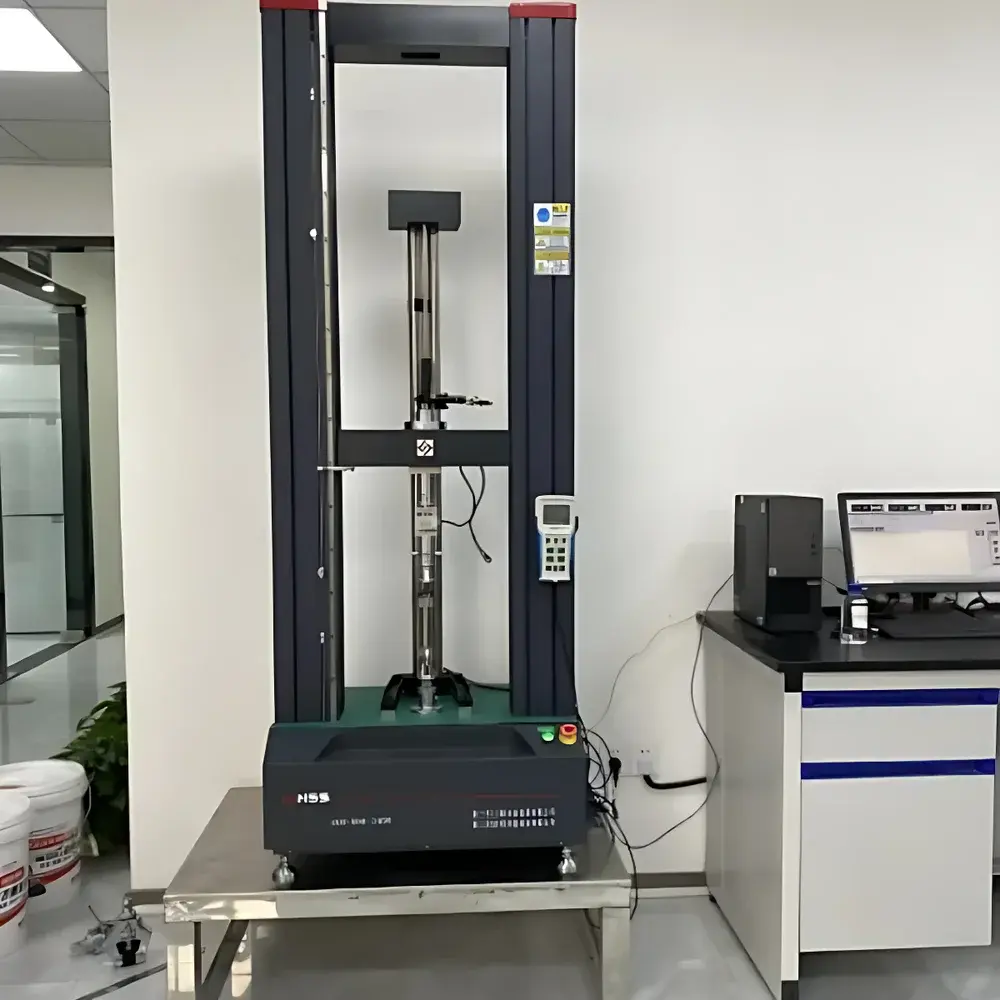
Jianhu JH-UTM Series Aerospace-Grade Universal Testing Machine
| Brand | Jianhu |
|---|---|
| Origin | Shanghai, China |
| Manufacturer Type | Authorized Distributor |
| Product Category | Domestic |
| Model | JH-UTM Series |
| Price Range | USD 850 – 8,500 |
| Instrument Type | Electromechanical Universal Testing Machine |
| Load Capacity | 0.02 N to 300 kN |
| Load Accuracy | ±0.5% |
Overview
The Jianhu JH-UTM Series Aerospace-Grade Universal Testing Machine is an electromechanical static testing system engineered for high-fidelity mechanical characterization of structural materials under conditions representative of aviation and spaceflight environments. Operating on the principle of controlled axial force application via precision servo-motor-driven crosshead displacement, it measures fundamental mechanical properties—including tensile strength, compressive yield stress, flexural modulus, fracture toughness, and creep deformation—across a wide dynamic load range (0.02 N to 300 kN) with traceable accuracy of ±0.5% of full scale. Designed explicitly for aerospace-grade validation workflows, the system integrates thermally stable load frames, low-drift strain measurement subsystems, and optional environmental chambers capable of simulating operational temperature extremes from –70 °C to +300 °C. Its architecture complies with ISO 7500-1 (Class 0.5), ASTM E4, and ISO 5893 standards for verification of force-measuring instruments, ensuring data integrity required for airworthiness certification and flight hardware qualification per FAA AC 20-152A and ECSS-Q-ST-70-02C.
Key Features
- Modular load frame design supporting dual-column configurations for enhanced rigidity during high-load compression and shear testing up to 300 kN
- High-resolution digital controller with closed-loop PID regulation enabling strain-controlled loading rates as low as 0.001 mm/min for precise yield point detection in advanced composites
- Interchangeable load cells calibrated to ISO/IEC 17025-accredited laboratories, featuring overload protection and thermal drift compensation algorithms
- Integrated extensometer interface compatible with clip-on, video-based (DIC), and non-contact laser extensometers for sub-micron displacement resolution
- Optional high-temperature furnace module (up to 1100 °C) and cryogenic cooling stage (down to –196 °C) for thermo-mechanical property mapping of Ni-based superalloys and CMCs
- Real-time data acquisition at ≥1 kHz sampling rate with synchronized analog inputs for simultaneous capture of load, displacement, temperature, and acoustic emission signals
Sample Compatibility & Compliance
The JH-UTM Series accommodates standardized test specimens per ASTM D3039 (polymer matrix composites), ASTM E8/E21 (metals), ISO 527 (plastics), and ECSS-E-ST-10-04C (spacecraft structural materials). It supports flat, round, notched, and miniature dog-bone geometries ranging from 1 mm diameter micro-tensile coupons to full-scale engine mount assemblies. All mechanical testing protocols align with regulatory requirements for aerospace material qualification, including FAA Order 8110.4B, NASA-STD-5019, and MIL-HDBK-17. The system’s traceable calibration chain meets ISO/IEC 17025 criteria, and its audit trail functionality satisfies FDA 21 CFR Part 11 and EU Annex 11 requirements for electronic records and signatures in GMP-compliant laboratories.
Software & Data Management
Jianhu UTM Control Suite v4.2 provides a validated Windows-based platform compliant with GLP/GMP documentation practices. It features automated test method templates aligned with ASTM, ISO, and EN standards; real-time curve overlay for comparative analysis across batches; and export-ready reporting in PDF/A-1b and CSV formats. Built-in statistical process control (SPC) tools calculate Cp/Cpk indices for production lot acceptance, while raw binary data archives support post-hoc reanalysis using third-party software such as MATLAB or Python-based SciPy libraries. All user actions—including method edits, calibration events, and result approvals—are time-stamped and logged with operator ID for full auditability.
Applications
- Mechanical validation of carbon-fiber-reinforced polymer (CFRP) wing spar laminates under quasi-static and fatigue loading per Boeing D6-17487
- Cyclic creep testing of single-crystal nickel superalloys used in turbine blades at 1100 °C and 200 MPa stress levels
- Interlaminar shear strength (ILSS) assessment of ceramic matrix composites (CMCs) for hypersonic vehicle leading edges
- Tensile-to-failure characterization of additively manufactured Ti-6Al-4V lattice structures for satellite brackets
- Compression-after-impact (CAI) testing of sandwich core materials per ASTM D7137 for UAV airframe certification
FAQ
What standards does the JH-UTM Series comply with for aerospace testing?
It conforms to ISO 7500-1 Class 0.5, ASTM E4, ASTM E8/E21, ECSS-Q-ST-70-02C, and supports execution of test methods defined in FAA AC 20-152A and NASA-STD-5019.
Can the system perform tests at elevated temperatures relevant to jet engine components?
Yes—when equipped with the optional high-temperature furnace module, it enables sustained creep and stress-rupture testing up to 1100 °C under controlled load conditions.
Is the software qualified for regulated environments such as FAA Part 21 or ESA ECSS-Q-ST-70?
The UTM Control Suite includes IQ/OQ documentation packages and supports 21 CFR Part 11-compliant electronic signatures, audit trails, and role-based access control.
How is traceability maintained for calibration and measurement uncertainty?
Each load cell carries a certificate issued by an ILAC-MRA signatory laboratory, with uncertainty budgets reported per ISO/IEC 17025 and documented in the system’s calibration management log.
Does the system support integration with digital twin platforms or MES systems?
Native OPC UA server capability allows bidirectional communication with manufacturing execution systems (MES), PLM platforms, and cloud-based digital twin infrastructures for real-time test data ingestion and predictive analytics.



