
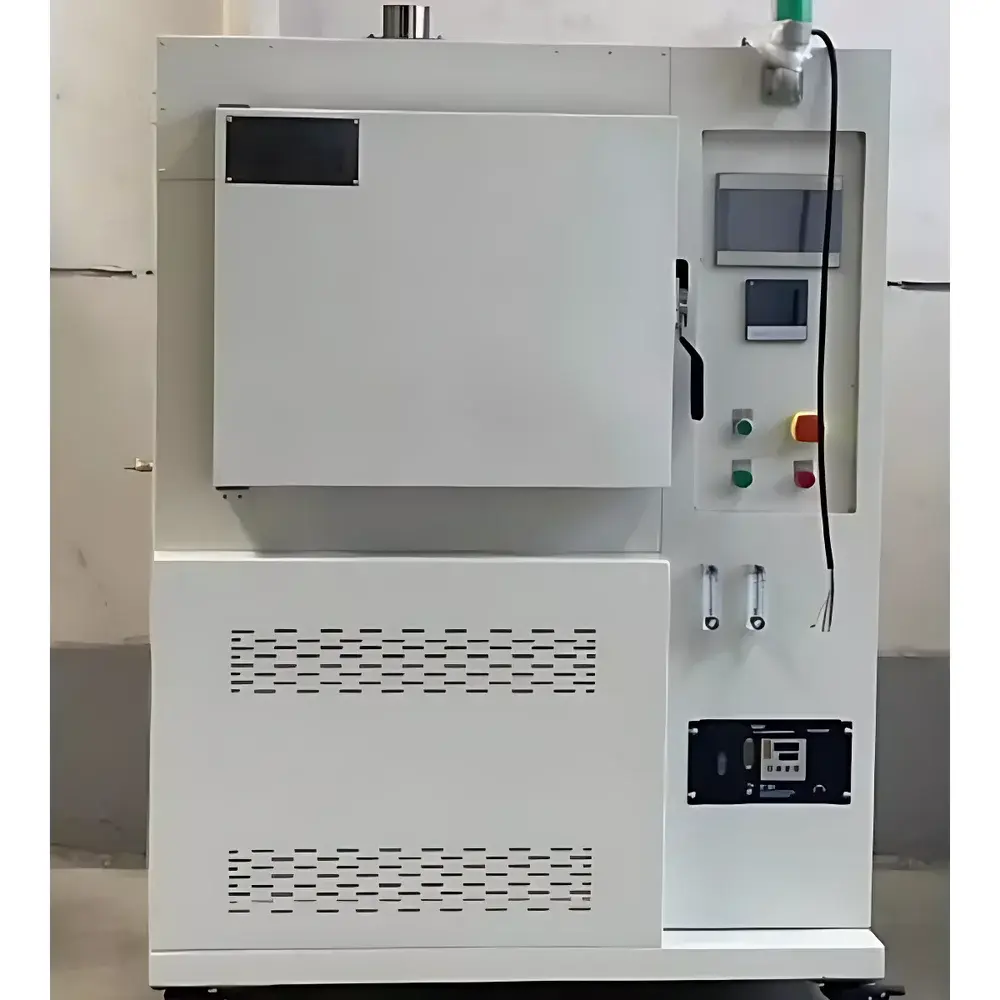
Jianhu PI Curing Oven – Programmable High-Performance Environmental Test Chamber
| Brand | Jianhu |
|---|---|
| Origin | Shanghai, China |
| Model | Jianhu PI Curing Oven |
| Temperature Range | −70 °C to +150 °C |
| Cooling Method | Compressor-Based Refrigeration |
| Explosion-Proof Design | Yes |
| Temperature Fluctuation | ±0.5 °C |
| Temperature Uniformity | ±2.0 °C |
| Temperature Deviation | ±2.0 °C |
| Heating Rate | ≤60 min (−70 °C to +150 °C) |
| Cooling Rate | ≤45 min (25 °C to −40 °C), ≤60 min (25 °C to −70 °C), ≤80 min (150 °C to 25 °C) |
| Internal Chamber Dimensions | Configurable across standard industrial variants |
Overview
The Jianhu PI Curing Oven is a precision-engineered environmental test chamber specifically designed for controlled thermal processing of polyimide (PI) films and other high-performance polymer substrates under inert or low-oxygen conditions. Built upon a robust dual-zone thermal architecture—integrating compressor-based refrigeration with high-stability resistive heating—the oven delivers tightly regulated temperature profiles across its full operational range of −70 °C to +150 °C. Its core functionality centers on programmable multi-step curing protocols, enabling users to define time-temperature ramps, dwell periods, and cooling sequences with sub-minute resolution. Unlike general-purpose ovens, this system incorporates laminar airflow optimization features—including adjustable inlet/outlet ducting, internal baffle arrays, and variable-frequency fan control—to minimize thermal stratification and ensure uniform convective heat transfer across the sample plane. This capability directly addresses documented challenges in PI film manufacturing, where localized air velocity gradients induce thickness variation, incomplete imidization, and inconsistent dielectric strength.
Key Features
- Explosion-proof construction compliant with IEC 60079-0 and GB/T 3836.1–2021 standards, certified for use with nitrogen-purged or vacuum-assisted inert atmospheres
- Programmable 30-segment controller supporting ISO/IEC 17025-compliant audit trails, with password-protected parameter locking and real-time deviation logging
- High-fidelity thermal regulation: ±0.5 °C temperature fluctuation, ±2.0 °C uniformity (measured per ASTM E2207–22 at 9-point grid), and ±2.0 °C chamber-to-setpoint deviation
- Dual-mode cooling architecture: cascade compressor system enables rapid cooldown from +150 °C to −70 °C in ≤80 minutes, while maintaining stability during extended low-temperature holds
- Modular chamber design with standardized internal dimensions (e.g., 500 × 600 × 500 mm, 800 × 1000 × 800 mm) and optional quartz viewport, gas purge ports, and load-cell integration interfaces
- Redundant safety systems including over-temperature cut-off, refrigerant pressure monitoring, door interlock, and oxygen depletion alarm (when used with N₂ supply)
Sample Compatibility & Compliance
The Jianhu PI Curing Oven accommodates rigid and flexible substrates up to 1.2 m in width, including PI films (Kapton®-type and custom formulations), polyamide-imide (PAI), benzocyclobutene (BCB), and photoresist-coated wafers. It supports both batch and continuous-feed configurations when integrated with conveyor modules. The chamber’s airflow management system has been validated per ISO 14644-3 Class 5 cleanroom airflow criteria for laminar flow uniformity, ensuring minimal particle generation and consistent solvent evaporation kinetics. Regulatory alignment includes adherence to USP , ISO 14971 risk management principles, and compatibility with FDA 21 CFR Part 11 requirements when paired with validated data acquisition software. All electrical components meet CE marking directives (2014/30/EU EMC, 2014/35/EU LVD), and explosion-proof variants carry CNEx certification for Zone 1/21 hazardous locations.
Software & Data Management
The embedded controller runs on a deterministic real-time OS and interfaces via Ethernet/IP or RS-485 to optional PC-based supervision software. This platform provides full traceability: each run logs timestamped temperature, pressure, fan speed, and alarm status with SHA-256 checksum integrity verification. Data export conforms to ASTM E2500-21 Annex A3 for raw instrument data packaging, supporting direct ingestion into LIMS or MES platforms. Optional 21 CFR Part 11 compliance packages include electronic signatures, role-based access control, and immutable audit trails with user-action attribution. Historical trend analysis tools allow comparative evaluation of curing profiles across batches, facilitating root-cause analysis for yield excursions related to thermal history deviations.
Applications
- Controlled imidization of polyimide precursor films in nitrogen or argon environments to achieve >95% cyclization conversion without oxidation-induced yellowing
- Thermal stress screening of flexible printed circuit (FPC) assemblies prior to solder reflow, simulating JEDEC J-STD-020 moisture sensitivity levels
- Cure profiling of aerospace-grade adhesives (e.g., FM-73, EA 9394) requiring precise ramp-and-soak sequences to prevent void formation
- Accelerated aging studies per MIL-STD-810H Method 502.7 for evaluating long-term dimensional stability of PI-based insulators
- Low-temperature conditioning of MEMS sensors and optoelectronic packages prior to hermetic sealing
FAQ
What inert gas compatibility does the chamber support?
The oven is configured for nitrogen (N₂) purging as standard; optional fittings enable argon (Ar) or forming gas (95% N₂ / 5% H₂) integration with mass flow controllers and O₂ analyzers.
Can the system be integrated into an automated production line?
Yes—digital I/O terminals support PLC handshaking (start/stop, fault reset, cycle complete), and Modbus TCP enables full SCADA-level integration with factory automation systems.
Is validation documentation available for GMP environments?
Factory-issued IQ/OQ protocols are provided, and site-specific PQ support is available through Jianhu’s ISO 17025-accredited validation services team.
How is airflow uniformity verified during commissioning?
Uniformity is confirmed using a calibrated 9-point thermocouple array per ASTM E2207–22, supplemented by anemometer mapping at three vertical planes (top/mid/bottom) to quantify velocity variance across the working volume.
What maintenance intervals are recommended for compressor and fan systems?
Compressor oil and filter replacement every 12 months; fan bearing inspection and lubrication every 6 months; full calibration verification annually or after 500 operational hours—whichever occurs first.



