
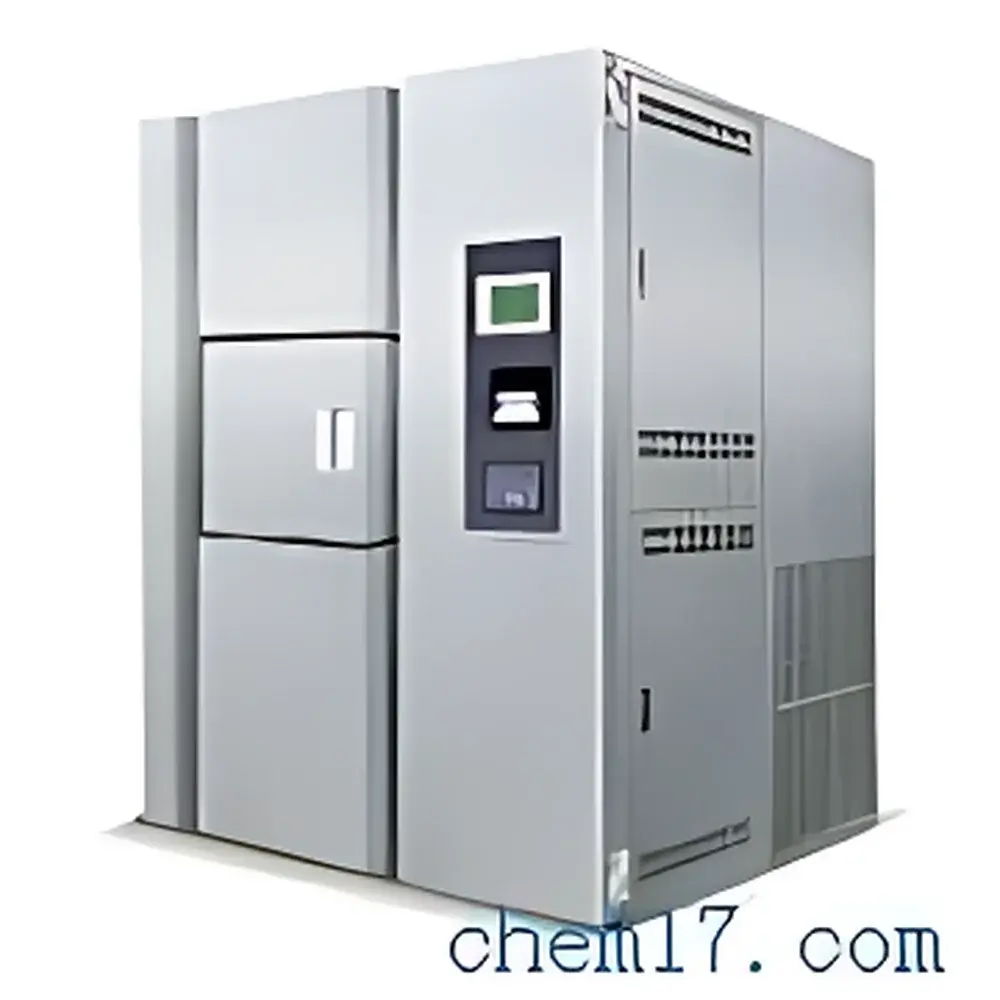
Jianhu TST Series Thermal Shock Test Chamber
| Brand | Jianhu |
|---|---|
| Origin | Shanghai, China |
| Model | TST |
| Temperature Range | +60 °C to +200 °C (High-Temp Zone) / −70 °C to 0 °C (Low-Temp Zone) |
| Transfer Time | ≤10 s |
| Temperature Recovery Time | ≤5 min |
| Control System | TEMP-880S Programmable Industrial Controller with Touchscreen LCD (English/Chinese Switchable) |
| Refrigeration | Dual-Stage Scroll Compressor (Embraco/Gaulin) with Water-Cooled Condensation |
| Compliance | JESD22-A104-B, MIL-STD-883C Method 1010.5/1010.7, MIL-STD-202F Method 107G, MIL-STD-810D Method 503.2 |
| Construction | Interior – SUS304 Stainless Steel |
| Remote Monitoring | Two-Way RS-232 & USB Data Logging |
| Power Efficiency | ~50% Reduction vs. Conventional Single-Zone Chambers |
Overview
The Jianhu TST Series Thermal Shock Test Chamber is an engineered environmental stress screening (ESS) system designed to evaluate material and component reliability under rapid, extreme temperature transitions. Based on the principle of thermal shock—inducing mechanical strain via differential expansion/contraction—the chamber subjects test specimens to repeated, controlled excursions between independently regulated high-temperature and low-temperature zones. Unlike conventional temperature cycling chambers, the TST Series employs a dual- or triple-zone architecture (VTS vertical, DTS horizontal, or TSB liquid-immersion variants) to achieve abrupt thermal transitions without subjecting samples to mechanical movement during exposure. This preserves test integrity by eliminating vibration-induced artifacts and enables precise simulation of real-world thermal transients encountered in aerospace, automotive electronics, semiconductor packaging, and military-grade hardware deployment.
Key Features
- Dual- or triple-zone configuration with independent PID-controlled temperature zones: high-temp zone (+60 °C to +200 °C), low-temp zone (−70 °C to 0 °C), and optional intermediate ambient zone (DTS model).
- Automated transfer mechanism with ≤10-second door switching time and ≤5-minute temperature recovery—verified per JESD22-A104-B requirements for thermal shock qualification.
- Industrial-grade TEMP-880S controller with 7-inch touchscreen LCD, multi-language UI (English/Chinese toggle), real-time PV curve display, USB data export, and programmable ramp-soak profiles including RAMP-mode accelerated life testing.
- Dual-stage scroll refrigeration system (Embraco/Gaulin) with water-cooled condensation, integrated compressor protection logic, and optimized heat exchanger geometry for stable sub-zero operation down to −70 °C.
- Optional liquid nitrogen (LN₂) injection module for enhanced cooling rate control—critical for applications requiring defined thermal ramp rates per MIL-STD-810D Method 503.2.
- Structural integrity assured by SUS304 stainless steel interior, fully welded seams, and powder-coated A3 steel exterior—resistant to corrosion, thermal fatigue, and long-term operational stress.
- Energy-efficient architecture delivering ~50% lower power consumption versus legacy single-chamber designs, validated via IEC 60068-2-14 Annex A thermal efficiency benchmarking.
Sample Compatibility & Compliance
The TST Series accommodates rigid and semi-rigid specimens up to 300 L volume (RGDC-300 model), including PCB assemblies, solder joints, encapsulated ICs, metallic housings, polymer casings, and elastomeric seals. Sample mounting fixtures are non-intrusive and thermally inert (e.g., ceramic or low-conductivity aluminum). The system supports both stationary specimen placement (air-based VTS/DTS models) and immersion-based testing (TSB series using perfluorinated heat-transfer fluid—non-volatile, non-residual, and chemically inert per ASTM D471). All configurations comply with internationally recognized environmental test standards: JESD22-A104-B (JEDEC), MIL-STD-883C Methods 1010.5 & 1010.7 (semiconductor reliability), MIL-STD-202F Method 107G (electronic component testing), and MIL-STD-810D Method 503.2 (thermal shock). Full traceability is supported through audit-ready controller logs aligned with GLP/GMP documentation frameworks.
Software & Data Management
The TEMP-880S controller provides embedded test sequencing, real-time parameter logging (temperature, time, zone status, alarm events), and timestamped CSV export via USB or RS-232 interface. Firmware supports configurable alarm thresholds (e.g., ±2 °C deviation, door open timeout, refrigerant pressure anomaly), automatic safety shutdown, and event-triggered data capture. Optional PC-based software (Jianhu TestSuite™) enables remote two-way monitoring, multi-chamber fleet management, statistical process control (SPC) charting, and integration with LIMS environments. Data files include ISO/IEC 17025-compliant metadata (operator ID, calibration date, sensor IDs) and support FDA 21 CFR Part 11–compliant electronic signatures when deployed with external authentication modules.
Applications
- Qualification testing of avionics components subjected to stratospheric-to-ground thermal gradients.
- Failure analysis of solder interconnects in high-density BGA packages under JEDEC-defined thermal shock stress.
- Validation of hermetic seal integrity in MEMS sensors and optical enclosures.
- Accelerated aging studies of polymer-based gaskets and thermal interface materials (TIMs) per IPC-9701.
- Environmental stress screening (ESS) of automotive ECUs prior to HALT/HASS protocols.
- Material compatibility assessment for cryogenic fuel systems and space-grade composites.
FAQ
What is the difference between vertical (VTS) and horizontal (DTS) thermal shock configurations?
The VTS series uses a single transfer basket moving vertically between upper (hot) and lower (cold) chambers—ideal for compact footprints and moderate sample volumes. The DTS series features three parallel chambers (hot-cold-hot), enabling simultaneous dual-sample testing and higher throughput for large-format assemblies.
Does the TST Series support automated test reporting compliant with ISO/IEC 17025?
Yes—controller-generated logs include calibrated sensor IDs, operator credentials, environmental conditions, and pass/fail flags. When paired with Jianhu TestSuite™ and external digital signature hardware, reports meet full ISO/IEC 17025 Clause 7.8 documentation requirements.
Can the chamber operate continuously for extended qualification runs (e.g., 1,000 cycles)?
Yes—dual-stage refrigeration, redundant safety interlocks, and compressor thermal management enable unattended operation for >72 hours. Preventive maintenance intervals are defined per IEC 60068-1 Annex B and documented in the supplied service manual.
Is LN₂ injection required to meet MIL-STD-810D Method 503.2 ramp-rate specifications?
Not universally—it depends on target ramp rate and specimen mass. Standard refrigeration meets ≥10 °C/min for lightweight PCBs; LN₂ augmentation is recommended for ≥15 °C/min or high-thermal-mass components.
How is temperature uniformity validated across the working volume?
Per IEC 60068-3-5, 9-point sensor mapping is performed at three load conditions (empty, 50%, full) using NIST-traceable Class A PT100 probes. Uniformity is specified as ±1.5 °C (high zone) and ±2.0 °C (low zone) at steady state.



