
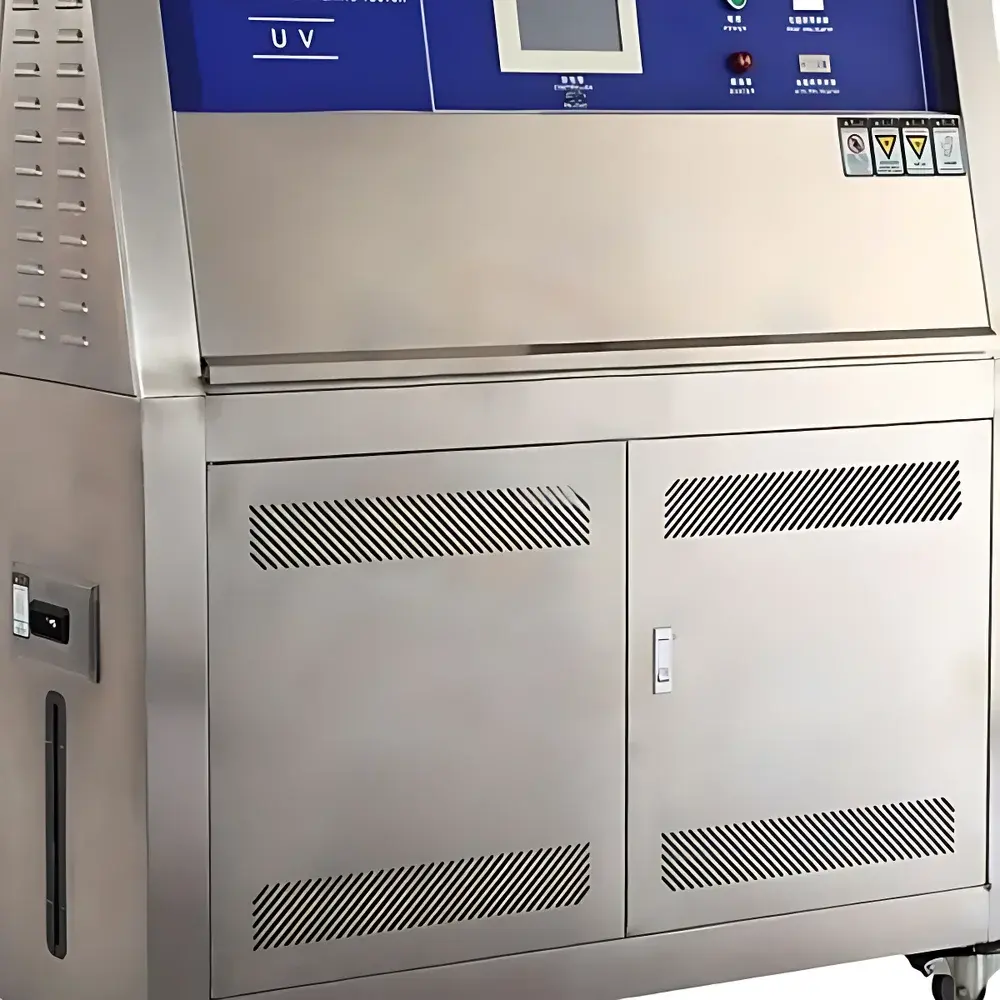
Jianhu UV Aging Test Chamber for New Energy Battery Reliability Testing
| Brand | Jianhu |
|---|---|
| Origin | Shanghai, China |
| Manufacturer Type | Authorized Distributor |
| Product Category | Domestic |
| Model | UV Aging Test Chamber for New Energy Batteries |
| Price Range | USD 850 – 85,000 |
| Humidity Range | ≥95% RH |
| UV Lamp Power | 40 W per lamp |
| Irradiance Range | 0.72 W/m² (at 340 nm) |
| Exposure Time Setting | 1–9999 hours (adjustable) |
Overview
The Jianhu UV Aging Test Chamber for New Energy Batteries is an engineered environmental simulation system designed to accelerate and quantify the degradation mechanisms affecting lithium-ion and solid-state battery enclosures under realistic outdoor service conditions. It operates on the principle of controlled ultraviolet (UV) irradiation—primarily at 340 nm—combined with precise humidity regulation (≥95% RH) and thermal cycling capability, enabling reproducible assessment of polymer sealant embrittlement, gasket adhesion loss, housing stress cracking, and electrolyte containment integrity. Unlike generic UV chambers, this model integrates calibrated spectral output, real-time chamber condition logging, and structural compatibility for full-cell and module-level specimens up to 600 mm × 600 mm × 600 mm. Its design aligns with ASTM G154 (Standard Practice for Operating Fluorescent Ultraviolet (UV) Lamp Apparatus for Exposure of Non-Metallic Materials) and ISO 4892-3 (Plastics — Methods of Exposure to Laboratory Light Sources — Part 3: Fluorescent UV Lamps), serving as a critical tool in early-stage reliability validation prior to field deployment.
Key Features
- Calibrated UV-A fluorescent lamps (340 nm peak), each rated at 40 W, delivering stable irradiance of 0.72 W/m² at specimen plane—traceable to NIST-traceable radiometers
- Humidity control system maintaining ≥95% RH across temperature ranges from 40°C to 80°C, supporting synergistic UV-humidity aging protocols per IEC 62619 Annex D and UL 1642 Clause 9.3
- Digital timer with 1–9999 hour programmability, supporting multi-step exposure sequences including dark cycles, condensation phases, and intermittent UV dosing
- Stainless steel 304 interior chamber with removable specimen trays and reinforced viewing window (quartz glass, UV-transmissive)
- Integrated data logging (temperature, humidity, irradiance, elapsed time) with USB export capability; optional RS485 interface for SCADA integration
- Compliance-ready architecture: supports audit trails, user access levels, and calibration certificate management aligned with GLP and ISO/IEC 17025 laboratory requirements
Sample Compatibility & Compliance
This chamber accommodates prismatic, pouch, and cylindrical battery cells (up to 20 Ah), battery modules (≤25 kg), and enclosure subassemblies—including thermal interface materials, potting compounds, and gasketed housings. Specimen mounting fixtures are non-reactive (anodized aluminum or PTFE-coated stainless steel) to prevent catalytic surface reactions. The system meets electromagnetic compatibility (EMC) standards per EN 61326-1 and safety requirements under IEC 61010-1. All operational parameters are documented per ISO 17025-compliant calibration procedures, with annual verification recommended using certified reference lamps and hygrometers. For regulatory submissions—especially for UN 38.3, GB/T 31467.3, and UL 1973—the chamber’s traceable exposure history satisfies evidentiary requirements for accelerated life modeling.
Software & Data Management
The chamber operates via an embedded industrial controller with intuitive touch interface, supporting parameter locking, password-protected mode switching, and event-triggered alerts (e.g., humidity deviation >±3% RH). Raw sensor data—including irradiance drift compensation logs—is stored internally for ≥30 days and exportable as CSV. Optional Jianhu TestSuite™ software (Windows-based) enables synchronized multi-chamber monitoring, statistical process control (SPC) charting of degradation markers (e.g., weight loss, gas evolution rate correlation), and automated report generation compliant with FDA 21 CFR Part 11 (electronic signatures, audit trail, data integrity controls). All firmware updates undergo version-controlled release validation and are archived with SHA-256 checksums.
Applications
- Accelerated evaluation of polymer housing UV resistance (e.g., PC/ABS blends, PPA, LCP) under combined UV/humidity stress per ISO 4892-3 Cycle 1
- Sealant aging studies: quantifying compression set loss, adhesion decay, and interfacial delamination kinetics in battery gaskets and potting compounds
- Electrolyte containment validation: correlating microcrack formation (via post-test SEM/EDS) with measured internal pressure rise and leakage onset
- Material compatibility screening: detecting UV-induced catalyst leaching from flame retardants (e.g., DOPO derivatives) into adjacent separator films
- Design verification for tropical deployment: simulating 24-month field exposure in Southeast Asia within 4–6 weeks using accelerated UV dose equivalence (based on SMARTS2 solar spectrum modeling)
- Root cause analysis of field failures: reconstructing seasonal thermal-UV-humidity profiles to replicate observed swelling or venting behavior
FAQ
What UV spectrum does this chamber emit, and how is it calibrated?
The chamber uses UVA-340 fluorescent lamps conforming to ASTM G154 spectral requirements, peaking at 340 nm with minimal emission beyond 400 nm. Irradiance is calibrated annually using a NIST-traceable broadband radiometer (±2% uncertainty) mounted at specimen plane.
Can the chamber operate without humidity control during UV-only tests?
Yes—humidity can be disabled while maintaining UV exposure and temperature setpoints, enabling isolated photochemical degradation studies per ISO 4892-3 Cycle 3.
Is the chamber suitable for testing fully charged or cycled batteries?
It is intended for passive enclosure and material testing only. Active electrical testing requires integration with external BMS and thermal management systems—not provided with the chamber.
How does this model differ from standard UV weatherometers used in paint or plastic testing?
Unlike general-purpose units, it features extended high-humidity capability (≥95% RH), larger specimen volume, reinforced structural support for battery-weight loads, and firmware preloaded with battery-specific test profiles (e.g., IEC 62619 Annex D sequences).
Does Jianhu provide validation documentation for GMP/GLP environments?
Yes—IQ/OQ protocols, calibration certificates, and 21 CFR Part 11 compliance packages (including electronic signature implementation guides) are available upon request and included in enterprise licensing agreements.



