Jiapeng 2001-B-III Automated Liquid Chromatography Fractionation System
| Origin | Shanghai, China |
|---|---|
| Manufacturer Type | Authorized Distributor |
| Regional Origin | Domestic (PRC) |
| Model | 2001-B-III |
| Instrument Category | Magnetic Bead-Based Nucleic Acid Purification |
| Automation Level | Dedicated Fully Automatic |
| Batch Sample Capacity | 100 samples |
| Sample Volume Range | 12 mL per tube |
| Fraction Collection Time Range | 1 s – 199 h 59 min 59 s |
| Wavelength Options | 214 nm, 254 nm, 280 nm |
| Flow Rate Range | 1–14,500 mL/h |
| Flow Accuracy | ±1% |
| Pump Speed Resolution | 0.1–150 rpm (bidirectional) |
| OD Detection | Triple-channel real-time A-value output (214/254/280 nm) |
| Fraction Collection Modes | Time-based, Drop-counting, Peak-threshold (0–100 mV) |
| Collection Vial Capacity | 100 × 12 mL tubes with numeric indexing |
| Column Compatibility | Direct interface with GE Healthcare AKTA-scale prepacked columns (1.0×50 cm, 1.0×70 cm, 2.6×50 cm included) |
| System Control | Embedded microprocessor with blue-membrane LCD display |
| Software | PC-based chromatogram acquisition, peak integration, relative quantitation, and report generation (AUC-based normalization) |
Overview
The Jiapeng 2001-B-III Automated Liquid Chromatography Fractionation System is an integrated benchtop platform engineered for high-throughput, reproducible purification and analytical separation of nucleic acids, proteins, peptides, and other UV-absorbing biomolecules. It operates on the principle of liquid chromatography—specifically leveraging UV absorbance detection at standardized wavelengths (214 nm for peptide bonds, 254 nm for nucleic acids, and 280 nm for aromatic amino acids)—to enable real-time monitoring and fraction collection during column elution. Unlike generic HPLC systems, the 2001-B-III is purpose-built for life science laboratories requiring robust, cost-effective, and user-configurable chromatographic workflows without reliance on proprietary consumables or vendor-locked software. Its modular architecture supports gel filtration, ion exchange, affinity, and hydrophobic interaction chromatography—making it suitable for both preparative isolation and analytical characterization in academic, pharmaceutical QC, and biotech R&D environments.
Key Features
- Dedicated fully automated operation with single-batch processing of up to 100 samples using magnetic bead-based nucleic acid purification protocols.
- Triple-wavelength UV-Vis detection (214 nm, 254 nm, 280 nm) with simultaneous real-time optical density (OD) readout across three independent channels—enabling concurrent monitoring of protein and nucleic acid elution profiles.
- High-precision peristaltic pump with flow rate range of 1–14,500 mL/h and accuracy of ±1%, featuring 0.1 rpm resolution and bidirectional rotation for gradient reversal and backflush capability.
- Digitally indexed fraction collector accommodating 100 × 12 mL tubes, supporting time-, drop-, and peak-triggered collection modes with programmable thresholds from 0–100 mV.
- Direct mechanical and fluidic compatibility with GE Healthcare prepacked columns (e.g., HiTrap, Tricorn, and XK series), eliminating need for adapters when used in method transfer or scale-down studies from AKTA platforms.
- Embedded microcontroller with large blue-membrane LCD display providing intuitive system status feedback, real-time flow/pressure/OD values, and error diagnostics.
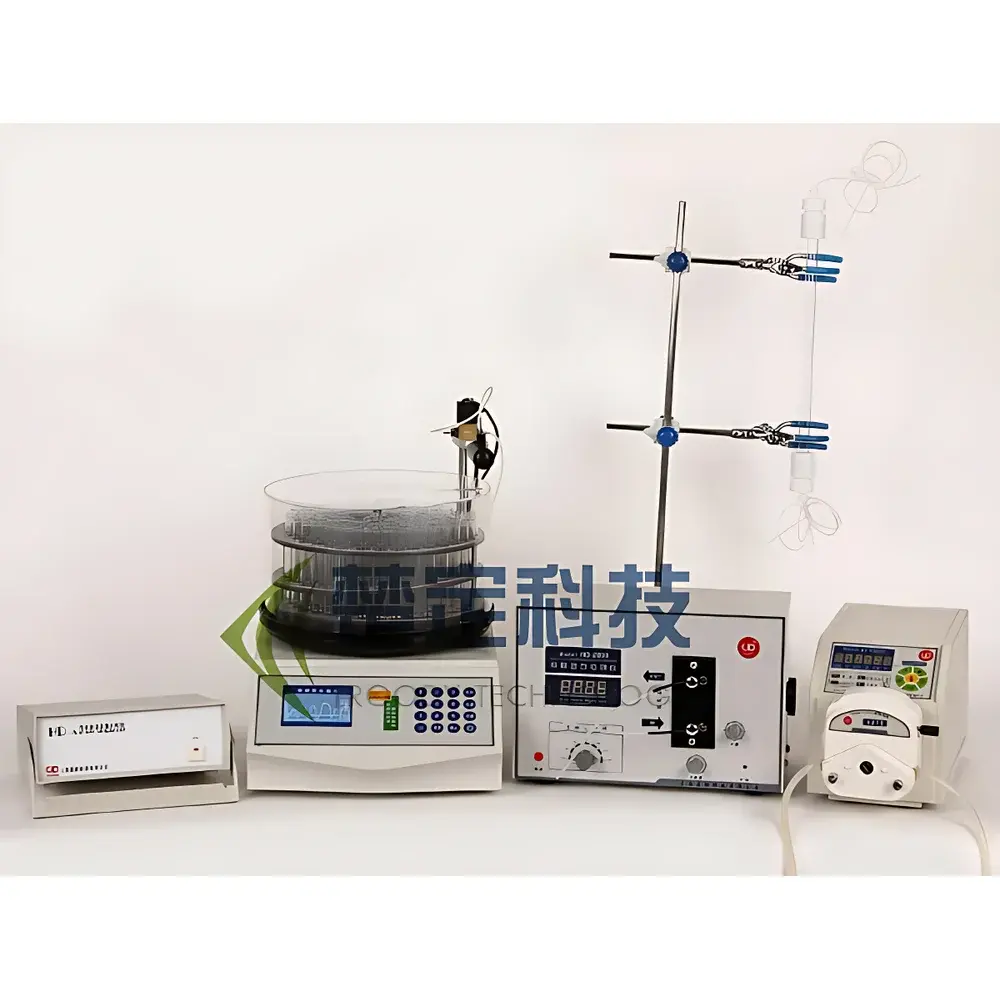
- Integrated hardware suite includes HD-2000 nucleic acid/protein detector, HD-A chromatogram acquisition module, BT-100SD constant-flow pump, DBS-100 fraction collector, and three standard columns (1.0×50 cm, 1.0×70 cm, 2.6×50 cm).
Sample Compatibility & Compliance
The 2001-B-III accommodates a broad range of biological sample matrices including cell lysates, serum, plasma, tissue homogenates, PCR products, and plasmid preparations. Its UV-based detection mechanism ensures compatibility with native, denatured, or partially purified biomolecules exhibiting absorbance above 190 nm. The system meets fundamental requirements for GLP-compliant workflows through traceable calibration logs, timestamped data acquisition, and user-accessible raw signal files (.csv/.txt). While not certified to ISO 13485 or FDA 21 CFR Part 11 out-of-the-box, its data export functionality supports integration into validated LIMS or ELN environments where audit trails and electronic signatures are externally managed. All wetted components are chemically resistant to common buffers (Tris-HCl, phosphate, imidazole, guanidine HCl) and sanitizing agents (20% ethanol, 0.05% sodium azide), ensuring long-term reliability under routine maintenance protocols.
Software & Data Management
The system interfaces with Windows-based acquisition software that captures analog detector output at configurable sampling rates, generates real-time chromatograms, and performs baseline correction, peak identification, and area-under-curve (AUC) integration. Quantitative analysis is supported via internal standard referencing or relative peak area normalization. Export formats include CSV for spreadsheet analysis, PNG/JPEG for publication-ready figures, and XML for interoperability with third-party bioinformatics pipelines. All collected metadata—including collection timestamps, flow parameters, OD values, and user annotations—are embedded in exported files. No cloud dependency or subscription licensing is required; software installation and updates are distributed as standalone installers with full local administrative control.
Applications
- High-yield plasmid DNA purification from bacterial cultures using silica-magnetic bead binding chemistry.
- Isolation of genomic DNA from clinical specimens with minimal carryover of inhibitors (e.g., heme, polysaccharides).
- Purification of RNA for downstream qRT-PCR or NGS library preparation, with optional DNase treatment integration.
- Analytical separation of recombinant proteins by size-exclusion chromatography (SEC) to assess aggregation state and monomer purity.
- Method development for ion-exchange purification of monoclonal antibodies, including gradient optimization and pool definition.
- Educational use in undergraduate biochemistry labs for teaching chromatographic theory, retention time correlation, and detector response linearity.
FAQ
What types of chromatography methods can be performed on the 2001-B-III?
The system supports gel filtration, ion exchange, affinity, and hydrophobic interaction chromatography—provided compatible resins and columns are used.
Is the system compatible with regulatory-compliant documentation practices?
Raw data files contain embedded timestamps and user-defined metadata, enabling alignment with internal SOPs for GLP/GMP documentation; however, full 21 CFR Part 11 compliance requires external validation of the software environment.
How often should the fluidic path be cleaned after use?
Flush all lines with low-salt buffer or deionized water immediately after each run; for extended storage, fill with 20% ethanol or 0.05% sodium azide solution to prevent microbial growth.
Can I use this system for protein purification in addition to nucleic acids?
Yes—the triple-wavelength detector enables simultaneous tracking of protein (280 nm) and nucleic acid (254 nm) peaks, making it suitable for co-purification studies or contaminant assessment.
Does the system support method transfer from AKTA platforms?
Yes—its column interface matches GE Healthcare’s standard fittings, allowing direct substitution of prepacked columns without adapters or revalidation of flow dynamics.