
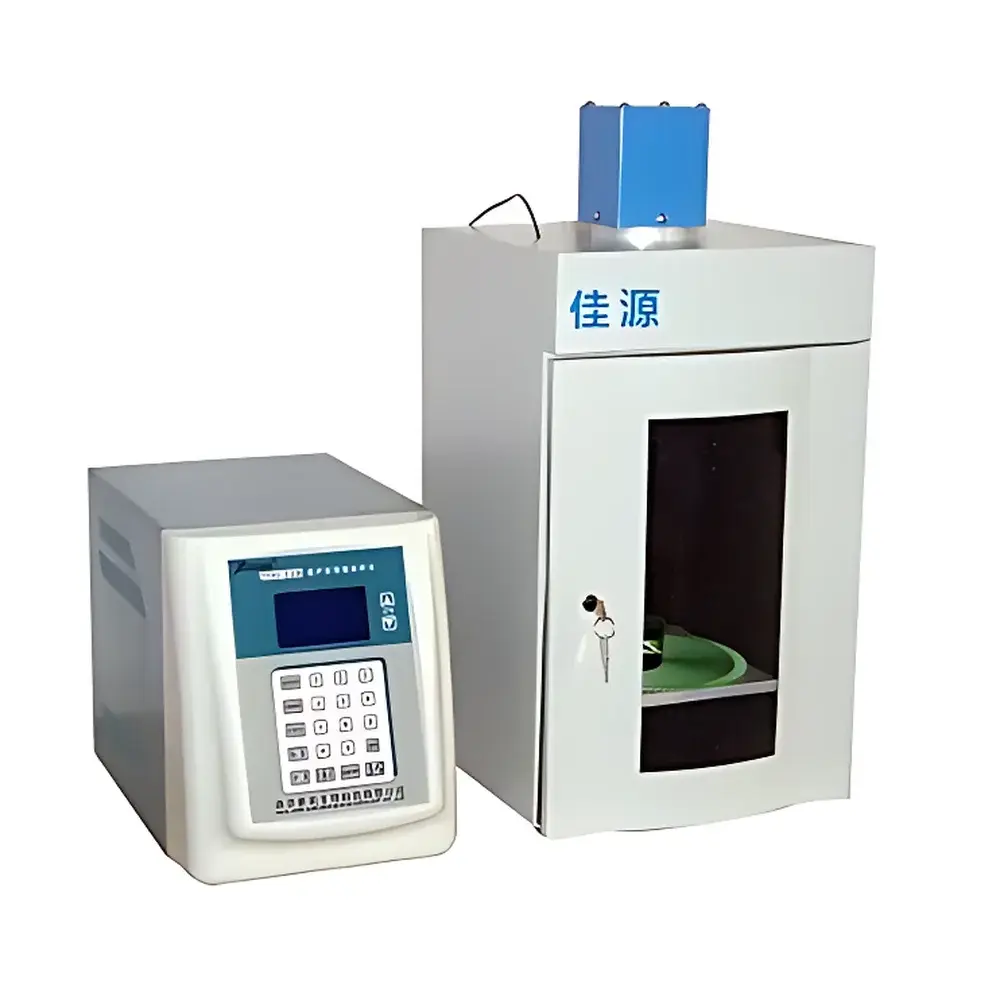
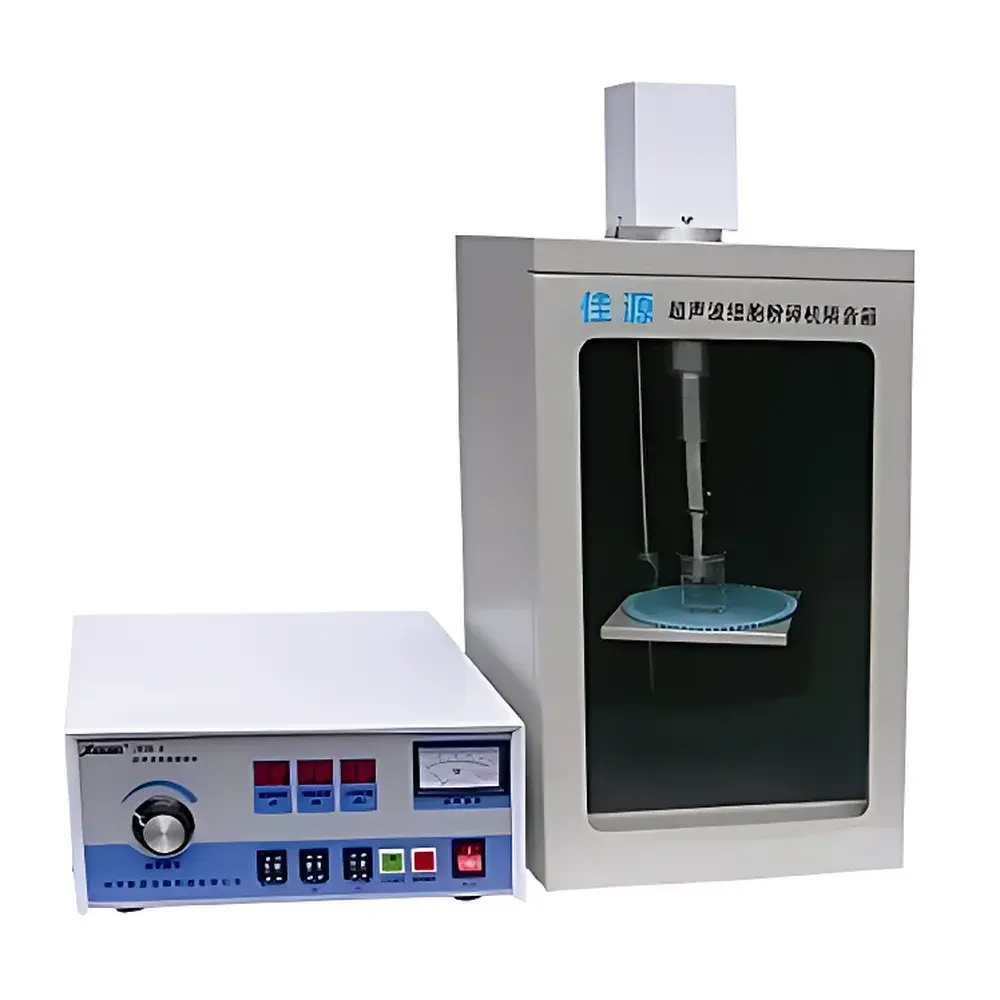
Jiayuan JY98-IIIN Ultrasonic Cell Disruptor
| Frequency | 20–25 kHz (auto-tracking) |
|---|---|
| Power Output | 1200 W (touch-key continuous adjustment) |
| Pulse Mode | 0.1–99.9 s on / 0.1–99.9 s off |
| Total Operation Time | 0.1–99 min |
| Temperature Monitoring Range | 0–100 °C |
| Standard Probe Diameter | Φ20 mm |
| Optional Probes | Φ15, Φ22, Φ25 mm |
| Sample Volume Capacity | 50–1000 mL |
| Duty Cycle | 1–99% |
| Input Voltage | 220 V / 110 V, 50 Hz / 60 Hz |
Overview
The Jiayuan JY98-IIIN Ultrasonic Cell Disruptor is a high-power, microprocessor-controlled sonication system engineered for reproducible cell lysis, tissue homogenization, and nano-emulsification in life science laboratories. It operates on the principle of acoustic cavitation—where high-intensity ultrasonic waves generate transient microbubbles in liquid media that collapse violently, producing localized shear forces, shockwaves, and thermal gradients sufficient to disrupt cellular membranes, organelles, and extracellular matrices. Unlike fixed-frequency units, the JY98-IIIN features real-time frequency auto-tracking within the 20–25 kHz range, ensuring optimal energy transfer across varying sample viscosities and compositions. Its 1200 W nominal output power enables rapid processing of demanding biological matrices—including fibrous plant tissues, Gram-positive bacteria, yeast cell walls, and mammalian suspension cultures—without requiring cryogenic pretreatment or chemical additives. Designed for routine use in academic research, biopharmaceutical process development, and QC labs, the instrument complies with core mechanical safety standards for laboratory ultrasonic equipment (IEC 61000-6-3, IEC 61000-6-4) and supports GLP-aligned documentation workflows.
Key Features
- Microprocessor-based digital control with touch-sensitive interface for precise parameter setting and recall
- Real-time frequency auto-tracking to maintain resonant coupling between transducer and probe under load variations
- Programmable pulsed sonication (0.1–99.9 s ON/OFF cycles) to minimize thermal accumulation and preserve labile biomolecules
- Integrated PT100 temperature sensor with continuous monitoring and audible/visual over-temperature alerts (0–100 °C range)
- Rugged titanium alloy probe (standard Φ20 mm) optimized for high-amplitude transmission and corrosion resistance in aqueous and mild organic solvents
- Interchangeable probe options (Φ15, Φ22, Φ25 mm) for scalable throughput—from small-volume lysates (50 mL) to bulk homogenization (up to 1000 mL)
- Duty cycle modulation (1–99%) for fine-tuned energy delivery, critical for sensitive applications such as chromatin shearing or exosome isolation
- Universal dual-voltage input (110 V / 220 V, 50/60 Hz) with EMI-filtered power supply for stable operation in multi-instrument lab environments
Sample Compatibility & Compliance
The JY98-IIIN accommodates a broad spectrum of biological and synthetic samples: intact mammalian cells (HEK293, CHO), bacterial cultures (E. coli, Bacillus subtilis), yeast (S. cerevisiae), plant leaf/tuber homogenates, viral suspensions, lipid vesicles, and colloidal nanomaterial dispersions. It is routinely employed in protocols compliant with ISO 13485 (medical device manufacturing), USP (cellular and gene therapy materials), and ASTM E2877-13 (ultrasonic disintegration validation). While not intrinsically 21 CFR Part 11–compliant, its parameter logging capability (via optional RS232/USB data export) supports audit-ready recordkeeping when integrated into validated SOPs. The unit meets CE marking requirements for electromagnetic compatibility and low-voltage directive compliance (2014/35/EU, 2014/30/EU).
Software & Data Management
The JY98-IIIN operates via embedded firmware with non-volatile memory storing up to 10 user-defined protocols. All operational parameters—including time stamps, setpoints, actual power delivery, and temperature history—are logged internally and exportable via USB flash drive in CSV format. No proprietary software is required; exported datasets are compatible with standard analytical platforms (Excel, GraphPad Prism, MATLAB). For integration into LIMS or ELN ecosystems, ASCII-based serial communication (RS232) enables automated parameter initiation and status feedback. Audit trails include operator ID fields (manually entered), session start/end times, and probe identification codes—supporting traceability in GxP-regulated environments when paired with institutional electronic signature policies.
Applications
- Nuclear extraction and chromatin immunoprecipitation (ChIP) sample preparation
- Preparation of soluble antigen extracts for monoclonal antibody development
- Disruption of biofilm-embedded pathogens for antimicrobial susceptibility testing
- Production of uniform liposomal and polymeric nanoparticles (e.g., PLGA, chitosan)
- Rapid lysis of thermosensitive archaeal strains without denaturation
- Homogenization of frozen tissue sections prior to RNA-seq library construction
- In-line emulsification of oil-in-water formulations for topical drug delivery systems
- Accelerated solvent extraction of secondary metabolites from medicinal herbs
FAQ
What is the maximum recommended continuous operating time per cycle?
For thermal management and transducer longevity, continuous operation should not exceed 5 minutes without a minimum 2-minute cooling interval. Pulsed mode (e.g., 5 s ON / 3 s OFF) is advised for sessions >10 minutes.
Can this instrument be used for sonocatalysis or sonochemical synthesis?
Yes—the JY98-IIIN delivers sufficient cavitation intensity for radical-mediated reactions (e.g., Fenton-like oxidation, polymer grafting), though reactor geometry and degassing protocols must be optimized separately.
Is probe sterilization possible using autoclaving?
Titanium probes (Φ20 mm and larger) are autoclavable at 121 °C, 15 psi for 20 minutes. Smaller-diameter probes (Φ15 mm and below) require ethanol wipe-down or ethylene oxide treatment due to thermal stress limitations.
Does the unit support external triggering or TTL synchronization?
No native TTL input is provided; however, the RS232 interface allows external script-driven control of start/stop commands and parameter updates via LabVIEW or Python-based automation frameworks.
How is amplitude calibrated across different probe diameters?
Amplitude is inherently coupled to probe geometry and drive voltage. The JY98-IIIN maintains consistent tip displacement (±5% repeatability) across its standard probe set when operated at equivalent % power settings; absolute amplitude values (µm peak-to-peak) require independent laser vibrometer verification per probe.





