
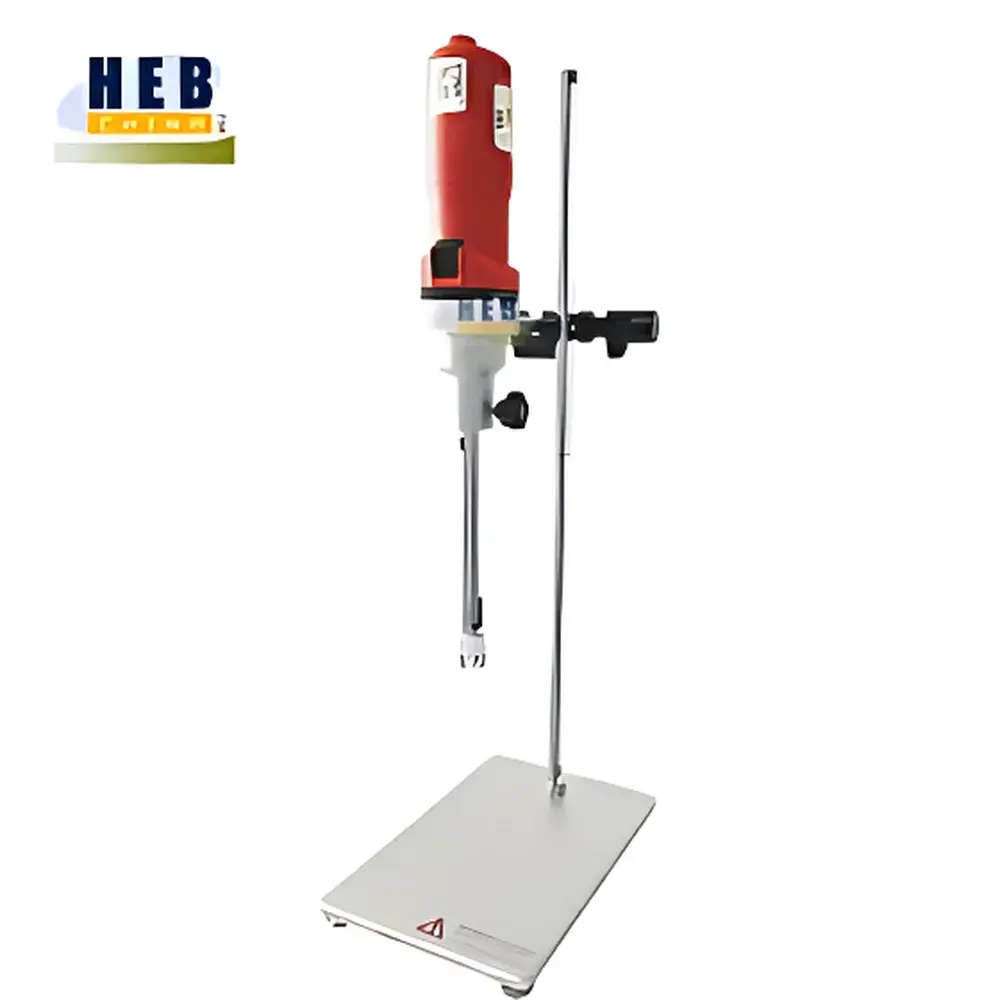
JIHEPU A18 High-Shear Laboratory Homogenizer
| Brand | JIHEPU |
|---|---|
| Model | A18 / A18-SA / A18-Digital |
| Power Supply | 220 V, 50 Hz |
| Motor Power | 500 W |
| Speed Range | 10,000–28,000 rpm |
| Tip Speed | 27 m/s |
| Max. Viscosity | 20,000 cP |
| Minimum/Maximum Sample Volume (H₂O) | 0.2–7,000 mL |
| Contact Material | SUS316L stainless steel |
| Shaft Sleeve Material | PTFE (ceramic optional) |
| Compliance | GMP-compliant design |
| Dimensions (W×D×H) | 300 × 200 × 700 mm |
| Net Weight | 8 kg |
| Modular Dispersion Tools | 18 interchangeable heads available |
| Safety Features | Overload protection, double-insulated motor housing, anti-fall lift mechanism (A18-SA), real-time temperature monitoring & programmable timer (A18-Digital) |
Overview
The JIHEPU A18 High-Shear Laboratory Homogenizer is an engineered solution for controlled mechanical dispersion, emulsification, and cell disruption in research and quality control laboratories. Based on rotor-stator hydrodynamic shear principle, the A18 generates intense localized turbulence and cavitation at the interface between a high-speed rotating rotor and a precisely fitted stationary stator—enabling efficient particle size reduction, phase homogenization, and colloidal stabilization. Designed for batch-mode operation, it delivers reproducible results across diverse sample matrices—from low-viscosity aqueous suspensions to highly viscous non-Newtonian fluids—without requiring pressurized systems or external cooling loops. Its modular architecture supports scalable method development from benchtop feasibility studies to pilot-scale process transfer.
Key Features
- German-sourced high-efficiency brushless motor with thermal management system, rated for continuous duty cycles ≥4 hours at maximum speed without performance degradation
- Electronically controlled infinitely variable speed regulation (10,000–28,000 rpm), delivering tip speeds up to 27 m/s for consistent shear energy input
- GMP-aligned wetted parts constructed entirely from electropolished SUS316L stainless steel; shaft sleeves fabricated from chemically inert PTFE (ceramic alternative available upon request)
- Modular head interchange system supporting 18 distinct rotor-stator geometries—including conical, saw-tooth, and high-torque configurations—for optimized processing under open-vessel, sealed, vacuum, or pressure-rated conditions
- Integrated safety architecture featuring dual electrical insulation, automatic current cutoff on overload, and mechanical anti-fall lift mechanism (A18-SA variant) preventing uncontrolled descent during vertical adjustment
- Digital control module (A18-Digital) with backlit LCD display showing real-time rpm, elapsed time, and probe-measured temperature (±0.5 °C accuracy); programmable auto-stop function with one-touch reset
Sample Compatibility & Compliance
The A18 accommodates samples ranging from 0.2 mL micro-volumes to 7 L bulk batches in standard laboratory glassware or jacketed reactors. It has been validated for use with biological suspensions (e.g., mammalian cell lysates, bacterial cultures), pharmaceutical emulsions (IV fat emulsions, vaccine adjuvants), agrochemical formulations (suspension concentrates, microemulsions), food-grade colloids (yogurt stabilizers, juice clouding agents), and industrial dispersions (pigment pastes, asphalt modifiers, textile auxiliaries). All wetted components comply with ISO 8573-1 for compressed air purity class 0 where applicable, and meet material eligibility criteria outlined in USP and EU Pharmacopoeia Chapter 3.2.1 for pharmaceutical contact surfaces. The device supports audit-ready documentation workflows aligned with GLP and GMP Annex 11 requirements when paired with validated data capture software.
Software & Data Management
While the base A18 operates via analog controls, the A18-Digital variant provides native RS-232 serial output for integration into LIMS or ELN platforms. Timestamped operational logs—including speed setpoint, actual rpm, duration, and temperature history—can be exported as CSV files for traceability. When deployed in regulated environments, the system supports 21 CFR Part 11-compliant electronic signatures through third-party validation packages, enabling secure user access levels, change-controlled parameter locking, and immutable audit trails for all critical process events.
Applications
- Cell lysis and organelle isolation in molecular biology workflows
- Preparation of nanoemulsions and submicron suspensions for drug delivery development
- Routine QC testing of droplet size distribution in topical creams and injectables
- Stabilization of pigment dispersions for inkjet inks and automotive coatings
- Homogenization of coal-water slurries and bitumen emulsions in energy R&D
- Development of functional food matrices incorporating insoluble fibers or probiotic carriers
FAQ
What is the maximum recommended viscosity for continuous operation?
For stable thermal performance and bearing longevity, continuous operation is advised at viscosities ≤20,000 cP. Higher-viscosity applications require intermittent duty cycles with ≥2-minute cooldown intervals.
Can the A18 be used under vacuum or inert gas?
Yes—select dispersion heads (e.g., A18-VAC series) are equipped with O-ring-sealed shaft couplings compatible with vacuum down to 10 mbar or nitrogen-purged environments.
Is calibration certification available?
Factory calibration reports per ISO/IEC 17025 are provided with each unit; NIST-traceable torque and rotational speed verification services are available as optional add-ons.
How often should rotor-stator assemblies be replaced?
Under normal use with non-abrasive media, rotor-stator sets maintain dimensional integrity for ≥500 operating hours; replacement intervals decrease proportionally with abrasive solids content or extended high-rpm cycling.
Does the A18 support remote start/stop via PLC interface?
The A18-Digital model includes dry-contact I/O terminals enabling integration into automated reactor control systems using standard 24 VDC logic signals.



