
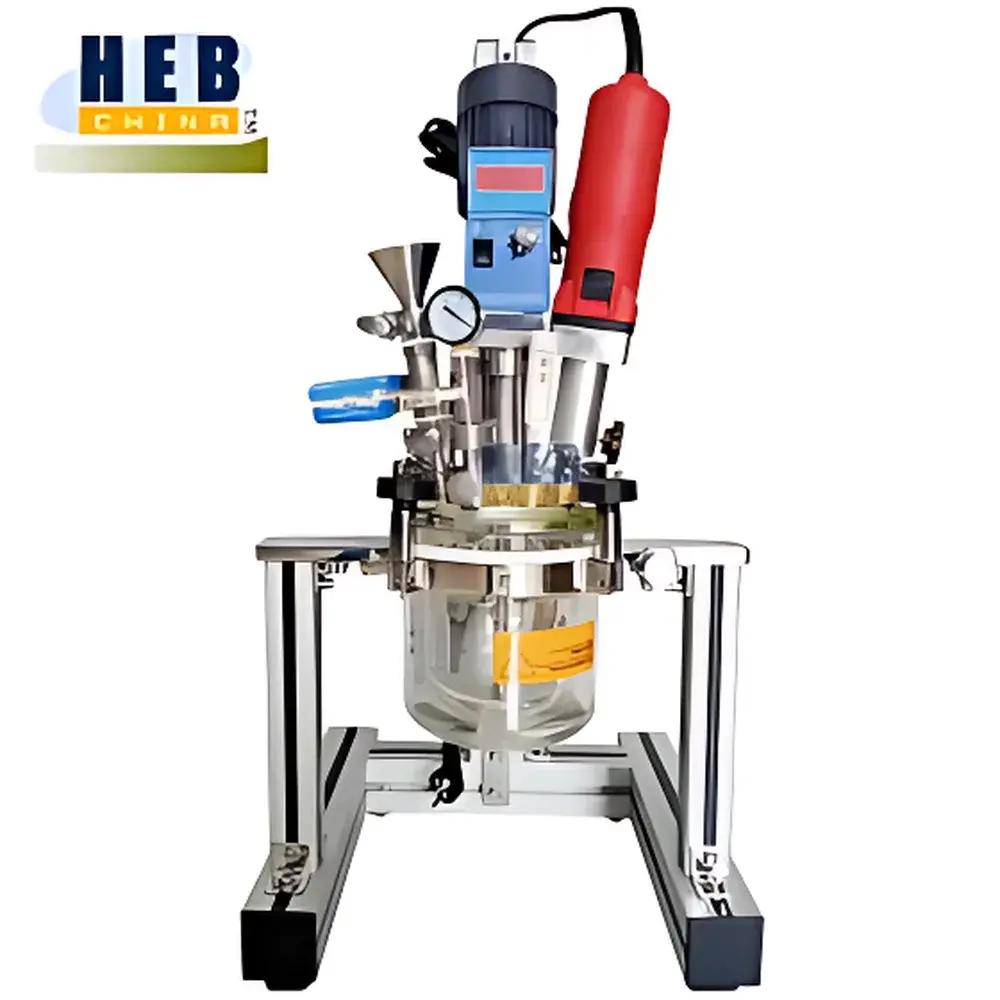
Jihepu AIR-5L Stainless Steel Vacuum Reactor
| Brand | Jihepu |
|---|---|
| Origin | Shandong, China |
| Model | AIR-5L |
| Capacity | 5000 mL |
| Material | SUS316L stainless steel + PTFE + borosilicate glass (jacketed vessel optional) |
| Operating Pressure Range | Vacuum to low positive pressure |
| Maximum Vacuum Level | −0.096 MPa |
| Temperature Range | Up to 120 °C (250 °C optional) |
| Stirring Speed | 0–200 rpm (variable speed) |
| Homogenizer Power | 1050 W |
| Homogenizer Speed | 10,000–28,000 rpm |
| Shear Tip Diameter | 25 mm (25BCS) |
| Jacket Inlet/Outlet | 12 mm OD |
| Vacuum Port | 10 mm OD |
| Weight | 40 kg |
| Dimensions (W×D×H) | 480 × 420 × 900 mm |
Overview
The Jihepu AIR-5L Stainless Steel Vacuum Reactor is a modular, laboratory-scale reaction system engineered for controlled synthesis, dispersion, emulsification, and homogenization under vacuum or low-pressure inert atmospheres. Based on Couette-type shear mechanics and jacketed thermal management, the reactor integrates a dual-drive architecture: a low-speed anchor-type刮壁 stirrer for bulk mixing and wall scraping, and a high-speed rotor-stator homogenizer for submicron particle size reduction and phase stabilization. Its design enables reproducible process scaling from lab to pilot—supporting reaction kinetics studies, catalyst screening, nanoparticle formulation, and API intermediate synthesis under GMP-aligned conditions. The vessel’s double-walled construction accommodates external heating/cooling media (water or oil bath), while its hermetic sealing system maintains vacuum integrity down to −0.096 MPa, minimizing solvent loss and oxidation risk during heat-sensitive reactions.
Key Features
- Modular platform with interchangeable functional modules: vacuum control unit, temperature regulation system (PID-controlled), digital torque monitoring, and optional pressure-rated lid configuration.
- SUS316L stainless steel reactor body with PTFE-sealed borosilicate glass jacketed vessel (alternative all-metal SUS316L vessel available); compliant with USP Class VI and FDA 21 CFR Part 11 material requirements for pharmaceutical R&D.
- Dual-drive operation: precision DC motor (180 W) for low-shear agitation (0–200 rpm), paired with a high-efficiency brushless homogenizer motor (1050 W) delivering 10,000–28,000 rpm and up to 27 m/s tip speed at 25BCS workhead.
- Electrically actuated vertical lift mechanism (280 mm travel) ensures repeatable positioning of homogenizer shaft and eliminates manual alignment errors.
- Multi-port reactor head (homogenizer port, feed port, PT100 temperature probe port, vacuum port, and three auxiliary ports) supports simultaneous in-process sampling, gas sparging, and real-time pH or conductivity monitoring.
- Integrated safety systems: electronic overload protection, double-insulated motor housing, emergency stop circuit, and thermal cut-off at 150 °C.
Sample Compatibility & Compliance
The AIR-5L accommodates viscous media up to 70,000 cP (130,000 cP with optional high-torque configuration) and operates effectively across aqueous, organic, and silicone-based formulations. Its contact surfaces meet ISO 8573-1 purity class 4 for compressed air systems and comply with ASTM E2500–13 guidelines for equipment qualification in regulated environments. When configured with traceable calibration certificates (NIST-traceable PT100 sensor, calibrated vacuum gauge), the system supports GLP/GMP documentation workflows—including audit trails, user access control, and electronic signature capability when integrated with validated LIMS or ELN platforms.
Software & Data Management
While the base unit operates via front-panel digital interface with real-time RPM, temperature, and vacuum readouts, optional RS485/Modbus RTU connectivity enables integration into centralized process control networks. Third-party SCADA or LabVIEW-compatible drivers allow automated logging of time-stamped parameters (temperature ramp rate, vacuum decay profile, homogenizer power draw) with CSV export. All data files retain metadata including operator ID, timestamp, and instrument firmware version—meeting ALCOA+ principles (Attributable, Legible, Contemporaneous, Original, Accurate, Complete, Consistent, Enduring, Available) required for regulatory submissions.
Applications
- Pharmaceutical development: liposome encapsulation, microemulsion preparation, and solvent-free crystallization under reduced boiling point conditions.
- Materials science: graphene oxide dispersion, polymer nanocomposite synthesis, and sol-gel processing with controlled hydrolysis kinetics.
- Agrochemical R&D: suspension concentrate (SC) formulation, wettable powder (WP) dispersibility testing, and adjuvant compatibility screening.
- Food & cosmetics: cold-process mayonnaise analogues, nanostructured delivery systems for bioactives, and viscosity-stable emulsions without thermal degradation.
- Electrochemistry: electrolyte blending for solid-state battery slurries under inert atmosphere and vacuum degassing prior to coating.
FAQ
Can the AIR-5L operate under inert gas pressure?
Yes—the standard lid includes a dedicated gas inlet port; with optional pressure-rated sealing components, it supports operation up to 0.3 MPa gauge pressure using nitrogen or argon.
Is the homogenizer workhead autoclavable?
All stainless steel and PTFE components are compatible with steam sterilization at 121 °C for 20 minutes; validation protocols per ISO 17665–1 are supported upon request.
What calibration documentation is provided?
Factory calibration certificates for temperature (±0.3 °C), vacuum (±0.002 MPa), and rotational speed (±0.5% FS) are included; IQ/OQ documentation templates are available for GxP environments.
Does the system support remote monitoring?
With the optional Ethernet-to-Modbus gateway, real-time parameter streaming and alarm notifications via MQTT or OPC UA are achievable using standard industrial IT infrastructure.
Can I retrofit a larger homogenizer motor later?
The mechanical mounting interface and power supply are pre-engineered for 1500 W upgrade; electrical cabinet space and cooling capacity accommodate future expansion without structural modification.



