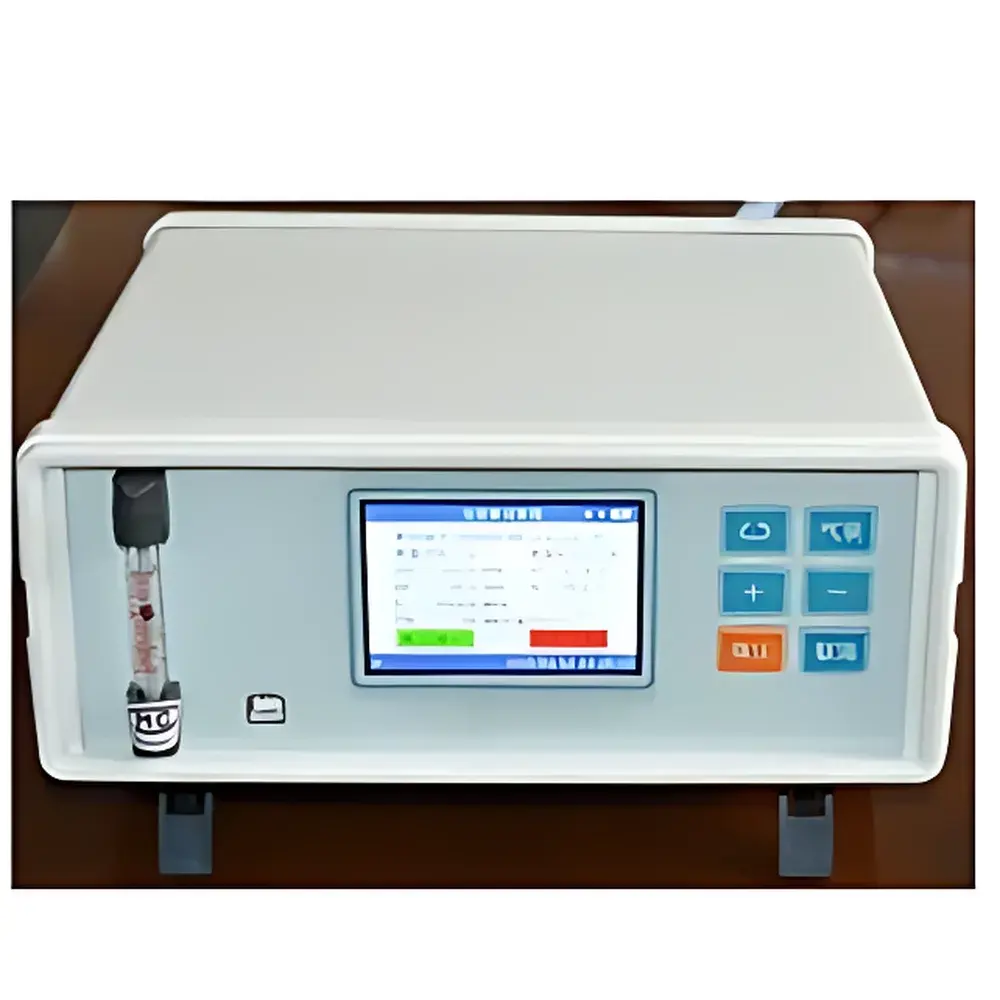
Tlyon Tlyon-1022B Fruit & Vegetable Respiration Rate Analyzer
| Brand | Tlyon |
|---|---|
| Model | Tlyon-1022B |
| Detection Principle | Non-dispersive Infrared (NDIR) CO₂ Analysis + Electrochemical O₂ Sensor |
| CO₂ Range | 0–5000 ppm (selectable spans: 0–1000 / 1500 / 2000 / 3000 / 5000 ppm) |
| CO₂ Accuracy | ±3 ppm |
| CO₂ Resolution | 0.1 ppm |
| CO₂ Response Time | <1 s (ΔCO₂ acquisition) |
| O₂ Range | 0–99.999% vol |
| O₂ Linearity | ≤±2% F.S. |
| O₂ Repeatability | ≤±1% |
| O₂ Response Time | 30 s |
| Temperature Range | −20 to +95 °C |
| Temp. Accuracy | ±0.2 °C |
| Temp. Resolution | 0.1 °C |
| Humidity Range | 0–99.999% RH |
| RH Accuracy | ±0.2% F.S. |
| RH Resolution | 0.1% |
| Flow Control | Adjustable via instrument keypad or PC software |
| Standard Chamber Volumes | 0.1 L (Ø40 mm × 80 mm), 0.25 L (Ø60 mm × 89 mm), 2.0 L (Ø120 mm × 180 mm) |
| Data Storage | 32 GB internal flash memory |
| Display | 3.5″ TFT color LCD, 320 × 480 pixels |
| Power Supply | AC 220 V ±10% |
| Compliance | Designed for GLP-aligned experimental workflows |
Overview
The Tlyon Tlyon-1022B Fruit & Vegetable Respiration Rate Analyzer is a dedicated, non-invasive gas exchange measurement system engineered for quantitative assessment of postharvest respiration intensity in horticultural commodities. It operates on the principle of open-system, real-time differential gas analysis: ambient air is drawn through a sealed, temperature- and humidity-controlled respiration chamber containing the sample; CO₂ enrichment and O₂ depletion relative to inlet gas are measured simultaneously using dual-sensor technology—NDIR spectroscopy for CO₂ and electrochemical detection for O₂. This enables calculation of net respiration rate (µmol CO₂ kg⁻¹ s⁻¹ or mL CO₂ kg⁻¹ h⁻¹) under controlled or ambient storage conditions—including room temperature, cold storage, controlled atmosphere (CA) rooms, and retail refrigerated display units. The instrument’s modular chamber design, thermally compensated NDIR optics, and integrated environmental monitoring (T/RH) ensure high reproducibility across variable physiological states and storage environments—critical for establishing shelf-life models, optimizing storage protocols, and validating modified-atmosphere packaging (MAP) performance.
Key Features
- Thermally stabilized dual-wavelength NDIR CO₂ sensor with automatic baseline correction—eliminates drift induced by ambient temperature fluctuations (−20 to +95 °C operational range) and delivers ±3 ppm accuracy and 0.1 ppm resolution within <1 s response time.
- High-fidelity electrochemical O₂ sensor with full-scale linearity ≤±2%, repeatability ≤±1%, and 30 s T₉₀ response—enabling stoichiometric validation of respiratory quotient (RQ = CO₂/O₂) where required.
- Three standardized, interchangeable respiration chambers (0.1 L, 0.25 L, 2.0 L) optimized for mass-to-volume ratio targeting (2:1 to 4:1 chamber headspace:sample volume)—reducing equilibration time to ≤15 min while maintaining measurement fidelity for single fruits (e.g., apple, pear) or bulk small produce (e.g., berries, nuts).
- Integrated environmental monitoring: simultaneous real-time acquisition of chamber temperature (±0.2 °C), relative humidity (±0.2% F.S.), CO₂, and O₂—with synchronized timestamped logging and dynamic curve visualization.
- Onboard 32 GB flash memory and USB/RS-232 connectivity for offline operation or PC-synchronized control; full parameter configuration (flow rate, sampling interval, chamber ID, calibration flags) managed via intuitive TFT interface or dedicated Windows-based acquisition software.
Sample Compatibility & Compliance
The Tlyon-1022B accommodates intact, unprocessed horticultural specimens—whole fruits (e.g., citrus, stone fruit), vegetables (e.g., leafy greens, root crops), cut produce, and floral tissues—without enzymatic or physical disruption. Chamber geometry permits vertical or horizontal orientation to minimize gravitational effects on gas diffusion within heterogeneous samples. All materials in contact with sample air (chamber body, seals, tubing) are inert, low-outgassing polymers compliant with USP Class VI standards. Data acquisition adheres to principles outlined in ISO 8601 (timestamping), ASTM D509–22 (respiratory gas analysis methodology), and FAO/WHO Postharvest Handling Guidelines. While not FDA 21 CFR Part 11-certified out-of-box, the system supports ALCOA+ data integrity practices when used with validated software configurations and documented change control procedures—making it suitable for GLP-regulated research, university extension trials, and industrial QA/QC laboratories conducting shelf-life benchmarking.
Software & Data Management
The included Tlyon RespiroSoft™ v3.2 application provides full instrument control, multi-parameter visualization (CO₂/O₂/T/RH overlay plots), and export-ready reporting. Users define sample metadata (species, cultivar, harvest date, weight, storage history) prior to assay initiation—enabling automated normalization to fresh weight or surface area. Raw sensor outputs are logged at user-selectable intervals (0.1–60 s); derivative calculations (respiration rate, RQ, cumulative CO₂ evolution) are performed post-acquisition using ISO 20933–2018-compliant algorithms. Data files (.csv, .xlsx) include embedded calibration certificates, operator ID, and instrument serial number—supporting traceability requirements under ISO/IEC 17025:2017. Audit trails record all parameter modifications, start/stop events, and manual overrides—facilitating retrospective review during internal audits or regulatory inspections.
Applications
- Quantification of respiratory climacteric onset and peak timing in ethylene-sensitive fruits (e.g., banana, tomato, avocado) under varying O₂/CO₂ atmospheres.
- Evaluation of chilling injury progression in subtropical crops (e.g., mango, guava) via respiration rate hysteresis analysis during rewarming cycles.
- Validation of MAP film permeability parameters by correlating in-package gas composition shifts with measured respiration kinetics.
- Screening of pre-storage treatments (e.g., hot water dips, 1-MCP exposure, UV-C irradiation) for suppressive effects on postharvest metabolic activity.
- Field-deployable monitoring of respiration dynamics during transit—using battery-powered operation (optional external 12 V DC adapter) and ruggedized chamber mounts.
FAQ
What is the recommended chamber size for measuring respiration of small fruits like blueberries?
For uniform small-fruit batches, select the 0.25 L chamber and maintain a headspace-to-sample volume ratio of 2:1 to 4:1. Avoid overloading—excessive packing impedes gas homogeneity and prolongs equilibration.
Does the CO₂ sensor require periodic zero/span calibration?
Yes. NDIR sensors drift minimally but require biweekly zero calibration with certified zero air (N₂ or CO₂-scrubbed synthetic air) and annual span verification using NIST-traceable 1000 ppm CO₂ standard.
Can the instrument operate continuously for >24 hours in a cold room at 2 °C?
Yes—the electronics and sensors are rated for −20 °C to +45 °C ambient; however, condensation on optical windows must be prevented via desiccant traps or heated sample lines if RH exceeds 85% at low temperatures.
Is O₂ measurement necessary for calculating respiration rate?
Not strictly—CO₂ evolution alone suffices for most postharvest applications. However, concurrent O₂ uptake allows RQ calculation, which distinguishes carbohydrate vs. lipid metabolism and detects anaerobic stress.
How does gas flow rate affect measurement accuracy?
Flow must balance two competing factors: too low → CO₂ accumulation gradients; too high → insufficient residence time for equilibration. For the 0.25 L chamber, 100–300 mL/min is optimal—verified via flowmeter calibration before each experiment.