
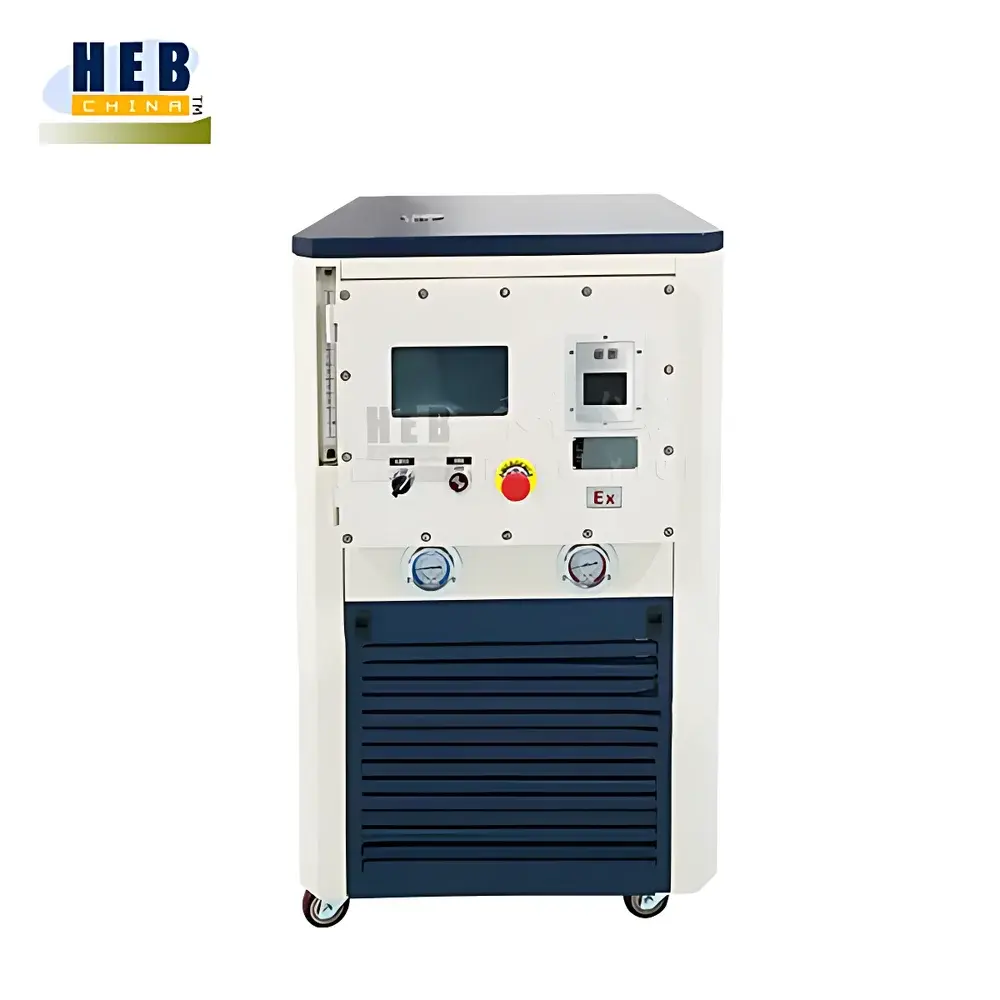
Jihepu EXGDSZ-20-80 Explosion-Proof High-Low Temperature Circulating Chiller
| Brand | Jihepu |
|---|---|
| Origin | Shandong, China |
| Model | EXGDSZ-20-80 |
| Temperature Range | −80 °C to +200 °C |
| Ambient Operating Temperature | 5–35 °C |
| Relative Humidity | ≤70% RH |
| Power Supply | 3-phase 380 V / 50 Hz |
| Control Accuracy | ±1 °C |
| Sensor Type | PT100 |
| Total Power Consumption | 9 kW |
| Heating Power | 3 kW |
| Compressor Configuration | Dual hermetic compressors |
| Compressor Total Power | 5.88 kW |
| Refrigeration Capacity | 17.64 kW @ −40 °C |
| Circulation Pump Power | 100 W |
| Flow Rate | 20–40 L/min |
| Head | 4–6 m |
| Max. System Pressure | 0.4 MPa |
| Refrigerant | R22 |
| Enclosure Material | Powder-coated cold-rolled steel |
| External Port Size | 1/4″ BSP female |
| Included Accessories | Two 2-m stainless-steel flexible hoses (1/4″) |
| Heat Transfer Fluid | High-grade silicone oil |
| Dimensions (W×D×H) | 804 × 703 × 900 mm |
| Explosion Protection Rating | Ex d IIB T4 |
Overview
The Jihepu EXGDSZ-20-80 is an explosion-proof, dual-function circulating chiller engineered for precise temperature control in hazardous laboratory and pilot-scale chemical synthesis environments. It integrates mechanical refrigeration and electric resistance heating within a single robust architecture to deliver stable thermal management across an extended operating range of −80 °C to +200 °C. The system operates on the principle of closed-loop liquid circulation: a thermally stable silicone oil medium is conditioned—either cooled via a dual-stage R22-based vapor-compression cycle or heated via immersed tubular heaters—and delivered under controlled pressure and flow to external process equipment (e.g., jacketed reactors, calorimeters, or analytical sample cells). Its design conforms to fundamental requirements for intrinsically safe operation in Zone 1/2 classified areas, with all critical components—including the main control cabinet, circulation pump, condenser fan, and internal wiring—certified to Ex d IIB T4 per IEC 60079-1 and GB 3836.1–2010. This enables reliable use in facilities handling flammable solvents such as acetone, ethanol, ethyl ether, or hydrocarbon mixtures where spark-free thermal regulation is non-negotiable.
Key Features
- Dual hermetic compressors with integrated high-pressure protection, thermal overload cutoff, and phase-sequence monitoring for uninterrupted low-temperature operation down to −80 °C
- Independent heating and cooling circuits with PID-controlled power modulation, minimizing thermal overshoot and ensuring ±1 °C steady-state accuracy
- Explosion-proof certified components throughout: flameproof enclosure (Ex d), intrinsically safe signal interfaces, and ATEX-compliant electrical routing
- High-flow, corrosion-resistant circulation pump (20–40 L/min, 4–6 m head) with stainless-steel wetted parts and pressure-regulated output (≤0.4 MPa)
- Intuitive LCD interface with real-time display of setpoint, actual bath temperature, compressor status, fault codes, and safety interlock states
- Structural housing fabricated from powder-coated cold-rolled steel for long-term resistance to solvent vapors and ambient corrosion
- Factory-configured for silicone oil (Grade 100–350 cSt), with 1/4″ BSP external ports and two 2-meter reinforced metal-braided hoses included
Sample Compatibility & Compliance
The EXGDSZ-20-80 is compatible with standard jacketed glass and stainless-steel reactors (50 mL–100 L), calorimetric cells, distillation columns, and spectroscopic sample holders requiring external thermal coupling. Its fluid compatibility is optimized for high-flashpoint silicone oils; it is not rated for water, glycol/water blends, or low-boiling organic solvents due to volatility and flashpoint constraints. From a regulatory standpoint, the unit satisfies essential safety requirements under GB/T 34036–2017 (Explosion-Proof Electrical Equipment for Laboratory Use) and aligns with functional safety expectations outlined in IEC 61508 for Safety Instrumented Systems (SIS) Level 1. While not FDA 21 CFR Part 11–compliant by default (as it lacks electronic audit trail functionality), its hardware-level safety interlocks—including overtemperature cutout, compressor high-pressure shutdown, and phase-failure detection—support GLP/GMP-aligned operational protocols when integrated into validated workflows.
Software & Data Management
The EXGDSZ-20-80 operates via embedded firmware with no proprietary PC software dependency. All configuration, calibration, and alarm logging occur locally via the front-panel keypad and LCD. Event history—including timestamped fault triggers (e.g., “Compressor Overheat Alert – 2024-06-12 14:22:07”)—is retained in non-volatile memory for up to 500 entries and can be reviewed onsite. For integration into centralized lab infrastructure, optional 4–20 mA analog outputs (temperature feedback) and dry-contact relay signals (alarm/fault status) are available upon request. RS485 Modbus RTU communication can be added via field-installable module (Model: EX-MOD-RS485), enabling read-only access to real-time temperature, setpoint, pump speed, and compressor run hours for SCADA or LIMS synchronization.
Applications
- Exothermic/endothermic reaction control in API synthesis under Class I, Division 1 or Zone 1 conditions
- Low-temperature crystallization of fine chemicals using cryogenic solvent systems
- Calibration of differential scanning calorimeters (DSC) and thermogravimetric analyzers (TGA) requiring traceable thermal ramps
- Temperature cycling tests for polymer stability assessment per ISO 11359-2
- Controlled cooling of hydrogenation reactors during catalyst activation under inert atmosphere
- Thermal conditioning of FTIR or Raman sampling accessories in solvent-rich analytical labs
FAQ
What explosion protection standard does this unit meet?
It complies with Ex d IIB T4 per IEC 60079-1 and GB 3836.1–2010, suitable for Group IIB gases (e.g., acetone, propane) with autoignition temperatures ≥135 °C.
Can it operate continuously at −80 °C?
Yes—provided ambient temperature remains ≤30 °C and ventilation meets minimum 0.5 m³/s airflow; sustained sub−60 °C operation requires pre-cooling and thermal load stabilization.
Is R22 refrigerant still serviceable given global phase-out schedules?
R22 is restricted under the Montreal Protocol; Jihepu provides documented retrofit pathways to R404A or R507 for legacy units, subject to compressor and oil compatibility verification.
What maintenance intervals are recommended?
Compressor oil inspection every 2,000 operating hours; refrigerant leak check annually; silicone oil replacement every 18 months or after 3,000 h runtime, whichever occurs first.
Does it support external temperature feedback from the reactor jacket?
Not natively—but optional PT100 input module (EX-EXT-PT100) enables cascade control using external process temperature as the primary feedback variable.



