
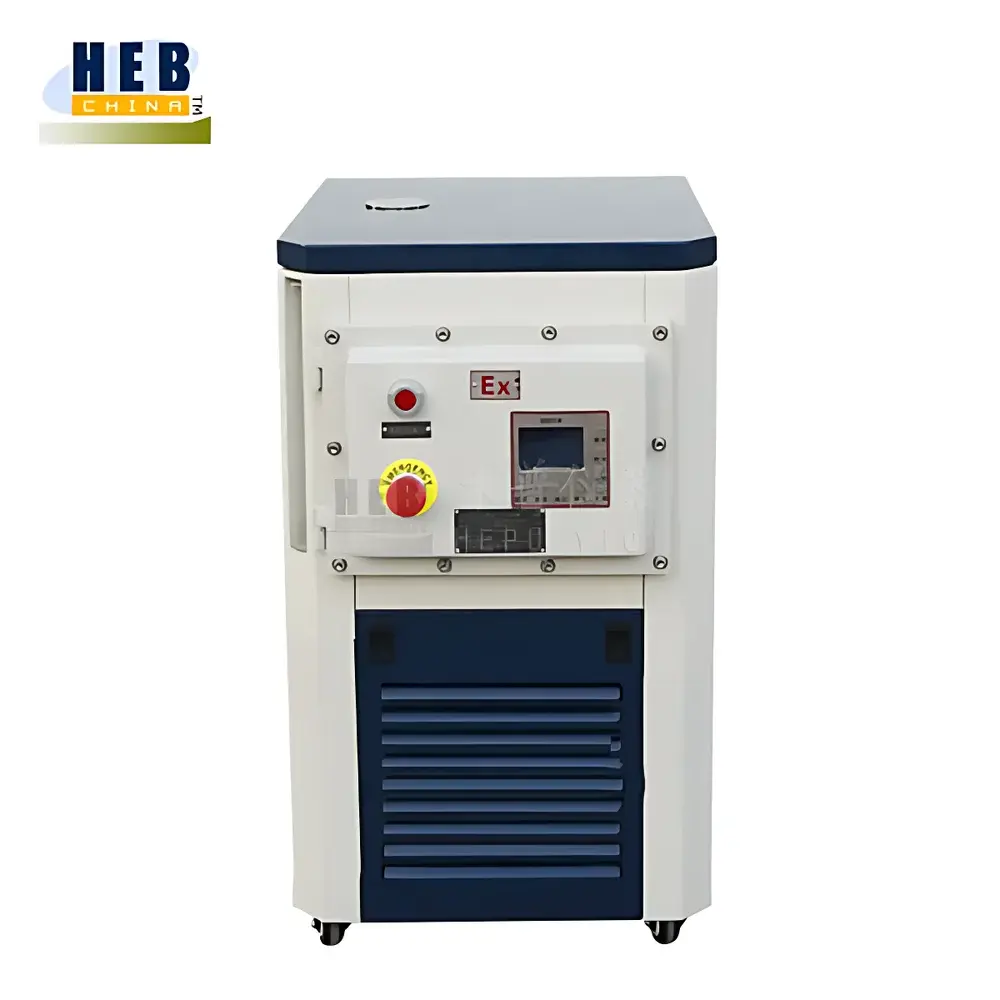
Jihepu GDSZ-25/200 Closed-Loop High-Low Temperature Circulator
| Brand | Jihepu |
|---|---|
| Origin | Shandong, China |
| Model | GDSZ-25/200 |
| Temperature Range | –50 °C to +250 °C (extended capability up to +350 °C) |
| Internal/External Circulation Flow Rate | 6 L/min or 13 L/min |
| Construction | Stainless Steel Interior and Work Surface |
| Safety Features | Overload Protection, High-Pressure Switch, Thermal Relay, Overheat & Overcurrent Protection |
| Cooling System | Hermetic Dual-Stage Compressor |
| Sealed Expansion Tank | Thermally Isolated, Ambient-Temperature Operation (<60 °C) |
| Compliance | Designed for GLP/GMP-aligned laboratory environments |
| Price Range | USD 1,400–7,000 (FOB) |
Overview
The Jihepu GDSZ-25/200 Closed-Loop High-Low Temperature Circulator is an engineered thermal management system designed for precise, stable, and contamination-free temperature control across demanding laboratory and pilot-scale applications. It operates on a fully sealed liquid circulation principle—eliminating vapor exchange with ambient air—thereby preventing moisture ingress at subzero temperatures and volatile oil mist generation at elevated temperatures. This architecture ensures long-term stability of heat transfer fluid (e.g., silicone oil or specialized synthetic bath fluids), extends service intervals, and maintains consistent thermal performance across its full operating range from –50 °C to +250 °C (with transient capability to +350 °C under controlled conditions). Unlike open-bath or semi-closed systems, the GDSZ-25/200 integrates a thermally isolated expansion tank that remains mechanically connected but thermodynamically decoupled from the main loop—keeping its internal medium below 60 °C regardless of process temperature. This design meets fundamental requirements for ISO/IEC 17025-compliant calibration workflows and supports traceable temperature uniformity in ASTM D5275 (viscosity measurement) and USP (thermal analysis validation) contexts.
Key Features
- Hermetically sealed dual-stage refrigeration circuit with high-efficiency compressors—enabling rapid cooling from ambient to –40 °C in under 25 minutes and stable hold at –50 °C without external cryogen support.
- Simultaneous heating and cooling capability via integrated electric resistance heaters and reverse-cycle refrigeration—enabling precise ramp-and-soak profiles without manual fluid switching.
- Stainless steel interior chamber and work surface (AISI 304)—resistant to corrosion from common organic solvents, acids, and thermal oils; facilitates cleaning and compliance with pharmaceutical cleanroom protocols.
- Dual-pump architecture: high-stability internal recirculation loop for bath uniformity (±0.05 °C spatial deviation at steady state), plus externally regulated output pump delivering 6 L/min or 13 L/min flow to auxiliary equipment (e.g., jacketed reactors, calorimeters, or material testing fixtures).
- Comprehensive safety suite including high-pressure cut-off switches, compressor overload relays, real-time thermal monitoring of motor windings and condenser coils, and automatic shutdown upon coolant level anomaly or sensor fault.
- High-head delivery design (up to 12 m static head)—supports vertical integration into multi-tier lab setups and long-distance fluid routing without flow degradation.
Sample Compatibility & Compliance
The GDSZ-25/200 accommodates a broad spectrum of sample containment formats—including glass-jacketed vessels (100 mL to 5 L), stainless steel reaction blocks, Peltier-cooled analytical cells, and custom-engineered thermal interfaces. Its sealed-loop operation eliminates cross-contamination risks associated with atmospheric exposure, making it suitable for moisture-sensitive catalysis studies (e.g., Grignard reactions), low-temperature polymerization, and high-temperature stability testing per ICH Q1A(R2). The unit complies with CE marking directives (2014/30/EU EMC and 2014/35/EU LVD), meets UL 61010-1 third-party certification prerequisites, and supports audit-ready documentation for FDA 21 CFR Part 11–aligned electronic records when paired with validated data acquisition software.
Software & Data Management
While the standard configuration includes an intuitive PID-based front-panel controller with programmable ramp/soak profiles and real-time temperature logging (internal memory: 10,000 data points), optional RS485/Modbus RTU or Ethernet TCP/IP interfaces enable integration into centralized LabVantage, DeltaV, or Siemens Desigo SCADA platforms. Exported CSV logs include timestamp, setpoint, actual bath temperature, compressor status, and error codes—structured for automated parsing in Python- or MATLAB-based QA/QC pipelines. Audit trail functionality (user login, parameter changes, alarm events) can be enabled through firmware update v2.3+, satisfying GLP traceability requirements for method validation reports.
Applications
- Calibration of thermocouples, RTDs, and infrared pyrometers across extended temperature ranges per ISO/IEC 17025 Clause 6.4.
- Controlled-rate cooling/heating in DSC and TGA sample preparation stages to minimize thermal history artifacts.
- Temperature conditioning of optical components (lenses, detectors) during spectral characterization at cryogenic or high-temperature extremes.
- Stabilization of laser diodes and photomultiplier tubes requiring sub-0.1 °C thermal drift suppression over 24-hour acquisitions.
- Process simulation in biopharmaceutical development—e.g., accelerated stability studies per ICH Q5C using controlled freeze-thaw cycling between –40 °C and +25 °C.
- Material property testing: coefficient of thermal expansion (CTE) measurements on composites, elastomer modulus profiling via DMA pre-conditioning, and viscosity benchmarking of lubricants per ASTM D445.
FAQ
What heat transfer fluids are compatible with the GDSZ-25/200?
Silicone oils (e.g., DC200 series), polyalphaolefins (PAOs), and specially formulated synthetic bath fluids rated for continuous operation between –60 °C and +350 °C. Water/glycol mixtures are not recommended due to freezing risk and vapor pressure limitations.
Can the unit operate unattended for extended periods?
Yes—its redundant safety architecture, self-diagnostic firmware, and non-volatile event logging support 72+ hour unattended runs. Remote monitoring via Modbus is recommended for mission-critical applications.
Is the expansion tank truly maintenance-free?
The thermally isolated design prevents thermal stress-induced seal degradation; however, annual visual inspection of diaphragm integrity and nitrogen precharge pressure (factory-set at 1.2 bar) is advised per preventive maintenance guidelines.
Does the system meet noise emission standards for ISO Class 5 cleanrooms?
At full load, acoustic emission is ≤58 dB(A) at 1 m distance—within acceptable limits for adjacent lab spaces but not classified cleanroom zones; acoustic enclosure kits are available as accessories.
How is temperature uniformity verified across the bath volume?
Per internal SOP-TC-007, uniformity is validated using nine calibrated PT100 probes arranged in a 3×3 vertical grid; typical results show ±0.08 °C deviation at 25 °C and ±0.15 °C at –40 °C (n=5 replicates).



