
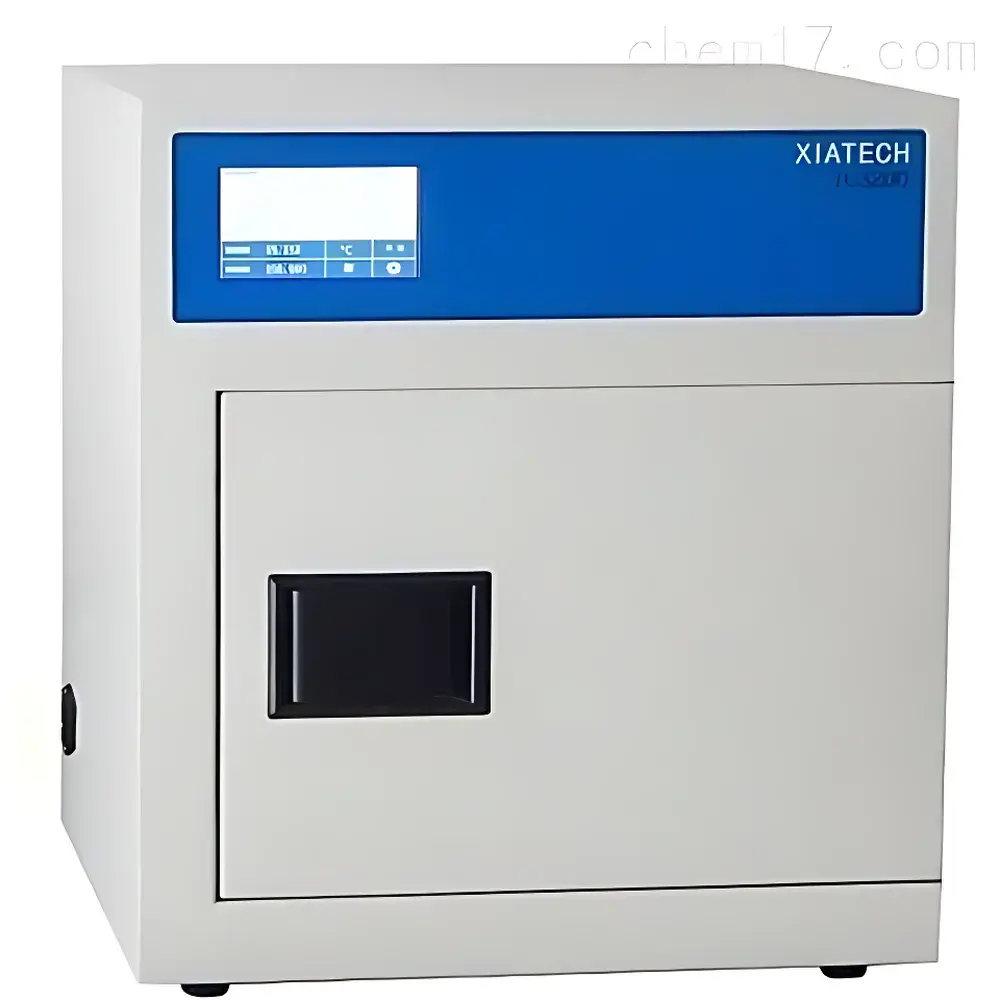
Xiatech TC5000 Series Transient Plane Source (TPS) Thermal Constants Analyzer
| Brand | Xiatech |
|---|---|
| Origin | Shaanxi, China |
| Manufacturer Type | Authorized Distributor |
| Country of Origin | China |
| Model | TC5000 Series |
| Pricing | Upon Request |
| Instrument Type | Transient Plane Source (TPS) Method |
| Sample Throughput | Single sample per test |
| Test Environment | Ambient temperature (20–25 °C, 40–60% RH) |
| Dimensions (L×W×H) | 500 mm × 450 mm × 700 mm |
| Accuracy | Thermal conductivity ±3 %, Thermal diffusivity ±5 %, Volumetric heat capacity ±7 % |
| Thermal Conductivity Range | 0.005–20 W/(m·K) |
| Repeatability | Thermal conductivity ±3 %, Thermal diffusivity ±5 %, Volumetric heat capacity ±5 % |
| Test Atmosphere | Ambient air |
| Sample Forms | Solid blocks, sheets, pastes, powders, granules, gels — compatible with circular, square, or irregular geometries (minimum thickness: 0.3 mm |
| minimum lateral dimension | 15 mm) |
Overview
The Xiatech TC5000 Series Thermal Constants Analyzer is a precision instrument engineered for the simultaneous determination of thermal conductivity (λ), thermal diffusivity (α), and volumetric heat capacity (Cv = λ/α) using the standardized Transient Plane Source (TPS) method—defined in ISO 22007-2 and ASTM D7896. Unlike steady-state or guarded-hot-plate techniques, the TPS method employs a symmetric, double-sided sensor that acts both as a heat source and a resistance thermometer. A short-duration DC current pulse generates a controlled thermal transient, while real-time voltage response is recorded to reconstruct the temperature rise curve. By fitting this curve to analytical solutions of the heat conduction equation in semi-infinite media, the instrument directly calculates λ and α without iterative assumptions or calibration against reference standards. This first-principles approach eliminates dependence on contact pressure, surface finish, or interfacial thermal resistance—making it uniquely suited for heterogeneous, hygroscopic, or low-density materials where conventional methods fail.
Key Features
- True dual-parameter acquisition: Simultaneous, independent measurement of thermal conductivity and thermal diffusivity in a single 10–120 second test cycle.
- Contact-resistance-immune architecture: The self-calibrating, sandwich-style sensor design inherently compensates for interfacial thermal resistance—critical for soft, porous, or irregularly shaped samples such as aerogels, soils, or phase-change composites.
- Minimal sample requirements: Accepts specimens as thin as 0.3 mm and as small as 15 mm in lateral dimension; no machining or polishing required.
- Ambient-air operation: No vacuum chamber or purge gas system needed—reducing operational complexity and cost of ownership.
- Robust mechanical platform: Precision-machined aluminum frame with vibration-damped base ensures measurement stability under typical laboratory conditions.
- Compliance-ready firmware: Built-in audit trail, user access levels, and electronic signature support align with GLP and FDA 21 CFR Part 11 requirements for regulated environments.
Sample Compatibility & Compliance
The TC5000 accommodates a broad spectrum of material classes without sensor swapping or hardware modification: rigid solids (ceramics, metals, polymers), compliant media (foams, gels, putties), particulates (powders, granules), and natural matrices (soil cores, wood, biomass). Its tolerance for surface roughness, moisture content, and geometric irregularity enables direct testing of as-received field samples—eliminating preparation artifacts common in comparative methods. All measurements conform to ISO 22007-2 (Plastics — Determination of thermal conductivity and thermal diffusivity — Part 2: Transient plane source (hot disc) method) and are traceable to NIST-traceable reference materials via internal validation protocols. For pharmaceutical excipients or building insulation products, data meets reporting thresholds specified in ASTM C177, ISO 10456, and EN 12664.
Software & Data Management
The TC5000 is operated via Xiatech’s proprietary ThermalLab v4.x software, a Windows-based application supporting multi-language UI (English, Chinese, German, Japanese). It provides real-time curve visualization, automatic baseline correction, outlier detection, and batch report generation in PDF or Excel format—including uncertainty propagation per GUM (JCGM 100:2008). Raw time–voltage datasets are saved in HDF5 format for third-party analysis. Audit logs record operator ID, timestamp, parameter settings, and result approvals. Optional network licensing enables centralized deployment across QC labs, with role-based permissions (e.g., operator, reviewer, administrator) and integration into LIMS via CSV export or OPC UA interface.
Applications
- Building science: R-value verification of aerogel blankets, vacuum insulation panels (VIPs), and bio-based insulators (hempcrete, cork).
- Energy storage: Thermal characterization of paraffin-based PCM composites and battery electrode coatings.
- Geotechnical engineering: In-situ thermal property mapping of unsaturated soils and fractured rock cores.
- Materials development: High-throughput screening of polymer nanocomposites, thermal interface materials (TIMs), and additive-manufactured metal lattices.
- Food & agriculture: Moisture-dependent thermal modeling of grains, dairy powders, and frozen tissue analogs.
FAQ
Does the TC5000 require sample mounting pressure control?
No—measurement relies on gentle, gravity-assisted contact; no external clamping force is applied or required.
Can I test liquids or low-viscosity suspensions?
Not recommended—the TPS method assumes solid-like thermal boundary conditions; liquids introduce convection artifacts that violate the semi-infinite medium assumption.
Is calibration against certified reference materials mandatory before each test?
No—system calibration is performed once during installation using SRM 1450a (standard reference glass) and verified quarterly; drift monitoring is automated via built-in reference resistor tracking.
What sample preparation is needed for powder testing?
Powders must be gently compacted into a cylindrical die (included accessory) to ensure planar contact; density is recorded for volumetric heat capacity correction.
How does the TC5000 handle anisotropic materials?
It reports bulk isotropic values by default; directional anisotropy requires orthogonal orientation testing and post-processing using the included Anisotropy Analysis Module (optional license).



