
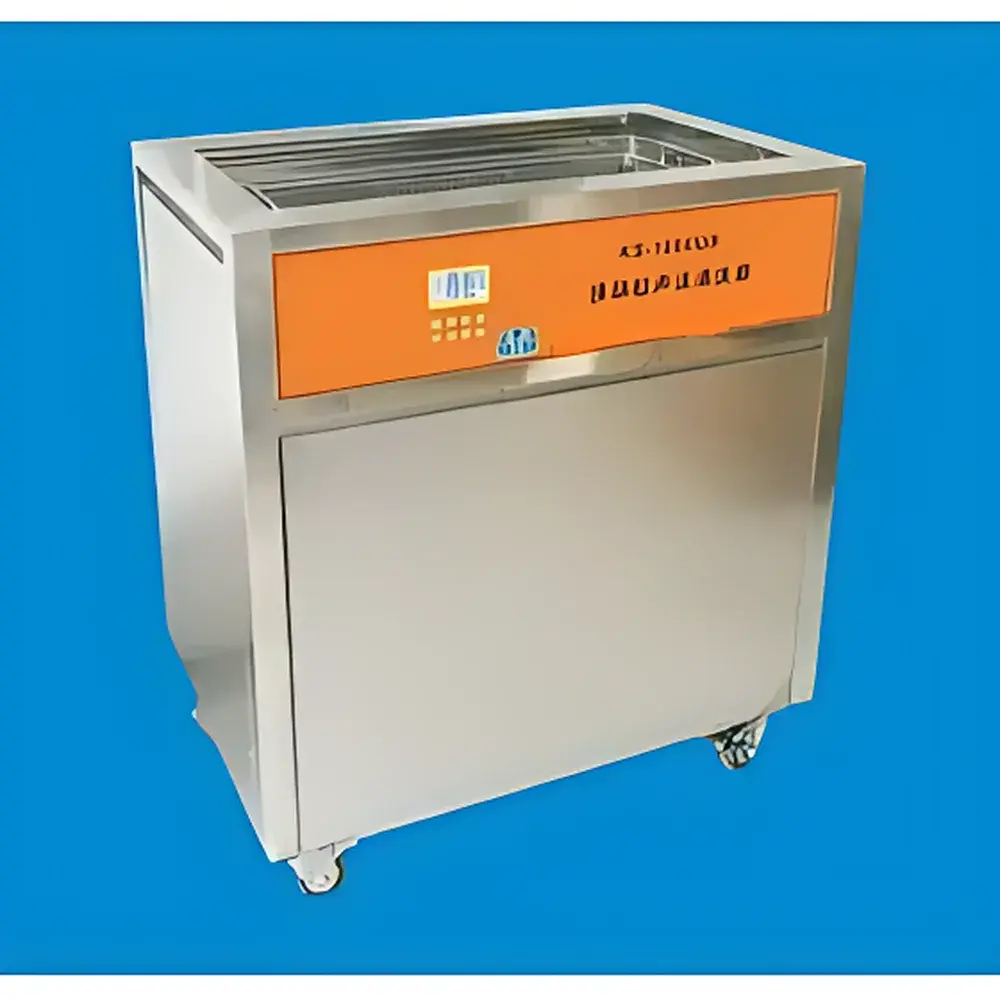
Jihepu KS-1000DE Single-Tank Ultrasonic Cleaner with Backlit LCD Interface
| Brand | Jihepu |
|---|---|
| Origin | Shandong, China |
| Model | KS-1000DE |
| Tank Capacity | 72 L |
| Ultrasonic Frequency | 40 kHz |
| Nominal Ultrasonic Power | 1000 W |
| Power Adjustment Range | 10–100% (stepless) |
| Temperature Control Range | 10–80 °C |
| Timer Range | 1–9999 minutes |
| Acoustic Lid | Included |
| Auto Fill/Drain Function | Yes |
| Construction Material | 304 Stainless Steel (tank, basket, lid, housing) |
| Display | 3.2-inch Backlit LCD with Full Chinese UI |
Overview
The Jihepu KS-1000DE is a single-tank, microprocessor-controlled ultrasonic cleaner engineered for precision cleaning, degassing, and sample preparation in laboratory, academic, and industrial quality control environments. It operates on the principle of high-frequency acoustic cavitation—generating controlled micro-bubbles in aqueous or mild solvent media at 40 kHz. Upon collapse, these bubbles produce localized shockwaves and micro-jets that dislodge particulate contaminants, organic residues, and biofilms from surfaces without mechanical abrasion. Designed for reproducible, non-destructive cleaning of delicate components—including optical lenses, semiconductor wafers, precision instrumentation parts, and analytical labware—the KS-1000DE integrates robust thermal regulation, programmable power modulation, and fail-safe operational monitoring to support GLP-compliant workflows.
Key Features
- 3.2-inch backlit LCD interface with full Chinese-language menu navigation—displaying real-time parameters including set and actual temperature, ultrasonic power level (%), elapsed and remaining time, water level status, and system fault codes.
- Adjustable ultrasonic output (10–100% in 1% increments) enables optimization for diverse sample types—from fragile glassware to dense metal fixtures—minimizing erosion while maximizing cleaning efficacy.
- Precise digital temperature control (10–80 °C ±1 °C) with PT100 sensor feedback ensures consistent thermal conditions critical for enzymatic decontamination, solvent-assisted extraction, or temperature-sensitive material processing.
- Extended timer range (1–9999 minutes) supports unattended operation for prolonged degassing, cell lysis, or nanoparticle dispersion protocols.
- Integrated auto-fill and auto-drain function reduces manual handling, improves workflow continuity, and minimizes operator exposure to solvents or heated liquids.
- Acoustic damping lid with ergonomic latch suppresses airborne noise (≤65 dB(A) at 1 m) and prevents solvent evaporation during extended cycles.
- All wetted components—including tank, mesh basket, lid interior, and housing—fabricated from electropolished 304 stainless steel for corrosion resistance, cleanability, and compliance with ISO 15190:2020 laboratory safety standards.
Sample Compatibility & Compliance
The KS-1000DE accommodates standard laboratory vessels (e.g., beakers, flasks, cuvettes, chromatography vials), surgical instruments, printed circuit boards, and small mechanical assemblies up to 600 × 300 × 200 mm (L×W×H). Its 72 L capacity supports batch processing of multiple items simultaneously while maintaining uniform cavitation field distribution. The unit meets CE electromagnetic compatibility (EMC) requirements (EN 61326-1) and conforms to IEC 61010-1 for electrical safety in laboratory equipment. While not certified for sterile processing per ISO 13485, its design facilitates validation of cleaning processes aligned with ASTM D4488 (Standard Practice for Validation of Cleaning Processes) and USP (Cleaning and Sanitization of Equipment).
Software & Data Management
The KS-1000DE operates via embedded firmware with no external PC dependency. All parameter settings—including power level, temperature setpoint, duration, and start delay—are stored in non-volatile memory and retained after power cycling. System diagnostics log over-temperature, low-water, over-current, and transducer impedance anomalies with audible alarm and on-screen alert. Though it lacks Ethernet or USB data export, its deterministic behavior and traceable parameter history support audit readiness under FDA 21 CFR Part 11 when used within documented SOPs and maintained with calibration records (e.g., temperature probe verification annually per ISO/IEC 17025 guidelines).
Applications
- Removal of polishing compounds, flux residues, and oxide layers from metallurgical specimens prior to SEM/EDS analysis.
- Degassing of HPLC mobile phases and ultrapure water to eliminate dissolved air bubbles affecting baseline stability.
- Cell disruption and DNA/RNA extraction from microbial cultures using optimized sonication protocols.
- Cleaning of pipette tips, syringe filters, and LC-MS autosampler vials to prevent carryover contamination.
- Dispersion of carbon nanotubes, graphene oxide, or ceramic nanoparticles in aqueous suspensions for rheological or optical characterization.
- Preparation of calibration standards by homogenizing trace-element reference materials in acid digestion matrices.
FAQ
Is the KS-1000DE suitable for use with flammable solvents?
No. This unit is designed exclusively for aqueous solutions and low-volatility, non-flammable cleaning agents (e.g., alkaline detergents, citric acid, ethanol ≤30% v/v). Flammable solvents require explosion-proof ultrasonic systems meeting ATEX or IECEx directives.
Does the device include calibration documentation?
Factory calibration certificates for temperature and timer accuracy are available upon request; users must perform periodic verification using NIST-traceable references.
Can the ultrasonic frequency be changed to 28 kHz or 35 kHz?
No. The KS-1000DE is fixed at 40 kHz. Frequency selection is hardware-determined at manufacture; alternative frequencies require different transducer arrays and generator tuning.
What maintenance is required for long-term reliability?
Monthly inspection of tank integrity, quarterly cleaning of transducer mounting surfaces with isopropyl alcohol, and annual verification of water-level sensor response and thermal cut-off functionality.
Is the stainless-steel tank passivated per ASTM A967?
Yes. All 304 stainless-steel components undergo nitric acid passivation post-fabrication to maximize corrosion resistance and minimize metallic ion leaching into cleaning solutions.



