
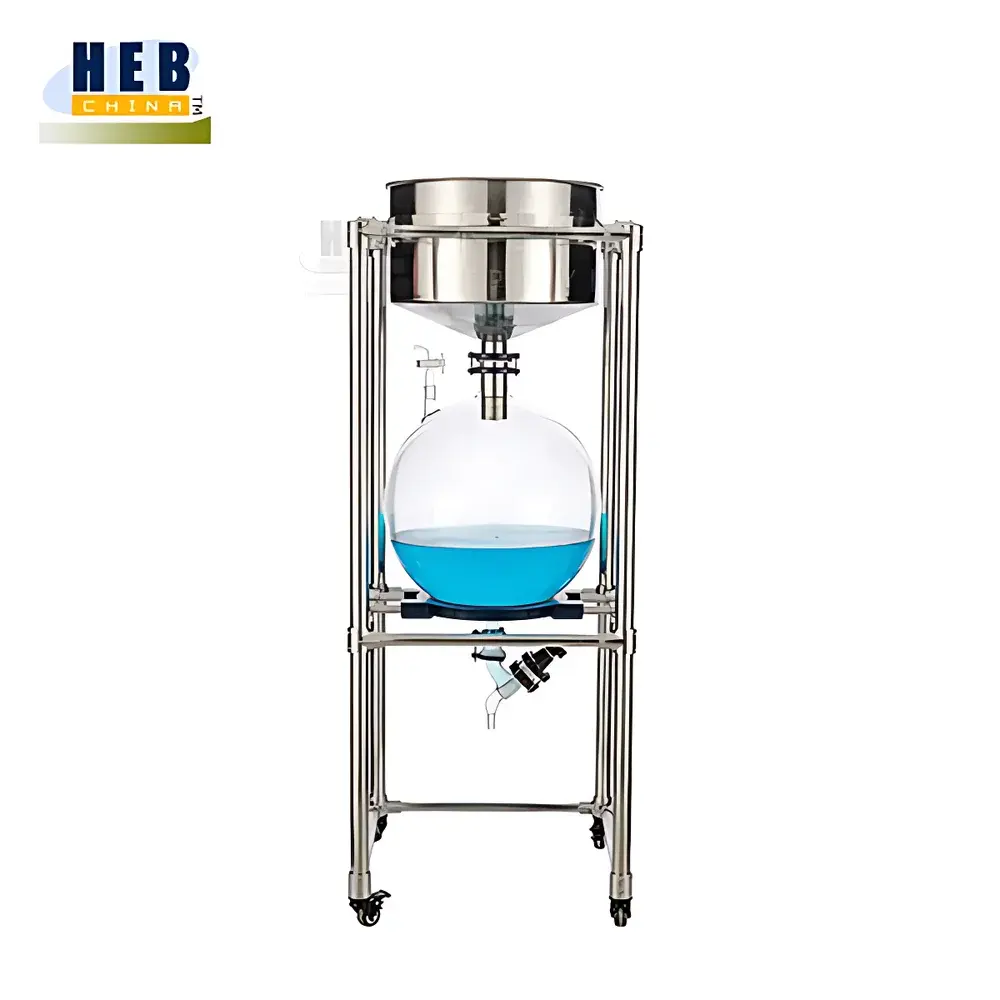
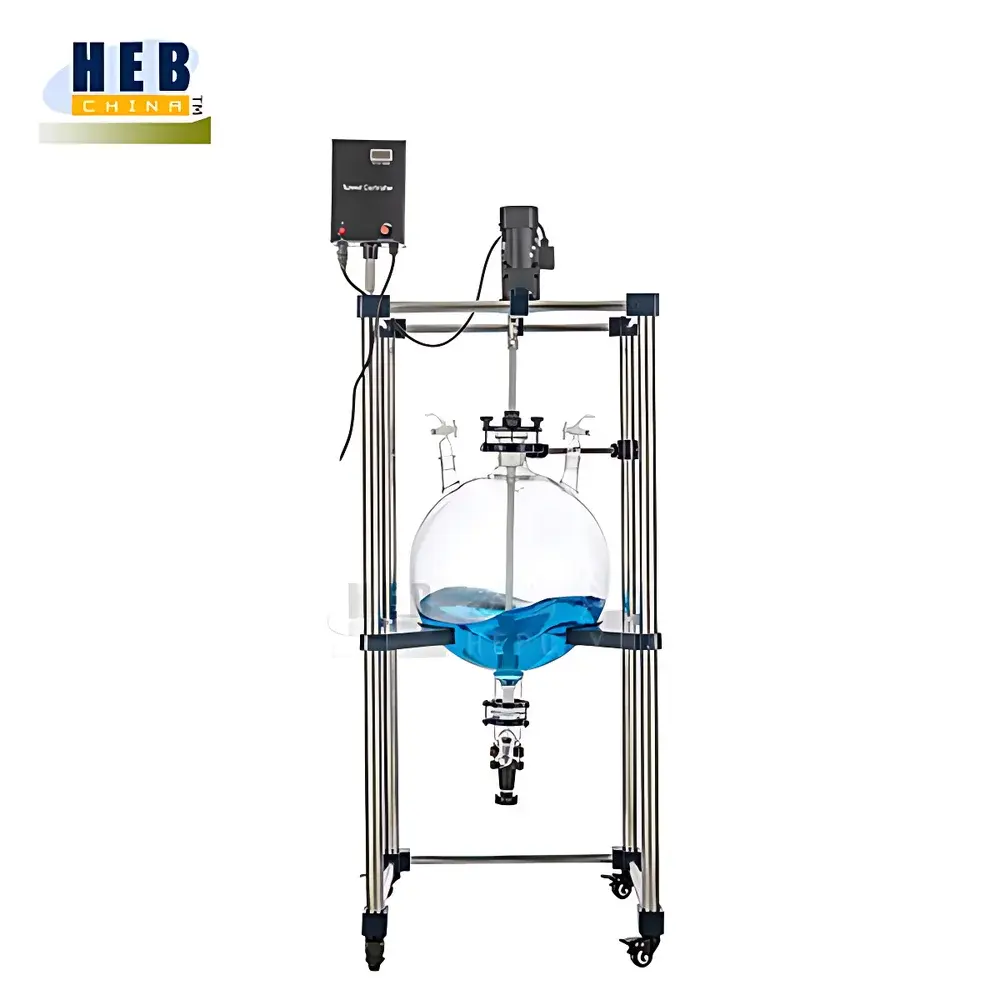
Jihepu ZF-20L Vacuum Filtration Apparatus
| Brand | Jihepu |
|---|---|
| Origin | Shandong, China |
| Manufacturer Type | Authorized Distributor |
| Country of Origin | China |
| Model | ZF-20L |
| Capacity | 20 L |
| Construction Material | Borosilicate Glass (3.3 expansion coefficient) & 304 Stainless Steel |
| Frame Material | Aluminum Alloy + Stainless Steel |
| Operating Pressure Range | Low Vacuum |
| Ultimate Vacuum | 0.098 MPa (≈735 Torr, -0.098 MPa gauge) |
| Filtration Funnel Dimensions | Φ350 × 220 mm (H) |
| Filtration Area | Approx. 0.096 m² |
| Vacuum Port | Standard 24/40 ground glass joint |
| Drain Valve | Φ45 spherical convex port with PTFE-core C-type glass valve |
| Discharge Outlet | Φ20 mm |
| Overall Footprint | 500 × 520 × 1330 mm (W × D × H) |
| Net Weight | 27 kg |
| Packing Volume | 0.49 m³ |
| Gross Shipping Weight | 53 kg |
Overview
The Jihepu ZF-20L Vacuum Filtration Apparatus is a benchtop-scale, manually operated vacuum-assisted solid–liquid separation system engineered for reproducible batch processing in synthetic chemistry, pharmaceutical development, and materials science laboratories. It operates on the principle of pressure-driven filtration: a vacuum source (e.g., diaphragm or oil-free rotary vane pump) connected to the borosilicate glass receiving flask generates negative pressure across a filtration medium—typically user-supplied filter cloth, stainless steel mesh, or polymeric membrane—placed within the 304 stainless steel funnel. This differential pressure gradient accelerates fluid phase passage while retaining suspended solids on the filter surface. The apparatus is not intended for continuous operation or high-throughput industrial use; rather, it supports controlled, gravity-assisted pre-filtration followed by vacuum-enhanced dewatering, crystallization workup, catalyst recovery, or precipitate isolation under ambient or mildly cooled conditions.
Key Features
- Borosilicate glass (Duran®-grade, expansion coefficient 3.3) filtration flask with 20 L nominal capacity and spherical geometry—resistant to thermal shock, chemical corrosion, and mechanical stress during vacuum cycling.
- 304 stainless steel conical filtration funnel (Φ350 × 220 mm H) featuring uniform 4 mm diameter perforations across the base plate—optimized for even flow distribution and minimal channeling.
- Modular ground-glass interface: 24/40 standard taper vacuum inlet and three-port neck configuration enable compatibility with auxiliary condensers, manometers, or inert gas purge lines.
- C-type glass drain valve with integrated PTFE sealing core (Φ45 spherical convex port), rated for repeated actuation under vacuum without leakage or galling.
- Stable freestanding frame constructed from anodized aluminum alloy uprights and stainless steel cross-bracing—designed to support full-load static weight (≤35 kg) with ≤0.5° tilt tolerance.
- Four swivel casters with locking brakes (two front, two rear) facilitate safe repositioning within fume hoods or between synthesis stations without disassembly.
Sample Compatibility & Compliance
The ZF-20L accommodates heterogeneous slurries, crystalline suspensions, colloidal dispersions, and viscous reaction mixtures compatible with borosilicate glass and 304 SS surfaces—including aqueous, alcoholic, acetone, THF, ethyl acetate, and dilute mineral acid systems (pH ≥2). It is unsuitable for hydrofluoric acid, hot concentrated alkalis (>10% NaOH at >60°C), or halogenated solvents above their boiling points under vacuum. While not certified to ISO 9001 or ASTM E2656 for manufacturing quality management, its material selection and dimensional tolerances align with common laboratory good practice (GLP) expectations for non-automated filtration equipment. No electrical safety certification (e.g., UL/CE) applies, as the unit contains no powered components.
Software & Data Management
This is a purely mechanical, analog filtration system with no embedded electronics, sensors, or digital interfaces. All operational parameters—including vacuum level, filtration rate, and cake thickness—are monitored externally via user-installed vacuum gauges (e.g., Pirani or capacitance manometers), stopwatch timing, and visual inspection. Data recording must be performed manually in laboratory notebooks or electronic lab notebooks (ELNs) compliant with 21 CFR Part 11 if used in regulated environments. No firmware, driver, or proprietary software is associated with this apparatus.
Applications
- Isolation of organic crystals post-reaction quench (e.g., Grignard adducts, amide couplings, Suzuki cross-coupling products).
- Removal of heterogeneous catalysts (Pd/C, Raney Ni) from hydrogenation filtrates.
- Recovery of inorganic precipitates (e.g., metal carbonates, phosphates, sulfides) from aqueous metallurgical leachates.
- Preparative-scale microfiltration of cell lysates prior to centrifugation or chromatography.
- Drying assistance: residual solvent removal from filter cakes under reduced pressure, optionally coupled with gentle heating of the receiving flask via water bath (not included).
- Scale-up feasibility studies: performance correlation between small-scale Büchner funnels and this 20 L platform supports process transfer to pilot reactors.
FAQ
What vacuum pumps are compatible with the ZF-20L?
Diaphragm pumps capable of achieving ≥0.095 MPa ultimate vacuum and ≥20 L/min free-air displacement are recommended. Oil-lubricated rotary vane pumps may be used but require cold traps to prevent oil backstreaming into the glassware.
Can the funnel be autoclaved?
No—the 304 SS funnel is not designed for steam sterilization cycles; thermal expansion mismatch between welded joints and base plate may compromise structural integrity.
Is the glass flask calibrated?
The 20 L capacity is nominal and marked only with approximate volume graduations; it is not volumetrically certified per ISO 4787 or ASTM E542.
What filter media are recommended for fine particulates?
For particles <10 µm, supported nylon or PVDF membranes (0.45 µm or 0.22 µm pore size) mounted on stainless steel mesh backing are advised; unsupported filter paper is not suitable due to collapse under vacuum load.
Does the unit include a vacuum regulator?
No—vacuum control must be implemented externally using an inline needle valve or pressure-controlled pump.



