
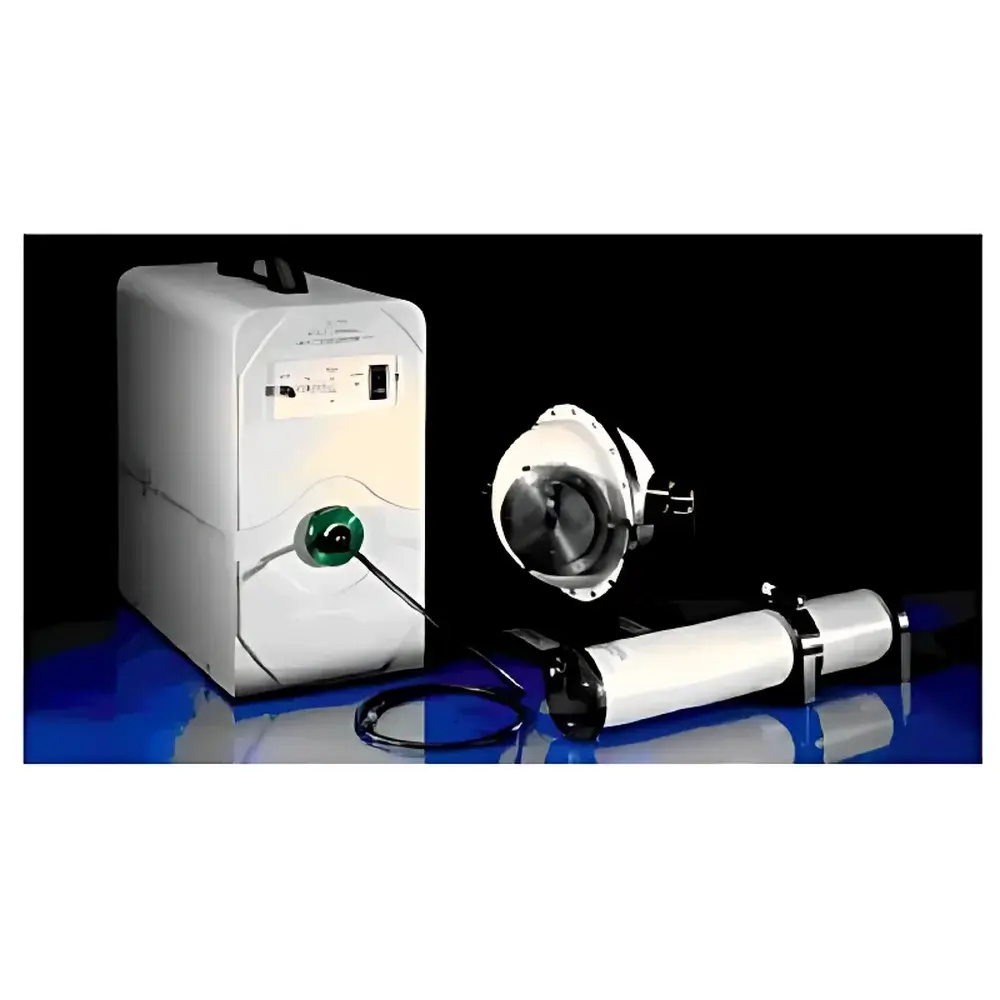
Optronic Laboratories OL770 CCD-Based UV-NIR Spectroradiometer
| Brand | Optronic Laboratories |
|---|---|
| Origin | USA |
| Manufacturer Type | Authorized Distributor |
| Product Origin | Imported |
| Model | OL770 |
| Pricing | Upon Request |
Overview
The Optronic Laboratories OL770 is a high-performance, CCD-based spectroradiometer engineered for precision optical radiation measurement across the ultraviolet, visible, and near-infrared spectral domains. Utilizing a fixed-grating monochromator architecture coupled with a thermoelectrically stabilized linear CCD array detector, the OL770 delivers rapid, repeatable, and research-grade spectral data acquisition without mechanical scanning. Its optical design follows Czerny–Turner configuration principles to minimize aberrations and ensure high wavelength fidelity, while optimized stray-light suppression enables reliable measurements down to 200 nm—critical for UV-emitting LED characterization and material reflectance analysis. The system operates on the fundamental principle of spectral radiometry: incident optical radiation is dispersed via a ruled or holographic grating, focused onto the CCD sensor, and converted into calibrated digital spectra (intensity vs. wavelength) using NIST-traceable radiometric calibration functions. Designed explicitly for compliance-driven photometric and radiometric applications—including LED testing, display metrology, and optical material qualification—the OL770 meets the core functional requirements of CIE Publication 127, IES LM-79, and ISO/CIE 11664 standards.
Key Features
- High-speed CCD detection enabling full-spectrum acquisition in sub-second intervals—ideal for pulsed-source characterization (e.g., xenon flash lamps) and production-line QA sampling
- Modular spectral range configuration: selectable UV/VIS (200–780 nm), VIS-only (380–780 nm), or VIS/NIR (380–1100 nm) via interchangeable optical filters and detector coatings
- Thermoelectric (TE) cooling of the CCD sensor to –10°C, reducing dark current noise and improving signal-to-noise ratio (SNR) for low-light measurements
- Integrated USB 2.0 interface compliant with Windows-based control software; supports real-time spectral streaming and hardware-triggered acquisition
- Optimized optical throughput via f/4.5 imaging optics and high-efficiency PTFE-coated integrating spheres (e.g., OL1272-LED, OL IS-670-LED)
- Factory-calibrated radiometric response traceable to NIST reference standards, with optional annual recalibration services supporting ISO/IEC 17025 laboratory accreditation
- Rugged aluminum chassis with shock-absorbing mounting points, designed for both benchtop R&D use and portable field deployment
Sample Compatibility & Compliance
The OL770 accommodates diverse sample geometries and illumination conditions through a comprehensive ecosystem of accessories certified for standardized measurement protocols. Solid-state emitters—including discrete LEDs, OLED panels, and micro-LED arrays—are measured under CIE 127 Standard Conditions A (316 mm distance, 0.001 sr solid angle) and B (100 mm, 0.01 sr) using the OL15AB receiver. Reflectance and transmittance of flat, curved, or irregularly shaped materials are quantified using double-beam-integrated accessories (OL700-70, OL700-71), which implement the “comparison method” to compensate for spectral efficiency drift caused by sample self-absorption and non-Lambertian behavior. All integral sphere attachments feature ≥99% spectral reflectance (300–1700 nm) PTFE coatings and precisely defined 10° incidence geometry per ASTM E275 and ISO 13468. The system supports GLP/GMP-aligned audit trails when used with OL770-420 SDK and compliant software configurations adhering to FDA 21 CFR Part 11 electronic record requirements.
Software & Data Management
The native OL770 Windows application provides full instrument control, spectral visualization, and photometric computation—including CIE 1931 xy chromaticity, CIELAB color space, CCT, CRI (Ra), spectral purity, dominant/peak wavelength, FWHM, and radiant/luminous flux integrals. Data export is natively compatible with Microsoft Excel (.xlsx) and Word (.docx) for direct report generation. Advanced users leverage the OL770-420 Software Development Kit (SDK), which exposes COM-based ActiveX interfaces for custom automation in LabVIEW, MATLAB, Python (via pywin32), or C# environments. All measurement sessions log timestamped metadata—including accessory ID, calibration certificate number, operator ID, and environmental temperature—enabling full traceability. Optional encrypted database logging supports ISO 17025-compliant record retention policies, with configurable auto-backup to network drives or cloud storage endpoints.
Applications
The OL770 serves as a primary measurement platform in LED product development labs, display manufacturing facilities, optical coating evaluation centers, and national metrology institutes. It performs full spectral characterization of high-brightness LEDs under thermal stress (using OL700-88TC temperature controller), quantifies angular radiation distribution (via OL700-30 goniometer), validates UV-curable resin photoinitiator response (200–400 nm), measures NIR absorption bands of semiconductor wafers (800–1100 nm), and certifies luminous efficacy of automotive headlamps per ECE R149. In academic research, it supports studies in photobiomodulation dosimetry, solar simulator spectral match validation (IEC 60904-9), and fluorescence quantum yield determination when paired with OL700-22 pulsed xenon excitation. Its modular architecture ensures scalability from single-point QA checks to fully automated multi-station test cells.
FAQ
What spectral calibration standards are supported?
The OL770 accepts NIST-traceable calibration via OL700-24 Hg/Ar wavelength standard and OL700-FCS field calibration source (available in 380–800 nm or 380–1110 nm variants).
Can the OL770 measure absolute irradiance without an integrating sphere?
Yes—when configured with calibrated input optics (e.g., OL700-LFOV wide-field adapter or collimated lens assemblies), the system reports absolute irradiance (W/cm²/nm) directly using factory-applied responsivity curves.
Is dual-source operation possible (e.g., simultaneous LED + xenon illumination)?
Yes—the OL700-22 pulsed xenon source and DC-driven LED sources can be independently triggered and synchronized via TTL signals routed through the OL770’s auxiliary I/O port.
Does the system support automated pass/fail grading against user-defined spectral limits?
Yes—custom spectral masks and tolerance bands can be defined in the OL770 software; results are flagged in real time with color-coded pass/fail indicators and exported CSV logs.
How is stray light corrected in UV measurements below 250 nm?
Stray light suppression is achieved through a combination of order-sorting filters, double-monochromator-compatible optical path design, and proprietary software-based correction algorithms derived from empirical slit-function modeling.
Related Products





