
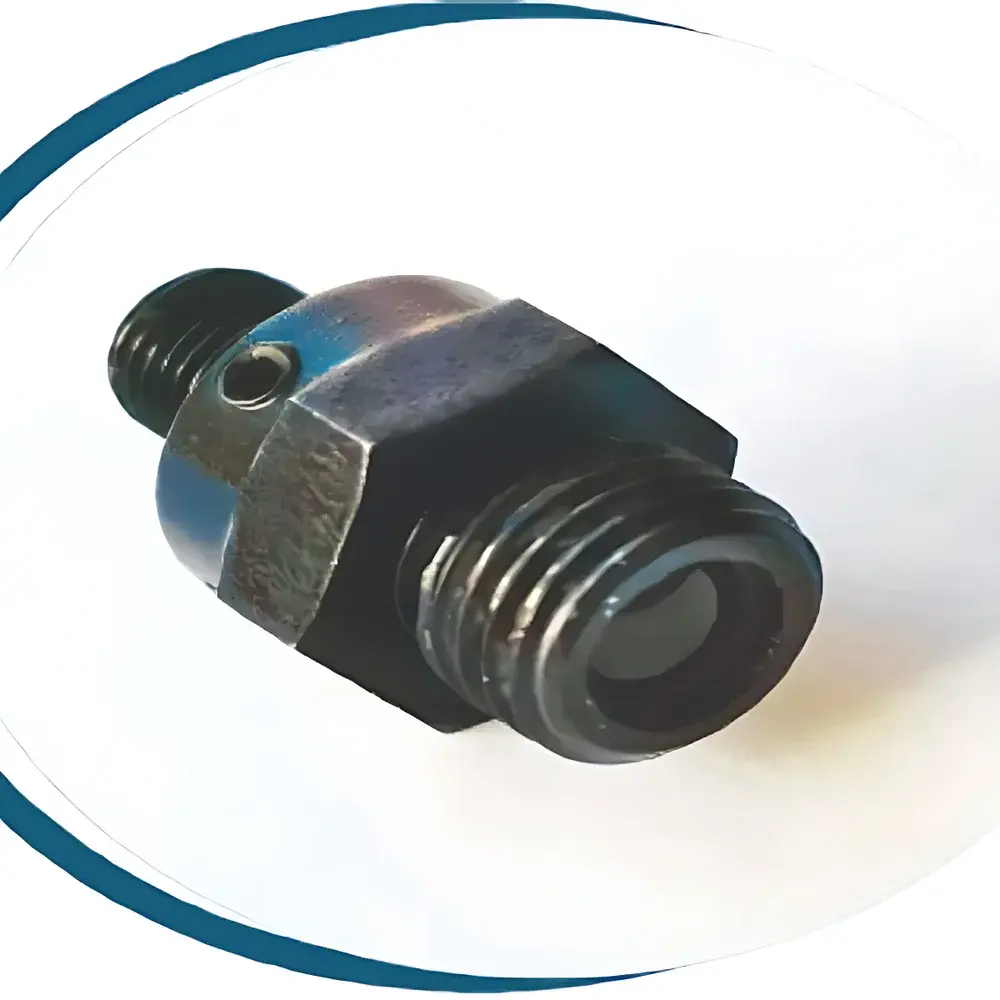
Jingfei FLB1001 Fiber Collimator
| Brand | Jingfei Technology |
|---|---|
| Origin | Zhejiang, China |
| Manufacturer Type | OEM/ODM Producer |
| Country of Origin | China |
| Model | FLB1001 |
| Interface | SMA905 / 3/8"-24 UNF |
| Lens Material | UV-Fused Silica |
| Focal Length | 10 mm |
| Output Beam Diameter | Ø5 mm |
| Spectral Range | 200–1100 nm |
Overview
The Jingfei FLB1001 Fiber Collimator is a precision optical component engineered for high-fidelity beam conditioning in spectroscopic and photonic measurement systems. It operates on the principle of collimation—converting the divergent Gaussian output from an optical fiber into a spatially uniform, low-divergence parallel beam. This function is critical in applications where efficient free-space coupling between fiber-delivered light and downstream optical elements (e.g., monochromators, interferometers, spectrometers, or detector arrays) is required. Designed with a single-element, achromatically optimized lens assembly, the FLB1001 minimizes wavefront distortion and chromatic aberration across its full operational bandwidth, ensuring consistent beam quality from deep ultraviolet (200 nm) through visible to near-infrared (1100 nm). Its mechanical architecture supports repeatable alignment and long-term thermal and mechanical stability—key requirements in laboratory-grade spectroscopy and industrial process monitoring environments.
Key Features
- UV-grade fused silica lens with high transmission (>99.5% per surface, AR-coated optional) and low fluorescence, suitable for demanding UV-VIS-NIR applications including UV-Vis absorption, fluorescence excitation, and Raman spectroscopy.
- Precisely centered 10 mm focal length lens enabling tight control over beam waist location and divergence (< 1.5 mrad typical full angle at 633 nm).
- Standardized dual-interface configuration: SMA905 receptacle for fiber termination and 3/8″-24 UNF external thread for secure mounting into kinematic mounts, lens tubes, or custom optomechanical housings.
- Collimated output beam diameter of Ø5 mm (1/e² intensity definition), optimized for compatibility with standard spectrometer slits, CCD/CMOS sensor apertures, and scanning galvanometer inputs.
- Ruggedized stainless-steel housing with black anodized finish, providing EMI shielding, thermal mass stability, and resistance to environmental oxidation—suitable for integration into ISO-classified cleanrooms or GMP-compliant analytical platforms.
Sample Compatibility & Compliance
The FLB1001 is compatible with standard multimode fibers (e.g., 200 µm, 400 µm, 600 µm core diameters) terminated with SMA905 connectors. Its broadband spectral response enables seamless integration into UV-Vis spectrophotometers (ASTM E275, ISO 13485-aligned systems), NIR process analyzers (per ASTM E1655), and laser-based diagnostic setups operating under FDA 21 CFR Part 11–compliant data integrity frameworks. While the device itself is not a regulated medical instrument, its optical performance meets traceable calibration requirements for GLP and GMP environments when used as part of validated spectroscopic measurement chains.
Software & Data Management
As a passive optical component, the FLB1001 requires no firmware, drivers, or software integration. However, it is fully interoperable with industry-standard spectroscopy control platforms—including Ocean Insight OceanView, Avantes ASE, and Thermo Fisher OMNIC—when deployed in fiber-coupled measurement configurations. Beam alignment verification and long-term stability assessment can be performed using NIST-traceable power meters (e.g., Thorlabs PM100D) and beam profilers (e.g., Ophir Spiricon SP620U), with data logging compliant with ISO/IEC 17025 documentation protocols.
Applications
- Free-space coupling in modular UV-Vis-NIR spectrometers and portable field-deployable analyzers.
- Input/output interface for FTIR sampling accessories, including attenuated total reflectance (ATR) cells and diffuse reflectance probes.
- Beam delivery in laser-induced breakdown spectroscopy (LIBS) and cavity-enhanced absorption systems.
- Optical path conditioning for multi-channel fluorescence detection systems in life science instrumentation.
- Reference-grade collimation in metrology-grade wavelength calibration sources and spectral line profile characterization rigs.
FAQ
What fiber core diameters are compatible with the FLB1001?
The collimator is optimized for multimode fibers with core diameters ranging from 200 µm to 600 µm; numerical aperture (NA) should not exceed 0.22 for optimal collimation efficiency.
Is the lens AR-coated?
Standard units feature uncoated UV-fused silica surfaces; broadband AR coatings (200–1100 nm, R < 0.5% per surface) are available as a factory option upon request.
Can the FLB1001 be used in vacuum environments?
Yes—the all-metal housing and epoxy-free lens mounting (mechanical retention only) support operation in moderate vacuum (down to 10⁻³ mbar); outgassing data available upon request for UHV integration.
What is the maximum input power handling capability?
For continuous-wave (CW) operation at 532 nm, the damage threshold exceeds 10 W/cm²; pulsed-laser use requires evaluation of peak fluence and pulse duration per ISO 21254 standards.
Does Jingfei provide test reports or calibration certificates?
Each unit ships with a factory inspection report including measured collimation divergence, wavefront error (λ/8 @ 633 nm), and spectral transmission curves; NIST-traceable calibration certificates are available as an add-on service.




