
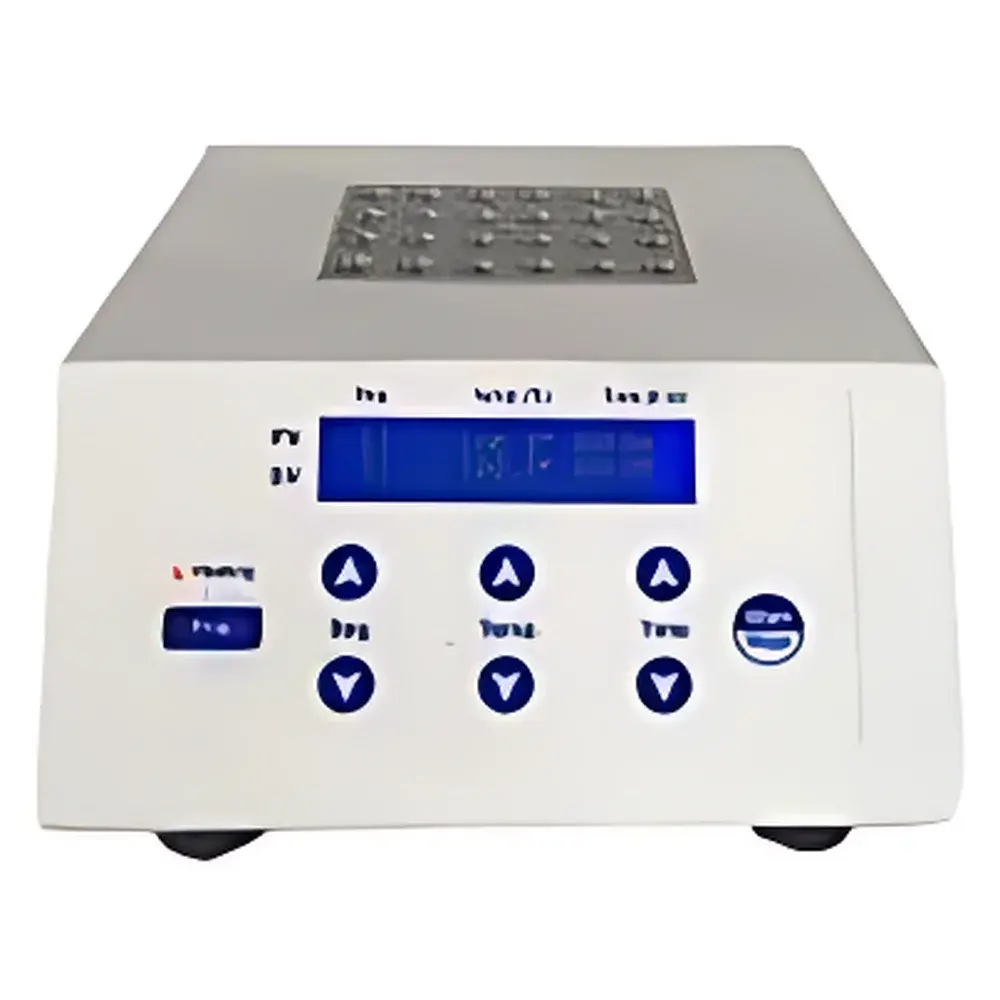
ZiQi MD150-1 High-Temperature Dry Block Heater
| Brand | ZiQi |
|---|---|
| Origin | Shanghai, China |
| Manufacturer Type | OEM/ODM Manufacturer |
| Country of Origin | China |
| Model | MD150-1 |
| Temperature Range | Ambient +5°C to 150°C |
| Temperature Accuracy | ±0.1°C (display resolution), ±0.5°C (control accuracy) |
| Heating Time | ≤30 min (40°C → 150°C) |
| Dimensions (W×D×H) | 230 × 220 × 95 mm |
| Net Weight | 3.8 kg |
| Uniformity @100°C | ±0.5°C |
| Uniformity @150°C | ±1.0°C |
| Max Power | 200 W |
| Timer Range | 1–99 h 59 min |
| Programmable Profiles | 5 user-defined temperature ramps |
| Cooling Mechanism | Integrated side-mounted thermal management fan |
| Module Compatibility | 17 interchangeable aluminum blocks (0.2–40 mL formats) |
Overview
The ZiQi MD150-1 High-Temperature Dry Block Heater is a microprocessor-controlled dry bath system engineered for precise, stable, and repeatable thermal incubation of samples in sealed tubes and vials. Unlike water baths—prone to evaporation, contamination, and limited upper-temperature capability—the MD150-1 employs solid-state conductive heating via a high-purity aluminum heating block, delivering rapid thermal response and exceptional spatial uniformity across the entire sample zone. Its operational range spans from ambient +5°C up to 150°C, making it suitable for applications requiring elevated temperatures without phase-change media, including enzyme inactivation, DNA denaturation, protein aggregation studies, solvent evaporation, and accelerated stability testing. The device complies with fundamental thermal safety and electromagnetic compatibility requirements per IEC 61010-1 and is constructed with flame-retardant housing materials meeting UL94 V-0 standards.
Key Features
- High-resolution LCD interface with intuitive navigation and real-time display of setpoint, actual temperature, elapsed time, and remaining countdown.
- Rapid heating performance: achieves 150°C from 40°C in ≤30 minutes, minimizing assay turnaround time without compromising control fidelity.
- Advanced PID temperature regulation with auto-tuning and built-in offset calibration—ensuring long-term stability and traceable thermal consistency across daily use.
- Dual-layer thermal protection: electronic overtemperature cutoff (hardware-based) plus software-enforced safety limit, preventing unintended thermal excursions during unattended operation.
- Intelligent thermal management system: integrated side-mounted cooling fan activates automatically when internal chassis temperature exceeds safe thresholds during sustained 150°C operation, maintaining electronics reliability and extending service life.
- Five-step programmable ramp-soak profiles support complex thermal protocols—e.g., stepwise denaturation or multi-stage reaction kinetics—without external controllers.
- Compact footprint (230 × 220 × 95 mm) and lightweight design (3.8 kg) enable flexible benchtop deployment in crowded QC labs, biosafety cabinets, or mobile field units.
Sample Compatibility & Compliance
The MD150-1 accommodates 17 standardized interchangeable aluminum modules, supporting tube formats from 0.2 mL PCR strips to 40 mL scintillation vials. All blocks are precision-machined to ISO 2768-mK tolerances and anodized for corrosion resistance and ease of decontamination (autoclavable at ≤121°C for non-electronic components). The system supports GLP-compliant workflows through auditable parameter logging (when paired with optional RS232/USB data export), and its temperature accuracy (±0.5°C) and uniformity (±0.5°C at 100°C; ±1.0°C at 150°C) meet typical validation requirements for ASTM E2252 (Standard Practice for Calibration of Thermometers) and ISO/IEC 17025 clause 6.4.2 (Equipment Verification).
Software & Data Management
While the MD150-1 operates as a standalone instrument, its serial communication interface (RS232 standard, USB adapter optional) enables integration into LIMS or ELN platforms via ASCII command protocol. Users may log timestamped temperature readings, profile execution status, and fault codes for audit trails. Firmware supports firmware-upgradable calibration tables—critical for laboratories maintaining metrological traceability to NIST-traceable reference thermometers. No proprietary software installation is required; basic data capture is achievable using terminal emulation tools compliant with ANSI X3.64.
Applications
- Thermal inactivation of enzymes and nucleases in molecular biology workflows
- Controlled denaturation and renaturation studies for protein folding assays
- Accelerated degradation testing of pharmaceutical formulations (ICH Q1A)
- Residue evaporation in environmental sample preparation (EPA Method 502.2, 8081B)
- Pre-incubation of reagents prior to HPLC or GC injection
- Stabilization of heat-labile standards during calibration series preparation
- QC release testing of raw materials in food safety laboratories (AOAC 999.09, ISO 16140)
FAQ
What is the maximum continuous operating temperature?
The MD150-1 is rated for continuous operation at 150°C, provided ambient conditions remain below 30°C and adequate ventilation is maintained around the unit’s side vents.
Can the device be validated for GMP environments?
Yes—its temperature accuracy, uniformity, and programmable profile repeatability support IQ/OQ documentation. Optional NIST-traceable calibration certificates are available upon request.
Are modules autoclavable?
Aluminum blocks may be autoclaved at 121°C for ≤20 minutes; however, repeated sterilization cycles may affect surface finish and thermal contact integrity over time.
Does the unit support external temperature probes?
No—the MD150-1 relies on embedded Pt100 sensor feedback only; no external probe input is provided.
How is thermal uniformity verified across the block?
Uniformity is measured per ISO 17025 Annex B using nine-point mapping (center + eight equidistant positions) at steady-state conditions, with results documented in the factory test report shipped with each unit.



