
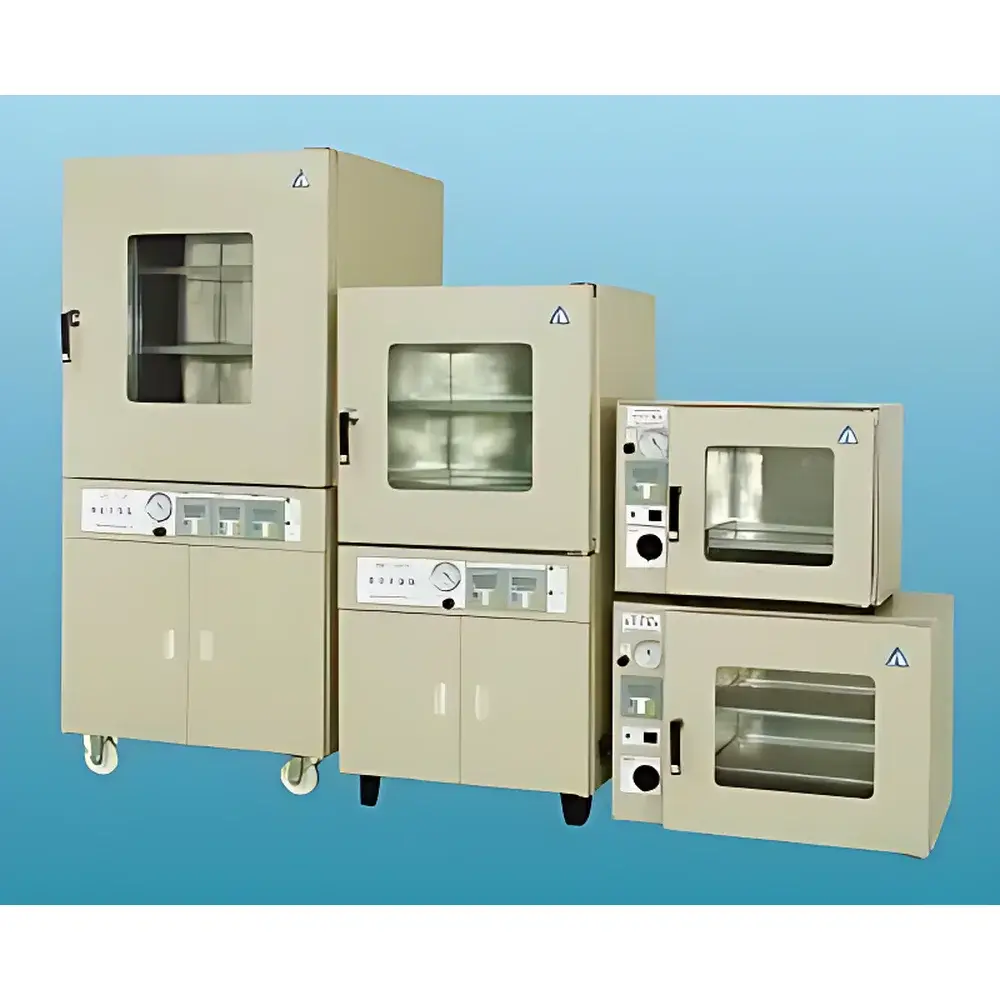
JingHong DZF-6050 Vacuum Drying Oven
| Brand | JingHong |
|---|---|
| Origin | Shanghai, China |
| Model | DZF-6050 |
| Instrument Type | Vacuum Oven |
| Temperature Range | Ambient +10°C to 250°C |
| Temperature Uniformity | ±3°C |
| External Dimensions | 710 × 520 × 535 mm |
| Internal Chamber Dimensions | 415 × 370 × 345 mm |
| Chamber Material | Stainless Steel (AISI 304) |
| Heating Method | Embedded Tubular Heating Elements |
| Door Type | Double-Layer Tempered Glass with Silicone Gasket Seal |
| Control System | Microprocessor-Based PID Controller with Dual Digital Display (Setpoint & Actual Temperature) |
| Vacuum Compatibility | Designed for operation under vacuum down to ≤10 Pa (with external vacuum pump) |
Overview
The JingHong DZF-6050 Vacuum Drying Oven is an engineered solution for controlled thermal processing under reduced-pressure environments. It operates on the principle that lowering ambient pressure reduces the boiling point of volatile components—enabling moisture and solvent removal from heat-sensitive, hygroscopic, or oxidation-prone samples at significantly lower temperatures than atmospheric drying. This minimizes thermal degradation, prevents surface hardening, and improves drying homogeneity—critical for pharmaceutical intermediates, polymer precursors, biological specimens, and precision electronic components. The unit features a rigid, double-walled steel enclosure with high-efficiency insulation, a vacuum-tight stainless steel chamber (AISI 304), and a robust sealing system compatible with standard mechanical vacuum pumps (e.g., rotary vane or diaphragm types). Its design complies with general laboratory safety standards for Class II electrical equipment (IEC 61010-1) and supports integration into GLP-compliant workflows when paired with validated vacuum gauges and calibrated temperature sensors.
Key Features
- Optimized chamber geometry: Rectangular internal volume (415 × 370 × 345 mm) maximizes usable space while maintaining uniform thermal distribution and efficient vacuum evacuation.
- Dual-layer tempered glass door: Provides real-time visual monitoring without compromising vacuum integrity; outer layer resists thermal stress and impact per EN 12150-1.
- Integrated silicone gasket seal: Molded-in-place fluorosilicone elastomer ensures repeatable sealing performance across repeated vacuum cycles and temperature excursions up to 250°C.
- Stainless steel working chamber: AISI 304 construction resists corrosion from organic solvents, acidic vapors, and residual moisture—supporting long-term reliability in QC and R&D labs.
- PID temperature controller: Microprocessor-based system with auto-tuning capability delivers stable setpoint regulation (±3°C tolerance) and dual digital display for simultaneous monitoring of target and actual chamber temperature.
- Embedded tubular heating elements: Distributed along chamber walls and floor to minimize thermal gradients and eliminate hot-spot formation during extended drying cycles.
Sample Compatibility & Compliance
The DZF-6050 accommodates a broad range of sample formats—including Petri dishes, weighing boats, glass desiccators, and custom trays—within its 53 L internal volume. It is routinely employed for drying lyophilized powders, ceramic green bodies, catalyst supports, thin-film substrates, and moisture-content reference standards. While not certified to ISO 17025 or ASTM E145 as a standalone metrological instrument, its thermal stability and repeatability meet the functional requirements outlined in USP for container closure integrity testing support, ASTM D2298 for adhesive drying protocols, and ISO 293 for thermoplastic compound conditioning. Vacuum performance depends on external pump selection; when operated with a two-stage rotary vane pump (≤1 Pa ultimate vacuum), the system achieves stable sub-10 Pa operating pressure within 15 minutes under standard load conditions.
Software & Data Management
The DZF-6050 operates via front-panel interface only—no embedded data logging or PC connectivity is provided. However, its analog voltage output (0–5 V DC proportional to chamber temperature) enables connection to external chart recorders, PLCs, or validated data acquisition systems compliant with FDA 21 CFR Part 11 requirements. Users implementing electronic recordkeeping must validate the full measurement chain—including sensor calibration traceability to NIST standards, signal conditioning accuracy, and audit trail generation—prior to use in regulated environments. Optional third-party USB or RS-485 adapters (sold separately) may be integrated with LabVIEW™ or Python-based monitoring scripts for time-stamped temperature logging.
Applications
- Pharmaceutical: Residual solvent removal from active pharmaceutical ingredients (APIs) prior to milling or blending; stabilization of amorphous solid dispersions.
- Materials Science: Debinding of metal injection molded (MIM) parts; outgassing of dielectric films and optical coatings.
- Academic Research: Preparation of anhydrous reagents; thermal aging studies of polymer nanocomposites under inert vacuum.
- Quality Control: Moisture content determination per AOAC 950.46 (vacuum oven method); stability testing of hygroscopic excipients.
- Electronics: Degassing of encapsulants and conformal coatings to prevent void formation during curing.
FAQ
What vacuum level can the DZF-6050 achieve?
The unit itself does not generate vacuum; it is designed for use with an external vacuum pump. With a typical two-stage rotary vane pump, users achieve ≤10 Pa (0.1 mbar) under no-load conditions. Actual performance depends on pump capacity, tubing length/diameter, and chamber loading.
Is the temperature controller programmable for multi-step profiles?
No—the DZF-6050 features a single-setpoint PID controller without ramp/soak programming capability. For time-temperature profiling, external programmable controllers or data loggers must be used.
Can the chamber be purged with inert gas?
Yes—optional inlet/outlet ports (not standard) can be added to enable nitrogen or argon purging before vacuum initiation, supporting oxygen-sensitive applications.
What maintenance is required for long-term vacuum integrity?
Annual inspection of the silicone door gasket for compression set or cracking is recommended. Chamber interior should be cleaned with non-chlorinated solvents after exposure to corrosive volatiles; heating element terminals require periodic torque verification per manufacturer specifications.
Does this model comply with CE or UL safety directives?
The DZF-6050 meets basic IEC 61010-1 safety requirements for laboratory equipment but is not CE-marked or UL-listed. Customers requiring formal regulatory certification should consult JingHong’s export compliance documentation or pursue third-party evaluation.



