
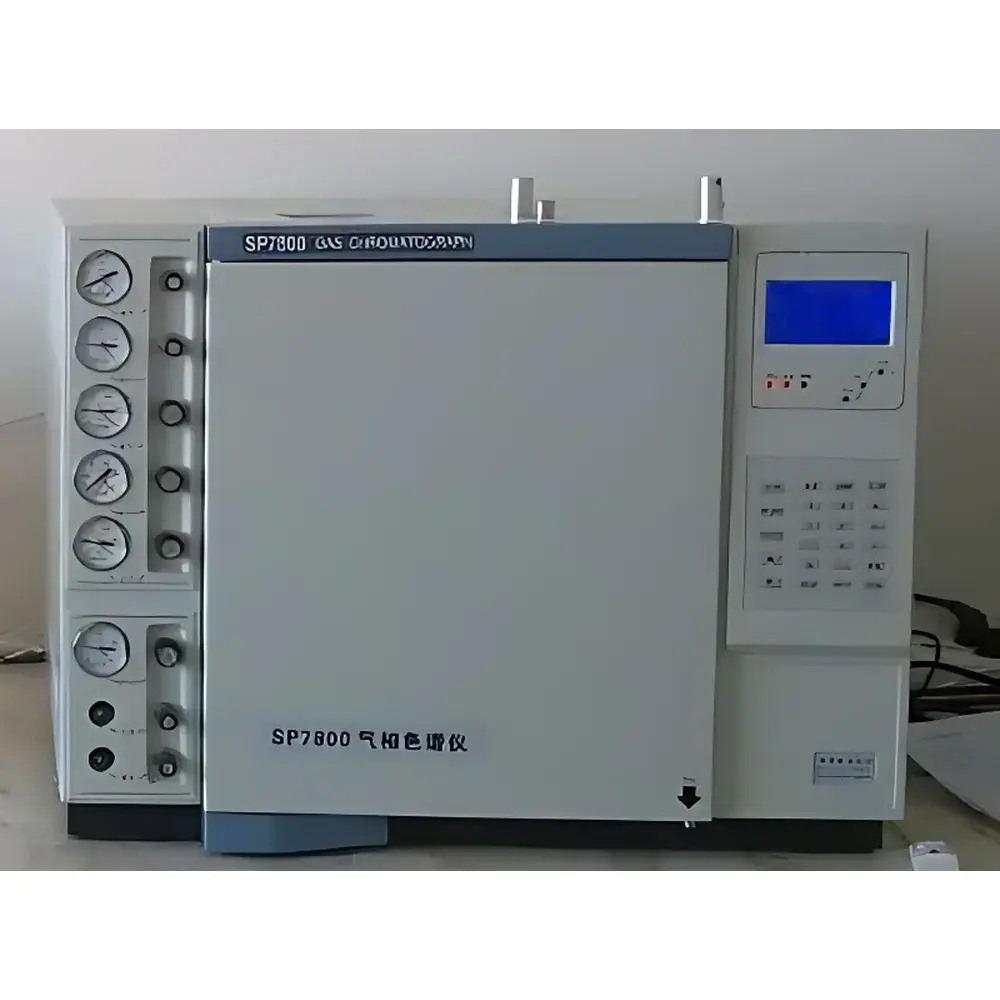
Jingke Ruida SP7800 Dedicated Gas Chromatograph for Benzene, Toluene, and Xylenes (BTX) Analysis in Gasoline
| Origin | Beijing, China |
|---|---|
| Manufacturer Type | Authorized Distributor |
| Origin Category | Domestic (PRC) |
| Model | SP7800 BTX & Oxygenates GC System |
| Pricing | Available Upon Request |
Overview
The Jingke Ruida SP7800 Dedicated Gas Chromatograph is a purpose-built analytical system engineered for the precise quantification of benzene, toluene, xylenes (BTX), and oxygenated compounds—including ethanol, methanol, tert-butyl alcohol (TBA), methyl tert-butyl ether (MTBE), ethyl tert-butyl ether (ETBE), and tert-amyl methyl ether (TAME)—in gasoline matrices. It operates on the fundamental principle of capillary gas chromatography with flame ionization detection (GC-FID), optimized for high-resolution separation of volatile aromatic and oxygenated hydrocarbons under regulated temperature-programmed conditions. Designed specifically for compliance-driven fuel testing laboratories, the SP7800 meets the rigorous physical and operational requirements of national standards governing automotive fuels in China, including GB 17930–2006 (Automotive Gasoline), GB 18351–2004 (Ethanol Gasoline E10), SH/T 0663 (Determination of Certain Alcohols and Ethers in Gasoline), and SH/T 0693 (Determination of Aromatics in Gasoline). Its architecture integrates dual-column, dual-channel pneumatic control with flexible detector configuration—supporting simultaneous or sequential analysis of BTX and oxygenates without hardware reconfiguration.
Key Features
- Microprocessor-controlled temperature management with five-stage programmable ramping (0.1–40 °C/min), enabling precise elution profiling of co-eluting BTX isomers and low-boiling oxygenates.
- Column oven operating range: ambient +3 °C to 400 °C; temperature stability: ±0.1 °C; axial temperature uniformity: ≤1% across active zone at 50–400 °C.
- Dual independent gas pathways accommodate parallel column configurations—e.g., one PLOT Al2O3/KCl column for oxygenates and one DB-1 or equivalent non-polar capillary column for BTX—minimizing cross-contamination and method transfer time.
- FID detection limit: ≤1 × 10⁻¹¹ g/s (benzene); baseline noise: ≤0.025 mV; drift: ≤0.15 mV/h—ensuring robust quantitation down to regulatory thresholds (e.g., benzene ≤1.0 vol% per GB 17930).
- Integrated inlet systems support multiple sampling modes: split/splitless capillary injection with septum purge, packed-column headspace injection, and optional gas sampling valve—compatible with both liquid and vapor-phase gasoline samples.
- Real-time thermal monitoring with active overtemperature protection: column oven maintains ≥20 °C below detector setpoint during ramping; dual hardware self-locking circuitry prevents uncontrolled heating during unattended operation.
- Carrier gas failure and low-pressure cutoff safeguards prevent column damage and ensure data integrity during extended runs.
Sample Compatibility & Compliance
The SP7800 is validated for direct injection of neat gasoline, denatured ethanol blends (E5–E10), and reformulated gasoline containing up to 15% oxygenates by volume. Sample introduction requires no derivatization or pre-concentration. All hardware components—including stainless-steel tubing, deactivated liners, and high-temperature FID jet assemblies—are selected to minimize catalytic degradation of reactive ethers and aromatics. The system complies with GLP-aligned data handling protocols and supports audit-ready reporting per ISO/IEC 17025 requirements. While not certified to FDA 21 CFR Part 11 out-of-the-box, its software architecture permits integration with validated electronic lab notebook (ELN) platforms supporting electronic signatures and full audit trails.
Software & Data Management
The bundled chromatography data system (CDS) provides automated calculation of volume %, mass %, and density-corrected concentration values per GB and SH/T standard reporting formats. Calibration curves are generated using multi-point external standardization or internal standard methods (e.g., fluorobenzene or n-butanol). Peak integration employs adaptive baseline algorithms resistant to solvent front distortion common in complex hydrocarbon matrices. Raw data files (.raw or .cdf) are stored with full metadata—including instrument parameters, sequence logs, and user annotations—enabling retrospective reprocessing. Export options include CSV, PDF, and XML for LIMS interoperability.
Applications
- Regulatory testing of commercial gasoline for benzene content (≤1.0 vol%) and total aromatics (≤35 vol%) per GB 17930–2006.
- Verification of ethanol content (9.0–10.5 vol%) and absence of unauthorized alcohols (e.g., methanol) in E10 fuel per GB 18351–2004.
- Quantitative screening of ether-type oxygenates (MTBE, ETBE, TAME) in reformulated gasoline to assess volatility and phase stability.
- QC/QA monitoring in refinery blending units, fuel distribution terminals, and third-party certification labs.
- Research applications involving fuel formulation optimization, oxidation stability studies, and emission correlation modeling.
FAQ
Does the SP7800 meet ASTM D3606 or D5599 for benzene and oxygenates analysis?
While primarily configured for Chinese national standards, the SP7800’s column selection, temperature programming, and FID sensitivity align with the retention and detection requirements of ASTM D3606 (benzene/toluene) and ASTM D5599 (oxygenates). Method adaptation requires minor validation per laboratory SOP.
Can the system analyze both BTX and oxygenates in a single run?
Yes—using dual-column/dual-detector configuration or sequential heart-cutting via backflush valves (optional accessory), enabling full speciation within one 25-minute run.
Is remote monitoring or network connectivity supported?
The instrument includes RS-232 and Ethernet ports; CDS software supports LAN-based client-server deployment for centralized instrument management across multi-lab environments.
What maintenance intervals are recommended for routine operation?
FID nozzle cleaning every 200 injections; column trimming every 500 runs; carrier gas filter replacement quarterly; annual calibration verification against NIST-traceable standards.
Are application notes or method packages available for SH/T 0693 and SH/T 0663?
Yes—Jingke Ruida provides validated method templates, chromatograms, and uncertainty budgets compliant with SH/T 0693 (aromatics) and SH/T 0663 (oxygenates), including linearity ranges, LOD/LOQ, and repeatability data.





