
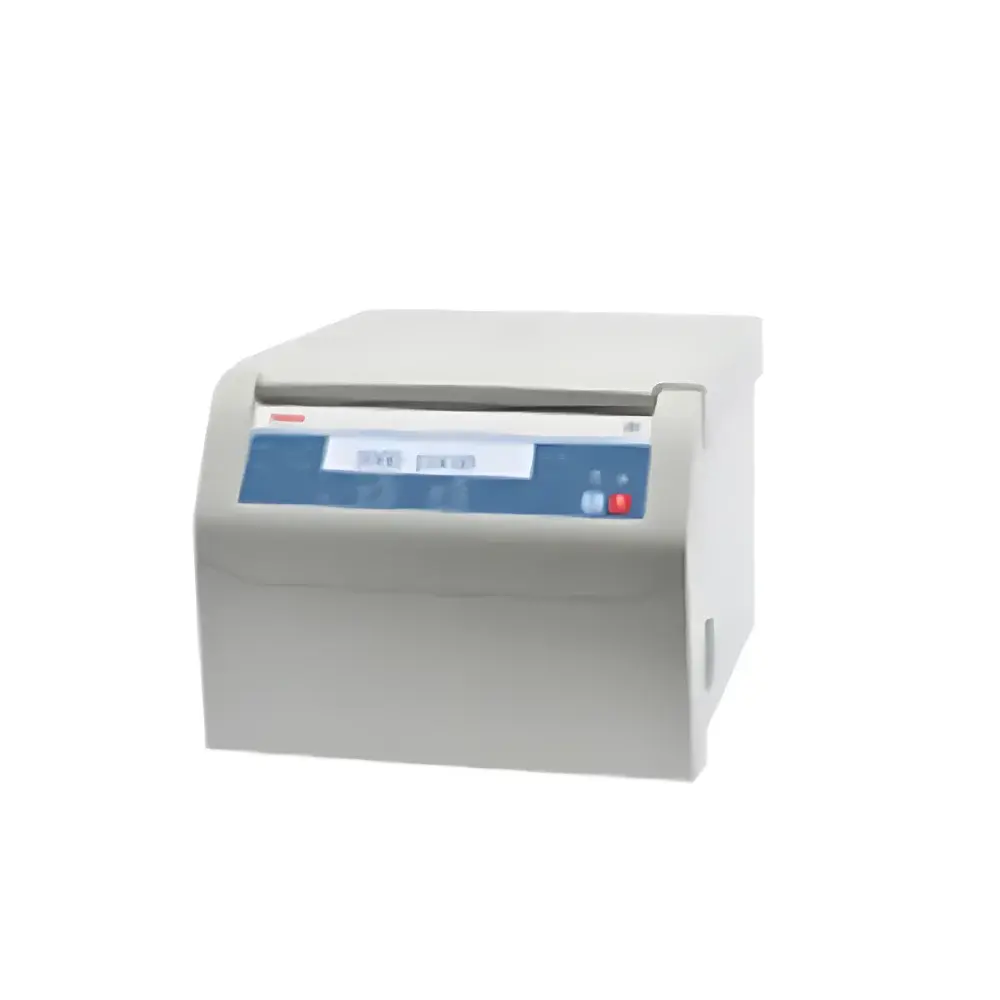
Thermo Fisher ST16 High-Speed Benchtop Centrifuge
| Brand | Thermo Fisher |
|---|---|
| Origin | Shanghai, China |
| Model | ST16 High-Speed Benchtop Centrifuge |
| Maximum Speed | 15,200 rpm |
| Maximum RCF | 25,830 × g |
| Maximum Capacity | 4 × 400 mL |
| Control System | Microprocessor-based with backlit large LCD display and LED status indicators |
| Time Range | 0–9 h 59 min (with short-spin and continuous modes) |
| Acceleration/Deceleration Profiles | 9 acceleration / 10 deceleration settings |
| Power Supply | 230 V, 50/60 Hz |
| Dimensions (W × D × H) | 580 × 630 × 370 mm |
| Weight | 72 kg |
Overview
The Thermo Fisher ST16 High-Speed Benchtop Centrifuge is a robust, microprocessor-controlled laboratory centrifuge engineered for high-throughput sample separation in clinical, pharmaceutical, and life science research environments. Designed around the principles of rotor dynamics and gravitational force amplification, the ST16 delivers precise, reproducible centrifugal acceleration up to 25,830 × g—enabling efficient pelleting of subcellular organelles, nucleic acids, proteins, and microbial cells. Its compact benchtop footprint (580 × 630 × 370 mm) integrates industrial-grade mechanical stability with intuitive digital operation, making it suitable for routine QC workflows as well as method-development labs requiring consistent rotor performance across variable run conditions.
Key Features
- High-performance brushless induction motor delivering stable rotational speeds from 200 to 15,200 rpm with ±10 rpm speed accuracy at setpoint
- Four-place horizontal rotor configuration supporting up to 4 × 400 mL bottles or compatible swing-bucket adapters for tubes ranging from 0.2 mL PCR strips to 50 mL conical tubes
- Microprocessor-based control system with backlit 5.7-inch LCD display providing real-time visualization of speed, RCF, time remaining, rotor ID, and temperature (when equipped with refrigerated variant)
- Dual-mode timing architecture: programmable duration from 0 seconds to 9 hours 59 minutes, plus dedicated short-spin (hold) and continuous-run modes for rapid sedimentation checks or buffer exchange protocols
- Configurable acceleration and deceleration profiles—9 acceleration and 10 deceleration ramps—to minimize sample disturbance during start-up and braking, critical for fragile pellets or density-gradient preparations
- Integrated safety architecture including automatic rotor recognition, imbalance detection (>5 g mass differential), lid interlock with dual-mechanical locking, and over-speed protection compliant with IEC 61010-2-020
Sample Compatibility & Compliance
The ST16 accommodates a broad range of primary containment formats through interchangeable rotors and bucket assemblies certified to ISO 13485 and tested per ASTM F2119 for mechanical integrity under maximum load conditions. Compatible consumables include polypropylene and polycarbonate centrifuge bottles (e.g., Nalgene™ 400 mL wide-mouth bottles), sealed conical tubes, and sealed microcentrifuge tube carriers. The instrument meets essential regulatory requirements for GLP-compliant laboratories, including audit-trail-capable event logging (when paired with optional Thermo Fisher CentriLog™ software), adherence to ISO 22870 for point-of-care testing infrastructure, and alignment with FDA 21 CFR Part 11 data integrity expectations when used with validated electronic record systems.
Software & Data Management
While the ST16 operates autonomously via its embedded controller, it supports bidirectional RS-232 and USB connectivity for integration into centralized lab management platforms. Optional CentriLog™ software enables remote parameter configuration, protocol library storage (up to 99 user-defined methods), and export of timestamped run logs—including actual vs. setpoint speed/RCF, total runtime, rotor serial number, and fault codes—in CSV or PDF format. All data exports are structured to support traceability requirements under ISO/IEC 17025 accreditation and internal SOP documentation frameworks.
Applications
- Cell culture harvest and clarification in bioprocessing scale-down studies
- Purification of plasmid DNA and viral vectors using iodixanol or sucrose density gradients
- Preparative isolation of exosomes and extracellular vesicles from serum or conditioned media
- Routine clinical centrifugation of whole blood, urine sediments, and CSF specimens per CLSI GP45-A4 guidelines
- Environmental microbiology workflows involving soil extract concentration and waterborne pathogen recovery
- Quality control testing of nanoparticle suspensions and colloidal dispersions where sedimentation velocity correlates with particle size distribution
FAQ
Is the ST16 compatible with refrigerated operation?
No—the base ST16 model is non-refrigerated. A separate ST16R variant with compressor-based cooling (–20 °C to +40 °C) is available for temperature-sensitive applications.
What rotor certifications are provided with the ST16?
Each rotor carries a CE-marked conformity declaration and is individually serialized and fatigue-tested per ISO 15530-3; certificates of conformance and calibration reports are supplied with initial delivery.
Can the ST16 be integrated into a LIMS environment?
Yes—via ASCII protocol over RS-232 or USB CDC, enabling automated method push, run initiation, and status polling within validated LIMS architectures.
Does the ST16 support GMP documentation requirements?
When operated with CentriLog™ and configured with electronic signature-enabled user accounts, the system supports ALCOA+ data integrity principles required for GMP-regulated environments.
What maintenance intervals are recommended?
Routine visual inspection and cleaning every 3 months; full preventive maintenance—including bearing assessment, drive belt tension check, and brake pad evaluation—every 12 months or after 1,000 runs, whichever occurs first.



