
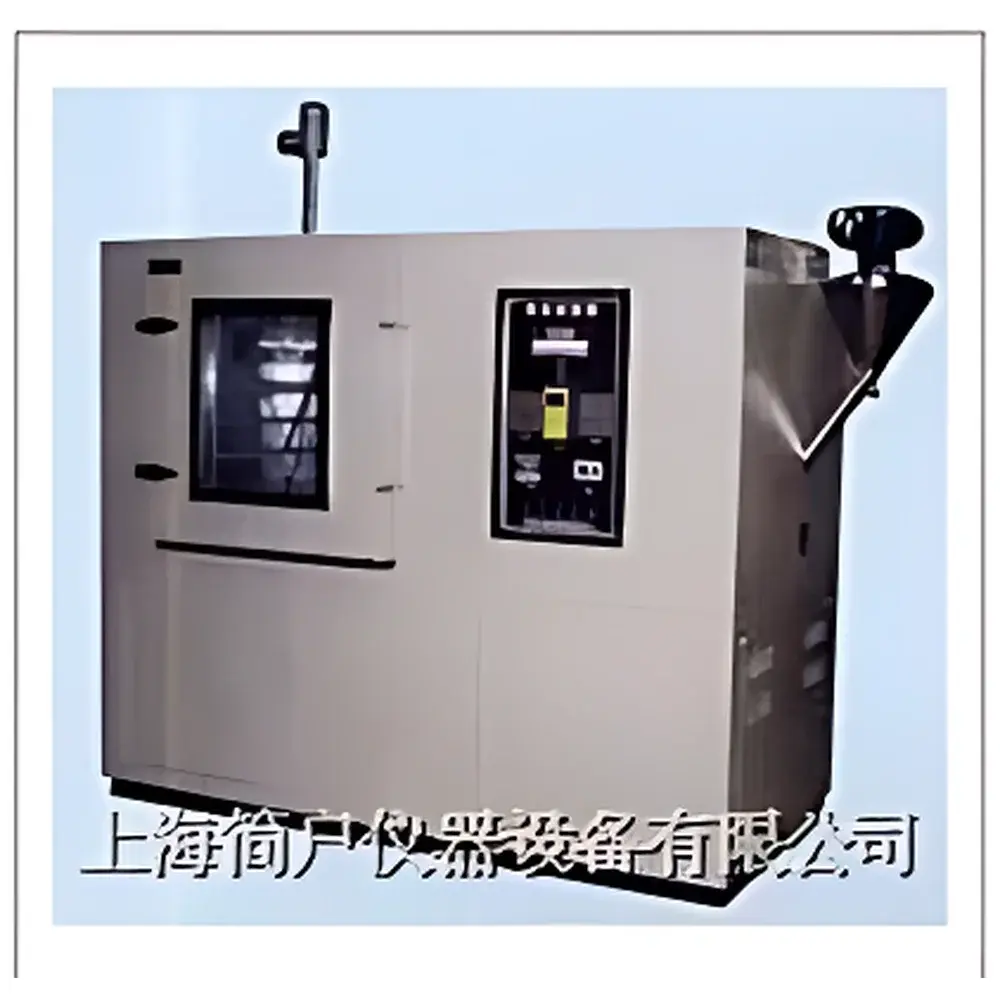
Jinhoo JHF-800 Sand and Dust Test Chamber
| Brand | Jinhoo |
|---|---|
| Model | JHF-800 |
| Chamber Internal Dimensions (W×D×H) | 800 × 1000 × 1000 mm |
| External Dimensions (W×D×H) | 1030 × 1120 × 1860 mm |
| Power Consumption | 1.0 kW |
| Filtration Mesh | Wire Diameter 50 µm, Pitch 75 µm |
| Dust Concentration Range | 2–4 kg/m³ |
| Timer Range | 0–99 h 59 min (for vibration & fan control) |
| Vacuum System | Equipped with pressure gauge, air filter, and pressure regulator (vacuum pump not included) |
| Heating System | Stainless-steel mica-sheathed heating elements |
| Fan Type | Enclosed alloy low-noise centrifugal blower |
| Safety Protections | Leakage protection, short-circuit protection, overtemperature protection, motor overheat protection, overcurrent protection |
| Compliance | GB/T 4208 (IP5X/IP6X), GB/T 2423.37–2006, GB/T 4706.1, GB/T 10485–2007, DIN 40050-9 |
| Sample Compatibility | Enclosures up to IP6X-rated electrical/electronic equipment, automotive lighting assemblies, connectors, consumer appliance housings, and industrial control cabinets |
| Software & Control | Imported programmable logic controller (Moeller/Knorr, Germany), integrated microcomputer-based timing and sequence control |
Overview
The Jinhoo JHF-800 Sand and Dust Test Chamber is an engineered environmental simulation system designed to evaluate the ingress protection (IP) performance of enclosures against non-abrasive dust and fine particulate matter in accordance with internationally recognized test standards. It operates on the principle of controlled turbulent suspension—using a precisely regulated centrifugal blower to fluidize standardized talcum-based test dust within a sealed chamber, while optional vacuum-assisted cycling enables dynamic pressure differential testing for IP5X and IP6X verification. Unlike wind-driven sand erosion testers (e.g., MIL-STD-810G Method 510.6 or GJB 150.12A), this chamber implements static or low-velocity dust exposure under gravity-settling and forced-air circulation conditions—making it suitable for evaluating sealing integrity, gasket resilience, and vent membrane functionality rather than mechanical abrasion resistance.
Key Features
- Stainless-steel internal chamber with seamless welded construction and electrostatically applied anti-static epoxy coating to minimize dust adhesion and simplify cleaning.
- Imported Moeller (Germany) programmable logic controller (PLC) providing precise, repeatable control over dust agitation duration, fan operation cycles, and timer sequencing—fully compliant with IEC 61000-4-29 immunity requirements for control electronics.
- Dual-mode operation: Standard dust suspension mode (GB/T 2423.37–2006 Clause 2) and optional vacuum-assisted differential pressure mode (per GB/T 4208 Annex B for IP6X verification).
- Integrated safety architecture including Class II insulation monitoring, thermal cut-off at 120°C, dual-pole contactors (Schneider Electric), and real-time current sensing for motor overload protection.
- Low-noise, enclosed alloy centrifugal blower (Panasonic OEM) delivering stable airflow ≥1.2 m/s at chamber center, calibrated per ISO 5801 for volumetric consistency across operational life.
- Modular filtration system featuring replaceable 50 µm wire mesh (75 µm pitch) conforming to ASTM D1898 specifications for standard test dust retention efficiency.
Sample Compatibility & Compliance
The JHF-800 accommodates samples up to 800 × 1000 × 1000 mm (W×D×H), supporting full-system validation of household appliances (IEC 60335-1), low-voltage switchgear (IEC 61439), automotive lighting modules (SAE J575), and industrial control panels. It satisfies mandatory test clauses for IP5X (limited dust ingress, no harmful deposit) and IP6X (dust-tight) per GB/T 4208–2017 (equivalent to IEC 60529:2013), GB/T 2423.37–2006 (identical to IEC 60068-2-68), and DIN 40050-9. The chamber does not replicate high-velocity airborne sand environments (e.g., GJB 150.12A or MIL-STD-810H Method 510.7); therefore, it is not intended for military-grade erosion or abrasive wear assessment.
Software & Data Management
The embedded Moeller PLC supports event-logged operation with timestamped start/stop records, fault code history (e.g., E01 = overtemperature, E03 = motor stall), and user-defined test profiles stored in non-volatile memory. While the base configuration lacks Ethernet connectivity or PC interface, optional RS-485 Modbus RTU output enables integration into centralized laboratory management systems (LMS) for GLP-compliant audit trails. All operational parameters—including elapsed time, fan status, heater duty cycle, and vacuum pressure readings—are retained for minimum 30 days without external power. Calibration certificates for pressure gauges and timers are traceable to CNAS-accredited laboratories per ISO/IEC 17025.
Applications
- Verification of IP rating compliance for consumer electronics enclosures prior to CE or CCC certification.
- Quality assurance testing of automotive HVAC actuators, sensor housings, and battery junction boxes exposed to desert or off-road environments.
- Validation of sealing performance in medical device enclosures subject to ISO 14971 risk management requirements.
- Pre-shipment screening of industrial IoT gateways deployed in dusty manufacturing facilities (e.g., cement plants, grain silos).
- Research-level studies on dust filtration efficacy of breathable membranes used in wearable electronics.
FAQ
Does the JHF-800 include a vacuum pump?
No—the vacuum system includes a pressure gauge, air filter, and pressure regulator; a compatible two-stage rotary vane vacuum pump (≥1.5 L/s, ultimate vacuum ≤10 Pa) must be specified separately at time of order.
What type of test dust is recommended?
Talcum powder meeting GB/T 2423.37–2006 specifications (particle size distribution D50 ≈ 30–50 µm, SiO₂ content <0.1%) is required; alternative dusts (e.g., Arizona Road Dust) require prior validation per ISO 16232.
Can the chamber be used for IP6K water-dust combined testing?
No—this model performs dry dust ingress only. Combined IP6K tests require synchronized spray nozzles and climate-controlled humidity staging, available only in hybrid environmental chambers (e.g., JHF-SDW series).
Is the controller FDA 21 CFR Part 11 compliant?
The base PLC does not support electronic signatures or audit-trail encryption; however, third-party LMS integration via Modbus enables Part 11-compliant data archiving when paired with validated software platforms.
What maintenance intervals are recommended?
Mesh filters require replacement every 50 test hours; blower bearings should be inspected annually; calibration of pressure sensors and timers is recommended every 12 months per ISO/IEC 17025 guidelines.



