
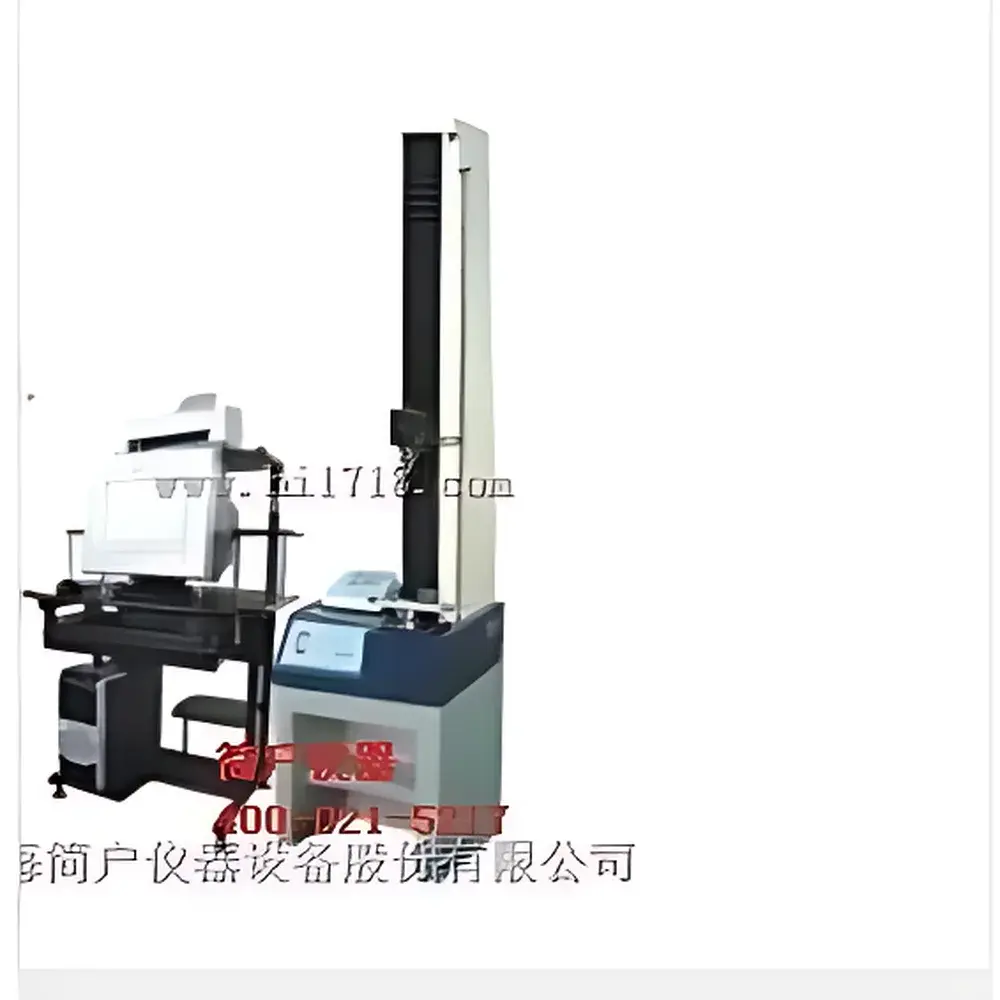
Jinhoo JHR-500P Advanced Electromechanical Universal Testing Machine
| Brand | Jinhoo |
|---|---|
| Model | JHR-500P |
| Type | Electromechanical Tensile & Compression Testing System |
| Load Capacity | 5 kN |
| Force Sensor Standard | 20 N (2 kgf), expandable with optional multi-range load cells |
| Accuracy Class | 0.2 |
| Force Measurement Range | 0.4–100% FS |
| Force Resolution | ±1/300,000 of full scale, unsegmented across entire range |
| Deformation Measurement Range | 0.2–100% FS |
| Deformation Accuracy | ±0.2% of reading |
| Deformation Resolution | ±1/300,000 of maximum deformation |
| Displacement Accuracy | ±0.2% of reading |
| Displacement Resolution | 0.02 µm |
| Crosshead Speed Range | 0.001–200 mm/min |
| Speed Control Accuracy | ±0.2% of set value |
| Strain Rate Range | 0.001–2% FS/min |
| Strain Rate Control Accuracy | ±0.2% of set value |
| Effective Test Width | 370 mm or 210 mm (configurable) |
| Maximum Tensile Travel | 700 mm or 1200 mm (configurable) |
| Maximum Compression Stroke | 700 mm |
| Frame Type | Dual-column portal structure |
| Power Supply | 220 V, 50 Hz |
| Rated Power | 0.4 kW |
| Net Weight | 160 kg |
| Dimensions (W×D×H) | 800 × 410 × 1600 mm |
| Compliance | ASTM E4, ASTM E8/E21, ISO 6892-1, ISO 7500-1, GB/T 228.1, JIS Z2241, DIN 50125 |
| Software Platform | Windows 2000/XP/7 compatible, bilingual (English/Chinese), GLP-compliant data handling |
Overview
The Jinhoo JHR-500P is a high-precision electromechanical universal testing machine engineered for static mechanical property evaluation of metallic, polymeric, composite, ceramic, and elastomeric materials under tension, compression, bending, and shear loading conditions. Based on closed-loop servo-controlled displacement actuation and high-fidelity load cell feedback, the system adheres to fundamental principles of Hookean elasticity and plastic flow characterization in accordance with ISO 7500-1 (static calibration) and ISO 6892-1 (tensile testing of metallic materials). Its dual-column portal architecture ensures torsional rigidity and axial alignment stability—critical for minimizing parasitic bending moments during high-resolution force-displacement acquisition. Designed for laboratory-based quality control, R&D validation, and regulatory submission support, the JHR-500P delivers traceable, repeatable, and auditable mechanical test data aligned with international metrological standards.
Key Features
- Modular load measurement: Factory-installed 20 N (2 kgf) transducer compliant with Class 0.2 accuracy per ISO 7500-1; supports hot-swappable auxiliary load cells (e.g., 100 N, 500 N, 5 kN) without recalibration downtime.
- Unsegmented force resolution: ±1/300,000 of full scale across the entire dynamic range—enabling sub-milligram force detection at low loads while preserving linearity at maximum capacity.
- Sub-micron displacement fidelity: 0.02 µm position resolution coupled with real-time crosshead speed control (0.001–200 mm/min) and strain rate regulation (0.001–2% FS/min), both maintained within ±0.2% of setpoint.
- Triple-layer safety architecture: Hardware-based over-travel limit switches, software-defined soft limits, and programmable emergency stop triggers ensure compliance with ISO 12100 and EN 60204-1 machinery safety directives.
- Thermally stable frame design: Precision-machined aluminum alloy columns and reinforced steel base minimize thermal drift and vibration coupling—essential for long-duration creep and relaxation tests.
- Energy-efficient operation: 0.4 kW brushless servo motor drive with regenerative braking reduces operational heat load and extends component service life.
Sample Compatibility & Compliance
The JHR-500P accommodates specimens ranging from thin films (<0.1 mm thickness) to structural coupons (up to 370 mm wide × 1200 mm gage length), supporting standardized grips (pneumatic, wedge, vise), environmental chambers (−70°C to +300°C), and extensometers (contact and non-contact). It fully satisfies mechanical test method requirements specified in ASTM E8/E21 (metals), ASTM D638/D790 (plastics), ISO 527/178 (polymer tensile/flexural), GB/T 228.1 (China national standard), and JIS Z2241 (Japanese industrial standard). All force, displacement, and time-stamped data are recorded with audit-trail metadata—including operator ID, calibration certificate number, environmental conditions, and test sequence parameters—to meet GLP and FDA 21 CFR Part 11 electronic record integrity requirements.
Software & Data Management
The embedded Windows-native software provides full IEC 62304-compliant test automation, including pre-configured method templates for ISO 6892-1 Annex A (engineering stress-strain), Annex B (true stress-strain), and ASTM E238 (pin-type proof testing). Real-time plotting displays up to six synchronized curves: load vs. displacement, load vs. time, displacement vs. time, engineering stress vs. strain, true stress vs. strain, and load vs. extension. Curve overlay functionality enables comparative analysis across batch lots or material grades. All raw data (including intermediate calculation variables such as modulus, yield offset, ultimate tensile strength, elongation at break, and reduction in area) are stored in encrypted .tdms binary format with SHA-256 checksums. Report generation supports customizable PDF/Excel exports with digital signatures, revision history, and configurable header/footer fields per ISO/IEC 17025 documentation guidelines.
Applications
- Quality assurance of incoming raw materials (e.g., stainless steel strips, carbon fiber prepregs, medical-grade silicone tubing).
- Mechanical validation of additive-manufactured components per ASTM F3122 and ISO/ASTM 52936.
- Creep rupture and stress relaxation profiling for polymer seals and elastomeric dampers under sustained load.
- Adhesion strength quantification of coated substrates using ASTM D4541 pull-off testing protocols.
- Biomechanical testing of orthopedic implant fixation systems (e.g., screw-bone interface shear strength per ISO 14801).
- Educational laboratories requiring ISO/IEC 17025-aligned instrumentation for undergraduate and graduate mechanical testing curricula.
FAQ
Does the JHR-500P support third-party extensometers?
Yes—it features analog and digital input interfaces compatible with industry-standard video extensometers (e.g., Keyence LK-G series) and clip-on mechanical extensometers meeting ISO 9513 Class 0.5 or better.
Can test methods be locked to prevent unauthorized modification?
Yes—the software includes role-based access control (RBAC) with administrator, technician, and viewer profiles; method templates can be digitally signed and write-protected.
Is calibration traceability provided with the system?
Each unit ships with an ISO/IEC 17025-accredited calibration certificate issued by CNAS-recognized laboratories, covering force, displacement, and speed channels with uncertainty budgets per ISO/IEC 17025 Clause 6.5.
What environmental conditions are required for optimal performance?
Operational ambient: 10–35°C, ≤80% RH non-condensing; recommended installation on vibration-isolated optical tables or concrete foundations with <5 µm peak-to-peak floor motion at 10–100 Hz.
How is firmware updated and validated?
Firmware updates are delivered via secure HTTPS download with cryptographic hash verification; update logs—including version, timestamp, and operator signature—are permanently archived in the system event database.



