
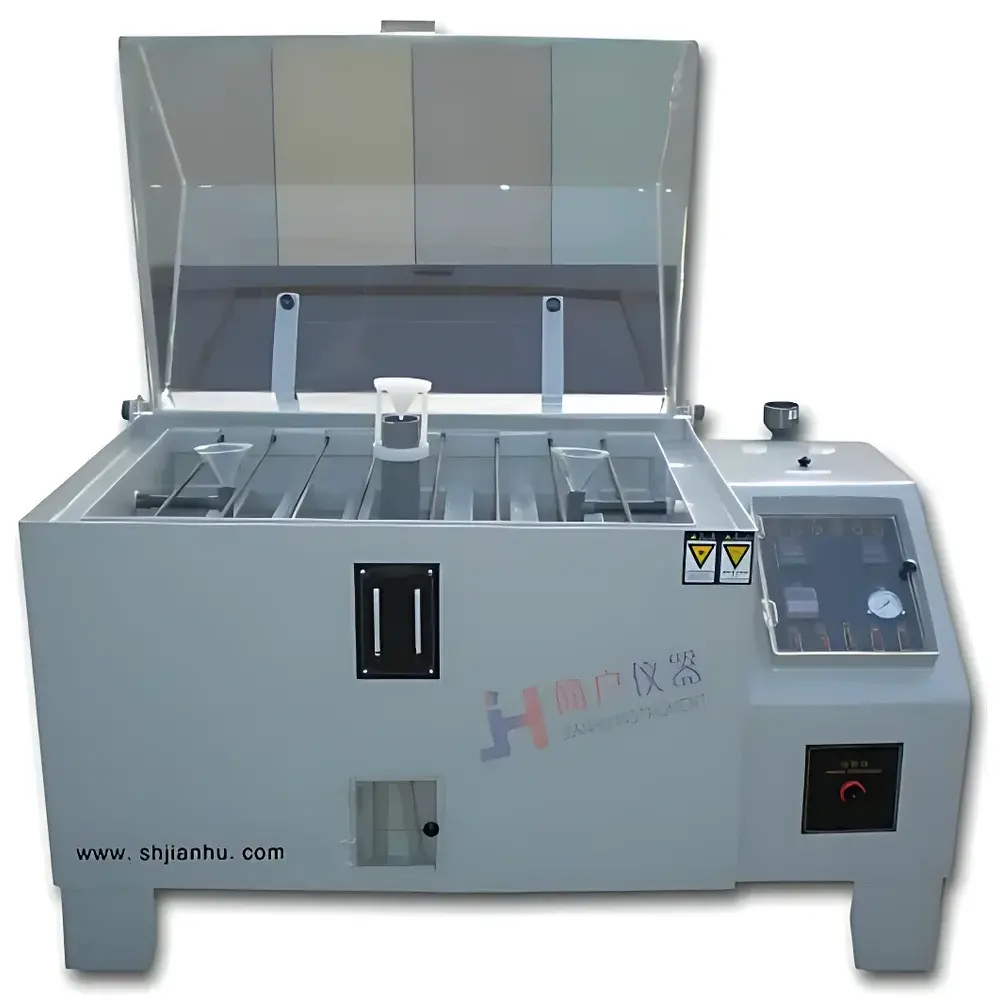
Jinhoo JST-090 Programmable Salt Spray Test Chamber
| Brand | Jinhoo |
|---|---|
| Origin | Shanghai, China |
| Model | JST-090 |
| Chamber Dimensions (W×D×H) | 90×60×50 cm |
| Interior Material | PVC & PP |
| Test Temperature Range | 35±1°C (NSS), 50±1°C (AASS/CASS) |
| Saturated Air Tank Temperature | 47±1°C (NSS), 63±1°C (AASS/CASS) |
| Saturation Pressure | 0.8–2.0±0.01 kg/cm² |
| Fog Output | 1.0–2.0 mL/80 cm²/h |
| pH Range | 6.5–7.2 (NSS), 3.0–3.2 (AASS/CASS) |
| Chamber Volume | 270 L |
| Water Reservoir Capacity | 25 L |
| Power Supply | AC 1φ 220 V, 50 Hz, 30 A |
| Compliance | ASTM B117, ISO 9227, GB/T 2423.17, GJB 150.11A, CNS 3627/3885/4519/7669/8886 |
Overview
The Jinhoo JST-090 Programmable Salt Spray Test Chamber is an engineered environmental test system designed to evaluate the corrosion resistance of metallic coatings, electroplated surfaces, and protective finishes under controlled saline aerosol exposure. It operates on the principle of continuous or cyclic salt fog generation—atomizing a standardized sodium chloride (NaCl) solution into fine droplets that settle uniformly onto test specimens in a thermally stabilized chamber. This method replicates aggressive coastal or industrial atmospheric conditions to accelerate corrosion mechanisms such as pitting, crevice corrosion, and galvanic degradation. The chamber supports three internationally recognized test modes: Neutral Salt Spray (NSS), Acetic Acid Salt Spray (AASS), and Copper-Accelerated Acetic Acid Salt Spray (CASS), each governed by strict temperature, humidity, pH, and deposition rate parameters defined in ASTM B117, ISO 9227, and GB/T 2423.17. Its programmable architecture enables multi-step test profiles—including dwell, spray, dry, and humid phases—making it suitable for both qualification testing per MIL-STD-810 and long-term reliability assessment in automotive, aerospace, electronics, and defense supply chains.
Key Features
- 7-inch full-color TFT LCD touchscreen interface with intuitive menu navigation and real-time parameter monitoring (temperature, saturation pressure, elapsed time, fault logs)
- Double-wall construction using seamless molded polypropylene (PP) and polyvinyl chloride (PVC) panels—chemically inert, UV-stabilized, and rated for continuous operation at 50°C without aging or warping
- Pyrex® precision glass nozzles with conical diffusers ensure uniform fog distribution (±5% deviation across test surface) and eliminate crystallization-induced clogging
- Dual over-temperature protection circuitry: primary PID-controlled heating element + independent mechanical high-limit switch (cut-off at 65°C)
- Direct steam injection heating system with titanium alloy heating tubes—corrosion-resistant, rapid thermal response (<15 min from ambient to 35°C), and minimal thermal gradient (<±0.3°C across chamber volume)
- Saturated air chamber fabricated from mirror-finished SUS304 stainless steel with integrated sight-level gauge, drain valve, and Henry’s Law-compliant humidification design
- Automated water replenishment system with float-level sensors and audible/visual low-water alarms—prevents test interruption during unattended operation
- Adjustable planar specimen rack with 360° rotational indexing—ensures consistent four-directional fog impingement and accommodates up to 48 standard 150×70 mm test coupons
- Post-test demisting function using low-noise axial fans and optimized airflow routing—enables immediate visual inspection without opening the chamber
Sample Compatibility & Compliance
The JST-090 accommodates flat, curved, and irregularly shaped samples up to 600 mm in height and 50 kg in total mass. Specimen holders are non-metallic (PP-coated ABS) to prevent galvanic coupling. All internal fixtures—including racks, nozzles, and saturator components—comply with ISO 9227 Annex A requirements for material compatibility. The system meets full traceability requirements for GLP and GMP environments: calibration certificates for temperature sensors (NIST-traceable Pt100 probes), pressure transducers, and pH meters are provided with delivery. Test reports generated by the embedded controller include timestamped metadata, operator ID, chamber setpoints, actual readings, and alarm history—supporting audit readiness per FDA 21 CFR Part 11 when paired with optional network logging software.
Software & Data Management
The embedded control firmware supports segmented test programming with up to 15 user-defined cycles, each configurable for duration (0.1 h to 9999 h), temperature setpoint, spray interval, and saturation pressure. All parameters are stored in non-volatile memory with battery-backed retention (>10 years). Optional Ethernet/Wi-Fi module enables remote monitoring via web browser or integration into LabVantage, Siemens Desigo, or custom MES platforms. Export formats include CSV (for Excel analysis) and PDF (with digital signature support). Firmware updates are performed via USB flash drive with SHA-256 integrity verification. Audit trails record every parameter change, user login/logout, and system reset event—with tamper-proof timestamps compliant with ISO/IEC 17025 Clause 7.7.
Applications
- Qualification of zinc-nickel, tin-zinc, and chromium-free passivation coatings per ASTM B633 and ISO 4520
- Validation of conformal coatings on PCBAs under IPC-J-STD-001 and IPC-A-610
- Corrosion screening of fasteners, hinges, and stamped metal components for Tier-1 automotive suppliers (VW 60300, GMW14872)
- Accelerated aging of marine-grade aluminum alloys (AA5052, AA6061) per MIL-A-8625 Type II/III
- Process capability studies for electroplating lines—measuring coating thickness loss via gravimetric analysis post-test
- Environmental stress screening (ESS) of military avionics enclosures per MIL-STD-810H Method 509.6
FAQ
What compressed air specifications are required for stable雾 generation?
A clean, oil-free, and dried air supply at 1–5 kg/cm² (14–72 psi) is mandatory. A refrigerated air dryer and 0.01 µm coalescing filter are recommended upstream of the chamber inlet to prevent nozzle fouling.
Can the JST-090 perform cyclic corrosion testing (CCT) per ISO 11997 or VDA 621-415?
Yes—when configured with optional humidity control and drying modules (sold separately), the base platform supports full CCT profiles including wet/dry/salt/freeze sequences.
Is calibration documentation included with shipment?
Yes—each unit ships with a factory calibration report covering chamber temperature uniformity (per ISO 16750-4 Annex D), fog deposition rate (per ASTM B117 Section 7), and saturated air temperature accuracy.
How often must the Pyrex nozzles be cleaned or replaced?
Under standard NSS operation (8 h/day), nozzles require ultrasonic cleaning every 200 hours; replacement is recommended after 2000 operational hours or if flow deviation exceeds ±10% during verification.
Does the system support remote diagnostics via Modbus RTU or TCP/IP?
Modbus RTU over RS-485 is natively supported for PLC integration; Modbus TCP/IP and OPC UA are available via optional communication gateway firmware upgrade.



