
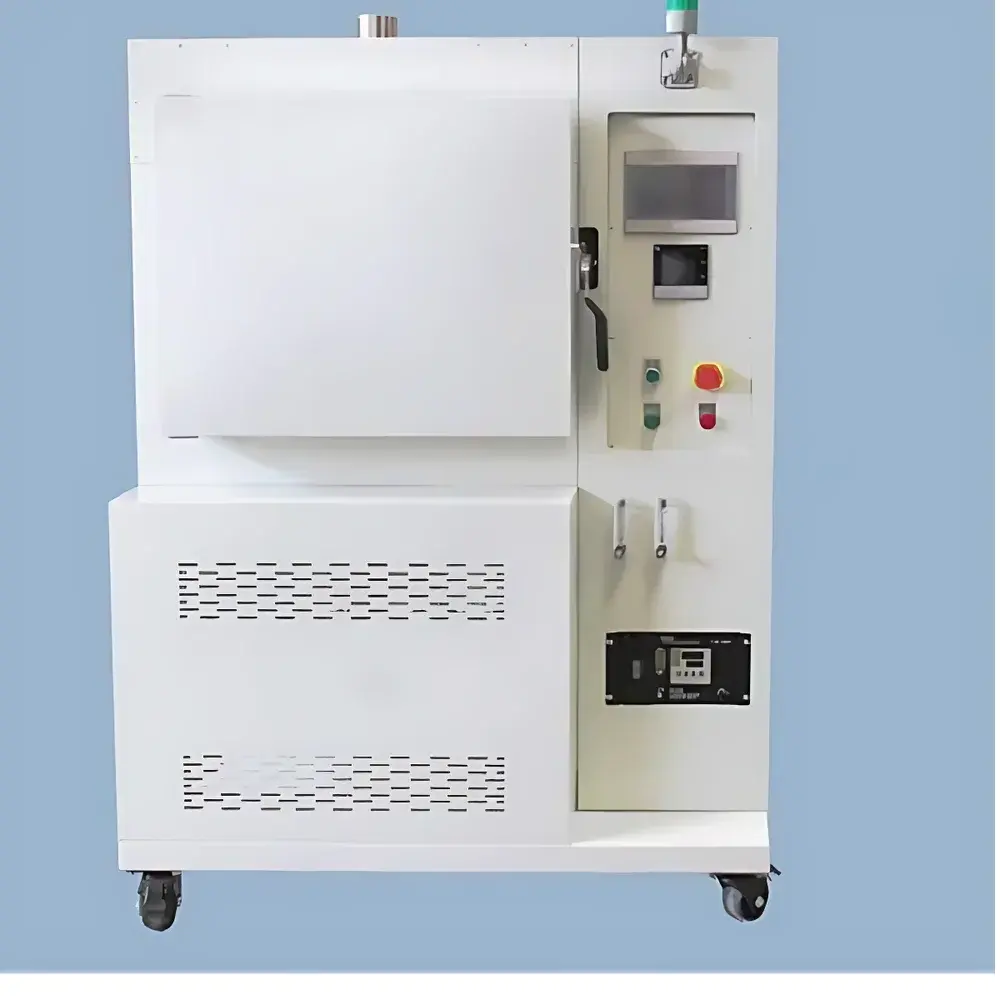
Jinhuhu JH-Series Polyimide (PI) High-Temperature Vacuum Curing Oven with Micro-Oxygen Control
| Brand | Jinhuhu |
|---|---|
| Origin | Shanghai, China |
| Manufacturer Type | OEM/ODM Manufacturer |
| Product Category | Domestic |
| Model | JH-Series Polyimide (PI) High-Temperature Vacuum Curing Oven |
| Temperature Range | 150 °C to 450 °C |
| Temperature Uniformity | ±1.0 °C (at 450 °C, 32-point measurement) |
| Temperature Stability | ±0.2 °C to ±0.5 °C |
| Temperature Deviation | ≤±2.0 °C |
| Heating Rate | Up to 20 °C/min |
| Cooling Rate | From 150 °C to −40 °C in ≤45 min |
| Oxygen Concentration Control | ≤5 ppm (real-time laser O₂ sensing + N₂ purge) |
| Vacuum Level | 5×10⁻⁴ Pa (turbomolecular + roots pump system) |
| Chamber Volume | Customizable (from 30 L to >5 m³) |
| Compliance | SEMI S2/S8, ISO 9001, AS9100D, GB/T 2423.2 |
Overview
The Jinhuhu JH-Series Polyimide (PI) High-Temperature Vacuum Curing Oven is an industrial-grade thermal processing system engineered for the precise, oxygen-free curing of polyimide films, adhesives, and photoresists used in semiconductor lithography, flexible electronics, and high-energy battery manufacturing. Unlike conventional air-circulation aging chambers, this oven integrates vacuum-assisted micro-oxygen control (≤5 ppm), multi-zone resistive heating using silicon carbide (SiC) elements, and adaptive PID temperature regulation—enabling stable operation at up to 450 °C with ±1.0 °C uniformity across the full working volume. Its design addresses critical failure modes in PI processing: oxidative degradation, thermal stress-induced delamination, and volatile outgassing-induced void formation. The system operates under controlled inert gas (high-purity N₂ ≥99.9995%) or hard vacuum environments, satisfying process requirements defined in SEMI F27 (for photolithographic materials), USP (for thermal stability testing), and IEC 60068-2-2 (for high-temperature endurance validation).
Key Features
- Dynamic micro-oxygen control: Real-time laser-based oxygen sensor (±0.1 ppm accuracy) triggers automatic high-purity nitrogen purging when ambient O₂ exceeds 5 ppm; validated CFD-simulated gas distribution ensures ≥98.7% spatial uniformity.
- Ultra-high-temperature capability: Silicon carbide heating elements rated for continuous operation at 450 °C with >5,000 hours service life; thermally isolated chamber walls minimize external heat leakage and improve energy efficiency (28 kWh per cycle vs. industry average of 42 kWh).
- Distributed thermal monitoring: 32-channel Type K thermocouple array embedded in chamber walls and payload zones enables real-time mapping and closed-loop correction of thermal gradients.
- Intelligent vacuum compensation: Dual-stage pumping system (roots + turbomolecular) maintains vacuum stability at 5×10⁻⁴ Pa; pressure deviation >5% triggers automated mass-flow-controlled inert gas injection to preserve process integrity during door cycling or material outgassing.
- Robust mechanical architecture: Stainless steel 316L inner chamber with graphite gasket sealing; double-walled insulation with ceramic fiber blanket (thermal conductivity <0.05 W/m·K at 400 °C); reinforced door mechanism with dual-seal compression system.
Sample Compatibility & Compliance
The JH-Series accommodates rigid and flexible substrates including silicon wafers (up to 300 mm), lithium-ion battery electrode stacks, OLED backplane assemblies, and thin-film photomasks. It supports standardized test protocols for polyimide film curing (ASTM D3418), thermal aging of encapsulants (IEC 61215-2 MQT 10), and outgassing characterization (ESA ECSS-Q-ST-70-02C). All firmware and data logging modules comply with FDA 21 CFR Part 11 requirements for electronic records and signatures, including audit trail generation, user role-based access control, and immutable data export (CSV, PDF, XML). Calibration certificates traceable to NIM (National Institute of Metrology, China) are provided with each shipment.
Software & Data Management
The integrated JH-ControlSuite™ v4.2 software provides ISO/IEC 17025-compliant process scripting, multi-step ramp-soak profiles, and real-time visualization of temperature, pressure, and O₂ concentration. Data is stored locally on encrypted SSD with optional cloud synchronization (AWS IoT Core compatible). Each run generates a digitally signed Process Record containing timestamped sensor logs, operator ID, environmental metadata, and pass/fail flags against predefined acceptance criteria. Historical datasets support statistical process control (SPC) analysis via built-in X-bar/R charting and Minitab-compatible export. Software validation documentation (IQ/OQ/PQ protocols) is available upon request for GMP/GLP-regulated facilities.
Applications
- Semiconductor fabrication: Curing of photosensitive polyimide (PSPI) for 28 nm node interlayer dielectrics; reduction of line-edge roughness (LER) from 8 nm to 5 nm in advanced lithography stacks.
- Lithium-ion battery manufacturing: Annealing of cathode current collectors and solid-state electrolyte laminates under inert atmosphere to suppress transition-metal dissolution and extend cycle life beyond 3,000 cycles.
- Flexible display production: Dimensionally stable curing of 30 µm-thick PI substrates for foldable OLEDs, achieving >300,000 bending cycles without delamination or haze increase.
- Aerospace composites: Outgassing-controlled thermal conditioning of carbon-fiber-reinforced polyimide laminates prior to bonding, meeting NASA-STD-6001B Class A requirements.
- Research & development: Accelerated aging studies of next-generation EUV photoresists and high-k dielectric precursors under programmable thermal-vacuum sequences.
FAQ
What is the maximum sustained operating temperature, and how is thermal uniformity verified?
The oven achieves continuous operation at 450 °C. Uniformity is validated per ASTM E2203 using a 32-point thermocouple probe array calibrated to NIST-traceable standards; results are documented in the factory acceptance test (FAT) report.
Does the system support GLP/GMP-compliant data integrity requirements?
Yes. All data acquisition, storage, and reporting functions conform to 21 CFR Part 11 and Annex 11. Audit trails record every parameter change, user login, and alarm event with immutable timestamps.
Can the chamber be configured for rapid thermal cycling between −40 °C and 450 °C?
Standard configuration supports cooling from 150 °C to −40 °C in ≤45 minutes. For extended low-temperature ranges or faster ramp rates, optional cryogenic assist modules (LN₂-cooled heat exchangers) are available.
Is third-party calibration and IQ/OQ documentation included?
Factory calibration is performed pre-shipment using accredited equipment. IQ/OQ protocols and templates are supplied; on-site PQ execution by qualified engineers is available as a value-added service.
What maintenance intervals are recommended for vacuum pumps and oxygen sensors?
Turbomolecular pump oil replacement every 6,000 operating hours; roots pump service every 12 months; laser O₂ sensor recalibration annually or after 2,000 exposure hours—whichever occurs first.



