
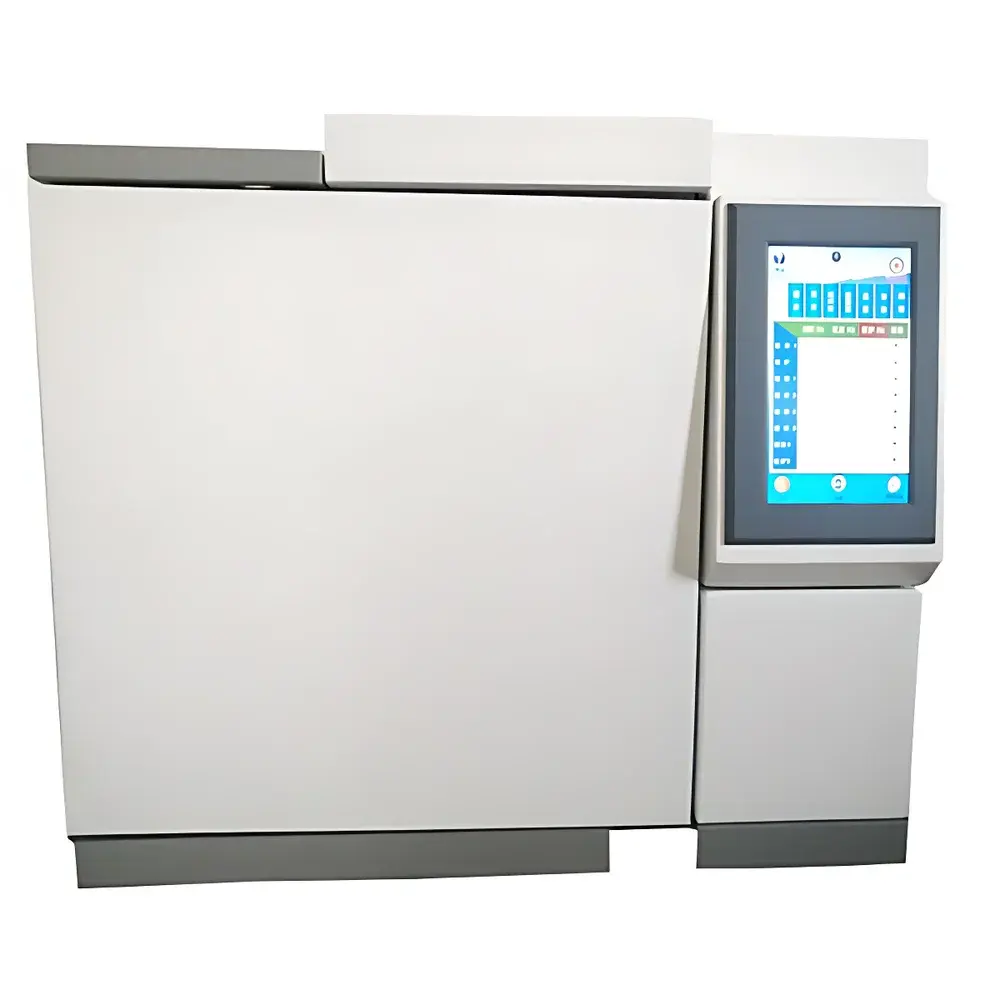
Jinpu GC-8890PLUS Gas Chromatograph
| Brand | Jinpu |
|---|---|
| Origin | Shandong, China |
| Model | GC-8890PLUS |
| Instrument Type | Laboratory Gas Chromatograph |
| Application Field | Environmental Analysis |
| Temperature Control Range | 5°C above ambient to 450°C |
| Maximum Ramp Rate | 120°C/min |
| Cooling Rate | ≤3.5 min from 350°C to 100°C |
| Carrier Gas Flow Range & Control | 0–300 mL/min |
| Carrier Gas Pressure Range & Control | 0–100 psi |
| Injector Maximum Operating Temperature | 450°C |
| Injector Pressure Setting Range | 0–100 psi |
| Injector Total Flow Setting Range | 0–300 mL/min |
Overview
The Jinpu GC-8890PLUS is a high-performance, network-enabled laboratory gas chromatograph engineered for precision, reproducibility, and regulatory-compliant operation in environmental testing laboratories. It employs classical capillary and packed column gas chromatography based on differential partitioning of analytes between a mobile phase (inert carrier gas) and a stationary phase (column coating), with separation driven by volatility, polarity, and molecular interaction. Designed for routine and method-developed analysis of volatile and semi-volatile organic compounds—including VOCs, SVOCs, pesticides, PAHs, PCBs, and halogenated hydrocarbons—the system supports multi-detector configurations and fully automated workflows. Its modular architecture integrates EPC/EFC (Electronic Pressure and Flow Control) technology, dual automatic oven door actuation, and intelligent ignition management, enabling stable baseline performance, sub-0.1°C temperature stability, and robust operation across extended unattended runs.
Key Features
- 6 independent temperature-controlled zones—including oven, up to 3 injectors, and up to 2 detectors—with programmable ramping across 16 heating stages and adjustable rates from 0.1 to 80°C/min (up to 120°C/min in high-speed mode)
- Full digital EPC/EFC system supporting N₂, H₂, He, and air; offering three operational modes (constant flow, constant pressure, split) and 4-step pressure programming; pressure control resolution: 0.01 kPa; flow resolution: 0.01 sccm
- Dual simultaneous detector capability—e.g., FID + TCD, dual TCD, or FID + ECD—enabled by optimized gas routing and independent detector power/temperature management
- Intelligent auto-ignition system using solenoid-controlled H₂/air delivery, eliminating manual flame adjustment and enhancing safety and repeatability
- 5.7-inch color TFT display with dual-channel real-time chromatogram visualization; optional resistive touch interface for local instrument control
- Four configurable external event ports supporting multi-valve sequencing, heart-cutting, and comprehensive two-dimensional GC (GC×GC) applications
- Network-ready architecture with 10/100M adaptive Ethernet—supports one-to-many (1 GC → 3 PCs) and many-to-one (up to 5000 GCs → 1 PC) remote operation under centralized LIMS or CDS environments
Sample Compatibility & Compliance
The GC-8890PLUS accommodates standard 0.53 mm, 0.32 mm, and 0.25 mm ID fused-silica capillary columns, as well as packed stainless-steel or glass columns. It accepts all common injection techniques—including split/splitless, on-column, PTV, headspace (with compatible autosampler integration), pyrolysis, and purge-and-trap—via standardized pneumatic interfaces. The system meets fundamental requirements for ISO/IEC 17025-accredited environmental testing labs and aligns with key method standards including EPA Methods 502.2, 524.4, 8021B, 8260D, and 8270E. While not pre-certified for FDA 21 CFR Part 11, its audit-trail-capable software architecture (when paired with validated third-party CDS) supports GLP/GMP data integrity frameworks through time-stamped parameter logging, user access controls, and electronic signature readiness.
Software & Data Management
Instrument control, method development, data acquisition, and reporting are managed via Jinpu’s proprietary ChromaVision™ CDS (Chromatography Data System), compatible with Windows 10/11 64-bit platforms. The software provides full remote configuration of all hardware parameters—including oven gradients, detector settings, EPC profiles, and valve events—as well as real-time spectral overlay, peak integration with customizable baselines, library search (NIST MS compatible), and customizable report templates. Raw data files adhere to ASTM E1947-compliant formats, ensuring long-term readability and interoperability. Audit trail functionality records all user actions, method modifications, and calibration events with immutable timestamps—essential for QA/QC traceability in regulated environments.
Applications
The GC-8890PLUS is routinely deployed in municipal and industrial environmental monitoring labs for the quantification of regulated contaminants in water, soil, air, and waste matrices. Typical use cases include: detection of benzene, toluene, ethylbenzene, and xylenes (BTEX) in groundwater per EPA 524.4; chlorinated solvents (e.g., TCE, PCE) in soil gas; organochlorine pesticides (e.g., DDT, chlordane) in sediment extracts per EPA 8081B; and polycyclic aromatic hydrocarbons (PAHs) in air particulate matter (PM₂.₅ filters) using EPA 8310. Its dual-FID/TCD configuration enables simultaneous hydrocarbon and permanent gas analysis in landfill gas or biogas profiling. With ECD or NPD, it satisfies low-level pesticide residue screening in food contact materials and wastewater effluent compliance testing.
FAQ
Does the GC-8890PLUS support 21 CFR Part 11 compliance?
The hardware and firmware support critical technical controls (e.g., electronic signatures, audit trails, role-based access), but full Part 11 validation requires implementation within a qualified CDS environment and documented procedural controls.
Can I operate multiple GC-8890PLUS units from a single workstation?
Yes—up to 5000 instruments can be remotely accessed and controlled simultaneously via standard TCP/IP, provided network bandwidth and CDS licensing accommodate concurrent sessions.
What is the minimum detectable concentration for chlorpyrifos using the NPD configuration?
Under optimized conditions (e.g., 0.25 mm ID DB-1701 column, 250°C injector, 280°C detector, hydrogen make-up gas), the system achieves ≤5 × 10⁻¹³ g/s sensitivity for chlorpyrifos, consistent with EPA 8310 requirements.
Is cryogenic cooling (e.g., liquid nitrogen) required for sub-ambient operation?
Yes—sub-ambient temperature control down to –80°C requires external cryogenic cooling; the oven’s fast-cool design reduces post-run cooldown time without cryogen only to ~100°C.
How many analog/digital I/O channels are available for external device synchronization?
The system provides four TTL-compatible external event inputs/outputs, supporting timed valve actuation, fraction collection triggers, and external detector synchronization.





