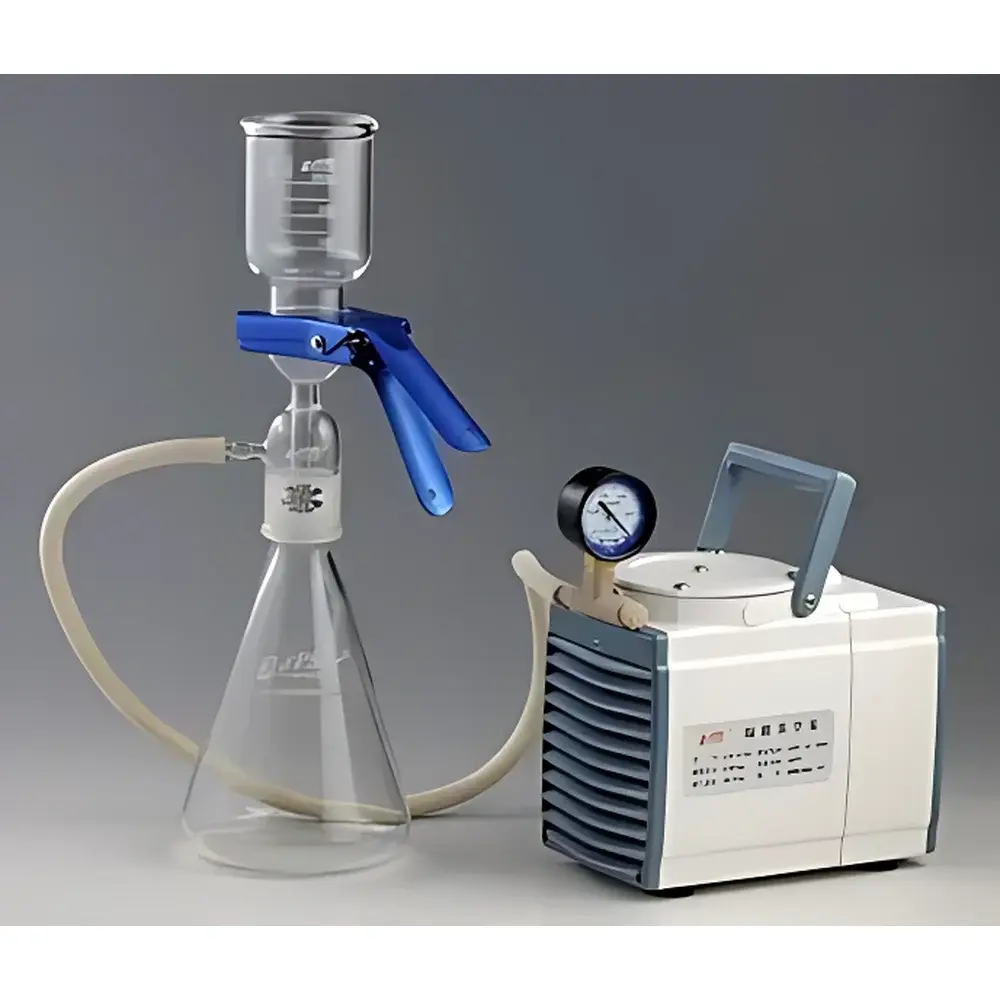
JINTENG GM-0.33A (1L) Borosilicate Glass Sintered Funnel Filtration Assembly
| Brand | JINTENG |
|---|---|
| Origin | Tianjin, China |
| Model | GM-0.33A (1L) |
| Filter Cup Capacity | 300 mL |
| Receiver Bottle Capacity | 1000 mL |
| Funnel Diameter | 50 mm |
| Sintered Disc Pore Size | 10 µm |
| Funnel & Housing Material | High-borosilicate glass (DIN/ISO-compliant) |
| Receiver Bottle Material | High-borosilicate glass |
| Filter Membrane Compatibility | Ø47 mm or Ø50 mm discs |
| Vacuum Pump Flow Rate | 20 L/min |
| Ultimate Vacuum Pressure | ≤200 mbar (≥0.08 MPa) |
| Motor Power | 160 W |
| Operating Temperature Range | 7–40 °C |
| Weight | 7.5 kg |
| Noise Level | <55 dB(A) |
Overview
The JINTENG GM-0.33A (1L) Borosilicate Glass Sintered Funnel Filtration Assembly is a precision-engineered vacuum filtration system designed for reproducible, contamination-free sample preparation in analytical and life science laboratories. It operates on the principle of negative-pressure-driven liquid-phase separation through a rigid, calibrated sintered glass disc—providing consistent flow dynamics, minimal adsorption, and high chemical inertness. Unlike polymeric filter housings, the all-glass architecture eliminates leachables and ensures compatibility with aggressive solvents, strong acids, bases, and HPLC-grade mobile phases. Its DIN-standardized ground-glass joints (ISO 1770:2021 compliant) guarantee leak-tight integrity under sustained vacuum, while the borosilicate 3.3 construction (e.g., Schott Duran® equivalent) supports autoclaving at 121 °C for sterile applications and repeated thermal cycling without stress cracking.
Key Features
- High-purity borosilicate glass (≥95% SiO₂) sintered disc with nominal pore size of 10 µm—certified for uniform porosity distribution and low extractables per USP
- DIN-standard conical ground-glass joints (ISO 1770) between funnel, filter head, and receiver bottle ensure repeatable alignment and vacuum-tight sealing without lubricants
- Integrated aluminum alloy clamp with high-yield-strength anodized finish—resists torsional deformation during repeated assembly/disassembly
- PTFE-reinforced sintered disc option available for enhanced corrosion resistance in HF, hot conc. HNO₃, or NaOH solutions (pH 0–14)
- Vacuum pump features oil-free diaphragm design, thermally protected motor (max. housing temp. <60 °C), and acoustic damping enclosure (<55 dB(A)) for benchtop use
- Receiver bottle calibrated to Class A volumetric accuracy (ISO 1042) with etched graduation marks and overflow relief groove
Sample Compatibility & Compliance
This filtration system accommodates aqueous, organic (e.g., acetonitrile, THF, chloroform), and corrosive media—including 30% HCl, 65% HNO₃, and 40% NaOH—without degradation. It meets ASTM D2972 for sintered glass filter performance verification and supports GLP-compliant workflows when paired with traceable calibration records. The glass components are certified non-pyrogenic and suitable for ISO 13485-aligned bioprocess validation. All wetted surfaces comply with USP and EU Pharmacopoeia 2.2.41 for extractables profiling. Autoclavability (121 °C, 20 min, 1.1 bar) enables reuse in sterile cell culture media preparation and microbiological assay support.
Software & Data Management
While the GM-0.33A is a manually operated, analog filtration platform, its mechanical design integrates seamlessly into digitally governed lab environments. Vacuum pressure can be monitored externally via compatible digital manometers (e.g., Vaisala BAROCAP® sensors) with RS-485 output for integration into LIMS or ELN systems. The standardized dimensions and joint geometry allow direct mounting onto automated liquid handling platforms equipped with vacuum manifolds meeting IEC 61000-6-3 EMC requirements. Full audit trails—including operator ID, batch number, filtration duration, and final vacuum level—are maintainable in accordance with FDA 21 CFR Part 11 when recorded via validated electronic notebooks.
Applications
- HPLC and UHPLC mobile phase degassing and particulate removal prior to column injection—reducing backpressure spikes and extending column lifetime
- Pre-filtration of environmental water samples (EPA Method 1664, ISO 11348) for suspended solids quantification and hydrophobic organic contaminant analysis
- Clarification of fermentation broths and protein purification intermediates under non-denaturing conditions
- Particle size distribution analysis of nanomaterials via membrane capture followed by SEM/EDS characterization
- Standardized gravimetric determination of total suspended solids (TSS) per ISO 11923 and APHA Standard Methods 2540D
FAQ
Can the sintered glass disc be cleaned and reused?
Yes—rinsing with dilute nitric acid (10% v/v), followed by ultrasonic cleaning in deionized water and drying at 110 °C, restores baseline flow rates without altering pore structure.
Is the system compatible with solvent-resistant filter membranes?
Yes—Ø47 mm and Ø50 mm membranes (cellulose acetate, nylon, PVDF, PTFE) fit securely beneath the sintered disc holder without bypass leakage.
What vacuum level is required for optimal HPLC mobile phase filtration?
A stable operating vacuum of 150–200 mbar is recommended; the integrated pump achieves this within 45 seconds and maintains it with <±2 mbar drift over 30 minutes.
Does the assembly meet ISO 9001-certified manufacturing standards?
JINTENG’s production facility is ISO 9001:2015 certified; each GM-series unit undergoes individual vacuum integrity testing and dimensional inspection per ISO 2768-mK.
Can the receiver bottle be substituted with a different volume or material?
Only DIN-standard borosilicate glass bottles with matching 29/32 ground joints are recommended; substitution with plastic or non-DIN glass compromises vacuum integrity and thermal stability.
Related Products