
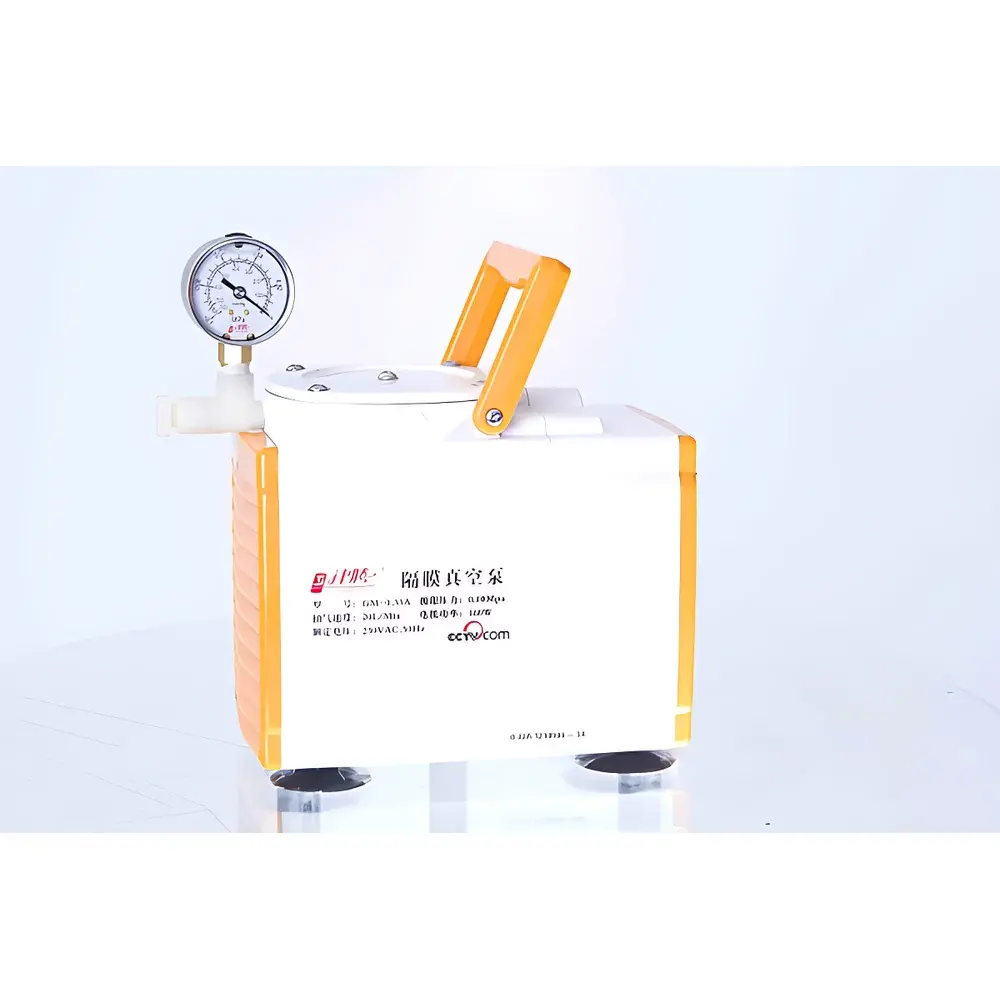
Jinteng GM-0.33A Corrosion-Resistant Oil-Free Diaphragm Vacuum Pump
| Origin | Shanghai, China |
|---|---|
| Type | Oil-Free Diaphragm Vacuum Pump |
| Model | GM-0.33A |
| Ultimate Vacuum | ≤0.08 MPa (200 mbar) |
| Flow Rate | 20 L/min |
| Noise Level | <55 dB(A) |
| Motor Power | 160 W |
| Inlet/Outlet Port | Ø6 mm |
| Dimensions (L×W×H) | 235×120×215 mm |
| Weight | 7.5 kg |
| Operating Temperature Range | 7–40 °C |
| Construction | Anodized Aluminum Housing with Corrosion-Resistant Coating |
| Pressure Mode | Negative Pressure Only (Vacuum-Only Operation) |
Overview
The Jinteng GM-0.33A Corrosion-Resistant Oil-Free Diaphragm Vacuum Pump is an engineered solution for laboratories requiring clean, reliable, and maintenance-free vacuum generation in chemically demanding environments. Based on positive displacement via elastomeric diaphragm oscillation—without lubricating oil or sliding mechanical contacts—the pump delivers consistent vacuum performance while eliminating hydrocarbon contamination risks associated with oil-lubricated systems. Its operating principle relies on a cam-driven, fatigue-resistant PTFE-reinforced diaphragm that alternately expands and compresses the pumping chamber, enabling continuous evacuation of gases without heat buildup or particulate shedding. Designed specifically for applications where sample integrity, regulatory compliance, and long-term operational stability are critical—including HPLC mobile phase degassing, solid-phase extraction (SPE), vacuum filtration of aggressive solvents, and inert gas purging—the GM-0.33A meets ISO 8573-1 Class 0 air purity requirements for oil-free operation. The unit operates silently (<55 dB[A]) and remains thermally stable (<60 °C housing temperature) during extended duty cycles, supporting unattended 24-hour operation under controlled ambient conditions (7–40 °C).
Key Features
- Corrosion-resistant construction: Anodized aluminum alloy housing with epoxy-polyester hybrid coating ensures durability against organic solvents, acids, and halogenated vapors commonly encountered in analytical and preparative labs.
- True oil-free operation: No lubricants, seals, or valves requiring periodic replacement—reducing downtime and eliminating risk of sample cross-contamination or chromatographic baseline drift.
- Precision pressure control: Integrated adjustable vacuum regulator enables fine-tuning of suction pressure across the operational range (up to 200 mbar ultimate vacuum), optimizing filtration rate and membrane integrity for sensitive samples.
- Thermally passive design: Diaphragm actuation generates negligible frictional heat; no external cooling required, even during continuous operation at rated flow (20 L/min).
- Compact footprint and low vibration: Optimized motor-diaphragm alignment and rubber-isolated mounting minimize transmission of mechanical resonance to adjacent instrumentation—critical when placed on analytical balance tables or HPLC benches.
- Compliance-ready architecture: All electrical components conform to IEC 61000-6-3 (EMC emission standards); CE-marked per Machinery Directive 2006/42/EC and Low Voltage Directive 2014/35/EU.
Sample Compatibility & Compliance
The GM-0.33A is validated for use with aqueous buffers, methanol, acetonitrile, ethyl acetate, dichloromethane, and dilute hydrochloric or phosphoric acid solutions—common in pharmaceutical QC, environmental testing, and forensic toxicology workflows. Its chemically inert wetted path (PTFE diaphragm, EPDM valves, stainless steel fasteners) complies with USP material safety requirements for contact with drug substances. When integrated into GLP- or GMP-regulated environments, the pump supports auditability through documented calibration intervals (recommended annually), traceable pressure verification using NIST-traceable digital manometers, and compatibility with electronic lab notebook (ELN) metadata capture for vacuum-dependent SOPs. It is routinely deployed in laboratories adhering to ASTM D1298 (crude oil density), ISO 11348 (luminescent bacteria toxicity), and EPA Method 505 (organochlorine pesticides) protocols.
Software & Data Management
While the GM-0.33A operates as a standalone analog device, its pressure output is compatible with third-party digital vacuum controllers (e.g., Vacuubrand VACUU·SELECT or KNF LabControl) for automated setpoint logging, trend analysis, and alarm-triggered shutdown. Analog 0–10 V or 4–20 mA vacuum feedback signals can be interfaced with PLC-based lab automation systems (Siemens S7, Allen-Bradley CompactLogix) to synchronize pump activity with filtration timers, autosampler triggers, or solvent reservoir level sensors. All firmware updates and configuration files for such controllers are stored in secure, version-controlled repositories compliant with FDA 21 CFR Part 11 requirements—including electronic signatures, audit trails, and role-based access controls.
Applications
- HPLC and UHPLC mobile phase degassing prior to column equilibration—preventing bubble formation and retention time variability.
- Vacuum-assisted filtration of corrosive filtrates (e.g., acidic digestates in ICP-MS sample prep) using PTFE or polypropylene membranes.
- Conditioning and elution steps in solid-phase extraction (SPE) cartridges containing silica-, C18-, or ion-exchange sorbents.
- Lyophilizer shelf pre-evacuation and condenser regeneration in pilot-scale freeze-drying systems.
- Inert atmosphere purging of glove boxes handling moisture-sensitive catalysts or air-sensitive organometallic compounds.
- Supporting vacuum ovens used in residual solvent determination per ICH Q3C guidelines.
FAQ
Is the GM-0.33A suitable for continuous-duty operation?
Yes—it is rated for uninterrupted 24/7 operation within ambient temperatures of 7–40 °C and relative humidity ≤80% non-condensing.
What maintenance is required over its service life?
No scheduled lubrication or seal replacement is needed. Recommended annual inspection includes diaphragm visual integrity check, valve seat cleanliness verification, and inlet filter cleaning.
Can it be used with aggressive solvents like THF or DMF?
Yes—the PTFE diaphragm and EPDM valve assembly provide proven resistance to polar aprotic solvents; however, prolonged exposure to chlorinated solvents (e.g., chloroform) should be avoided due to potential elastomer swelling.
Does it meet regulatory requirements for pharmaceutical manufacturing?
It satisfies material biocompatibility (USP ) and oil-free purity (ISO 8573-1 Class 0) prerequisites for ancillary equipment in API synthesis and formulation labs, though final validation must be performed per site-specific PQ protocols.
How is vacuum level adjusted during operation?
Via the front-panel precision needle valve, which modulates backpressure on the exhaust side—enabling real-time control from atmospheric pressure down to the specified ultimate vacuum (≤200 mbar).



