
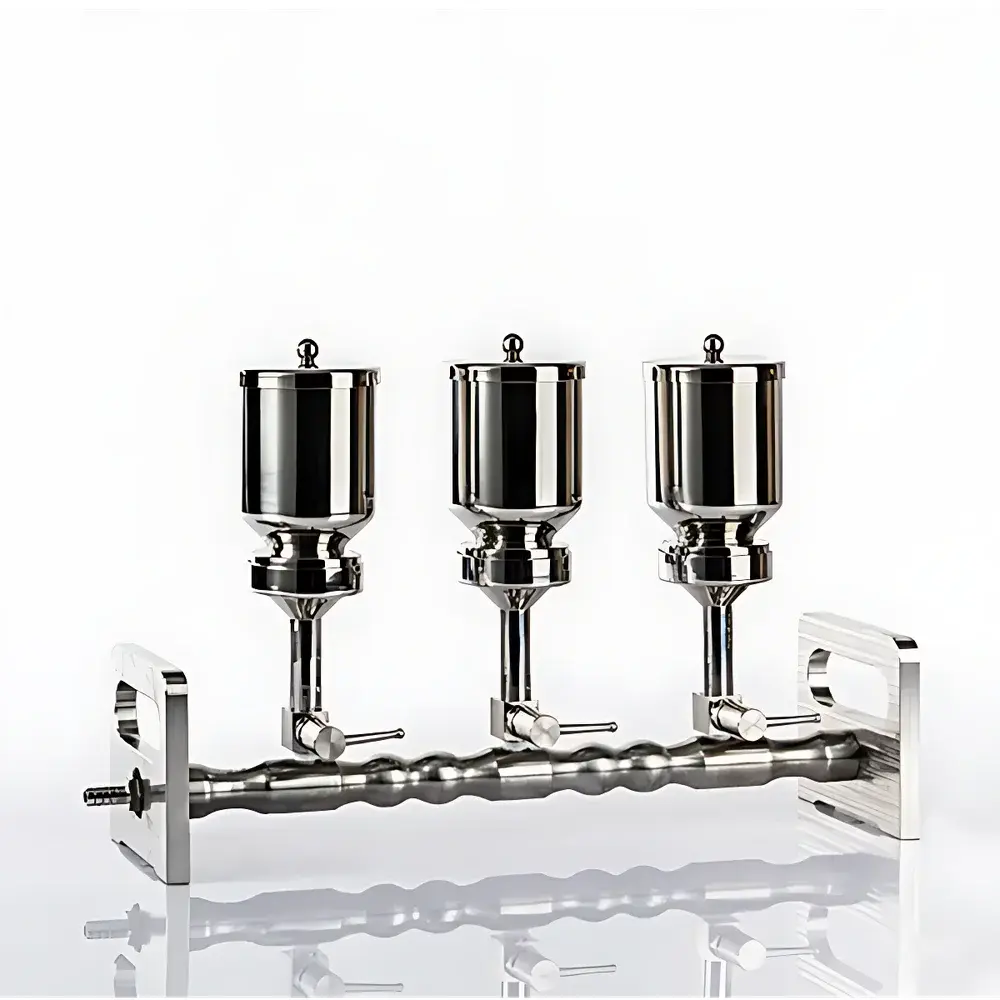
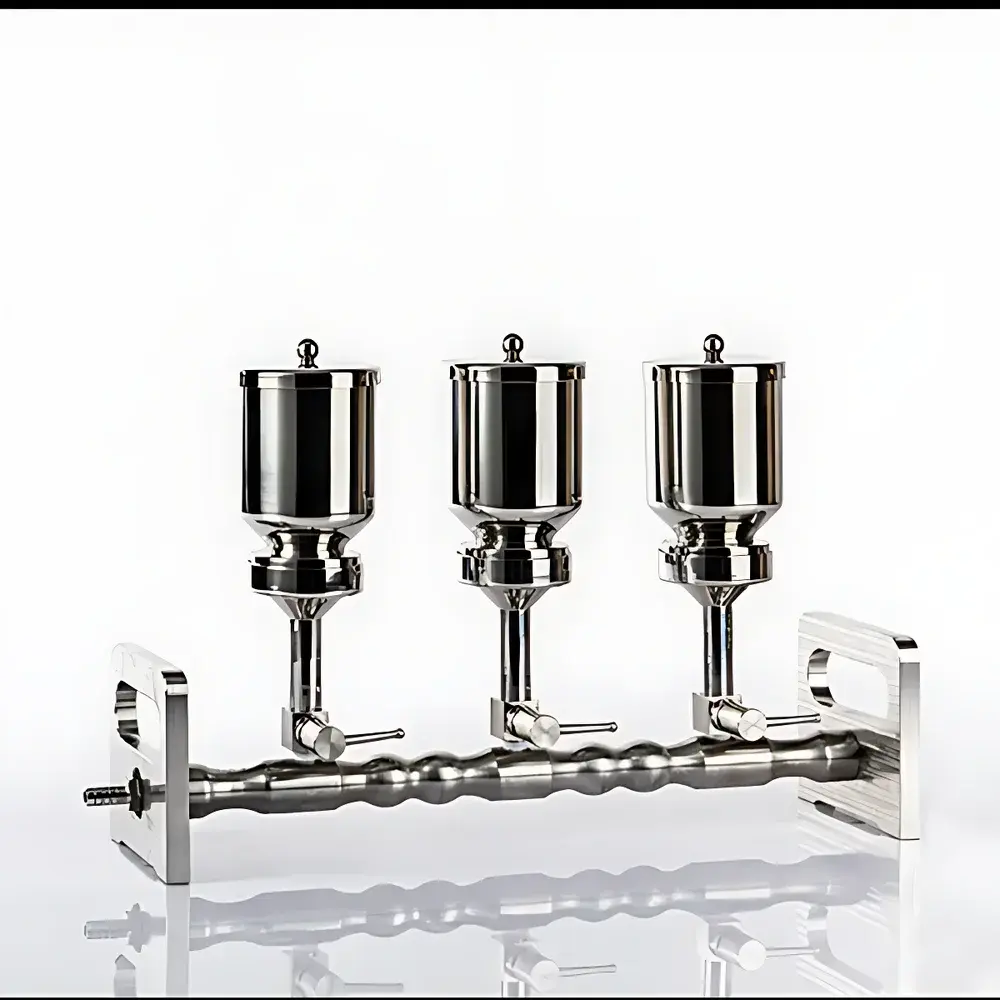
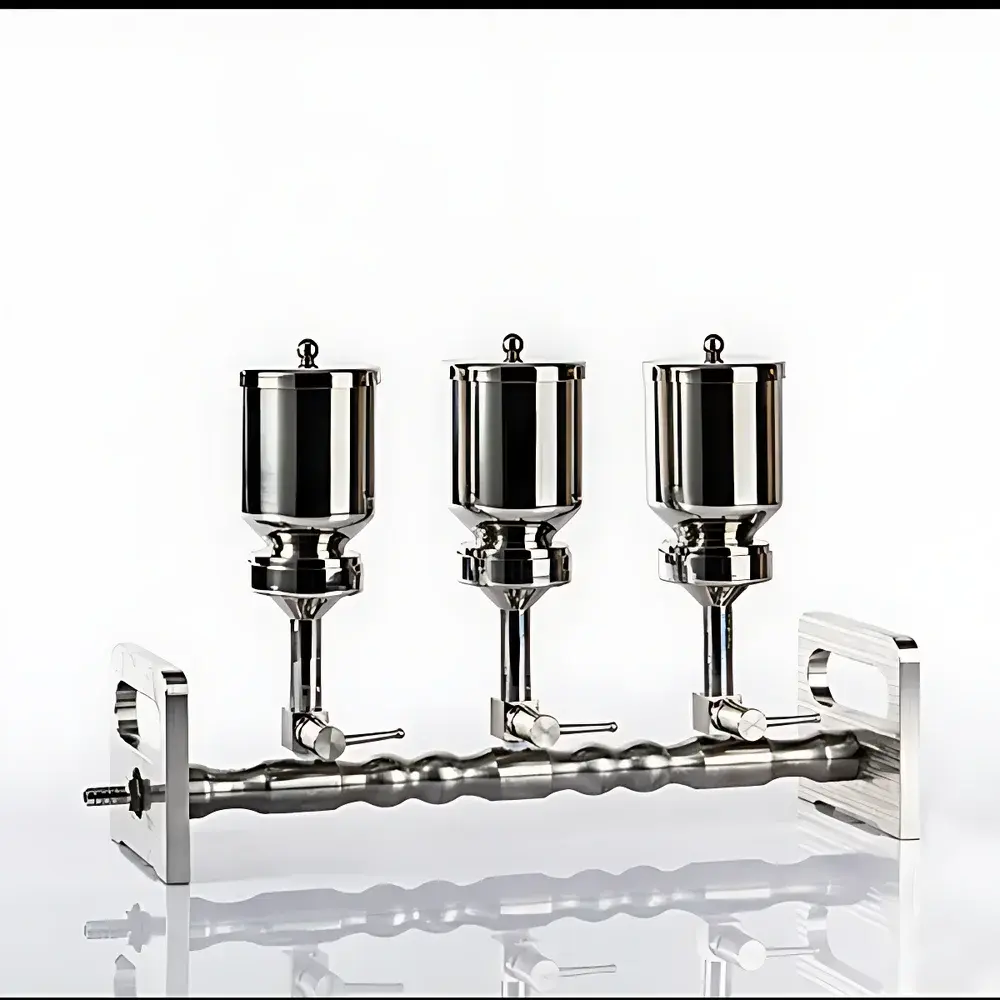
JINTENG Stainless Steel Triple-Filter Assembly with Magnetic Base
| Brand | JINTENG |
|---|---|
| Origin | Tianjin, China |
| Material | ASTM F138-compliant 316L stainless steel (electropolished) |
| Configuration | Triple-filter manifold with magnetic base |
| Filtration Capacity | 3 × 500 mL stainless steel filter cups |
| Sterilization Compatibility | Autoclavable (121°C, 20 min), gamma-irradiatable, and ethylene oxide compatible |
| Compliance | USP <788> Particulate Matter in Injections, ISO 8573-7 (compressed air purity for pharmaceutical use), GLP/GMP-aligned design |
| Vacuum Interface | Standard 1/4" NPT vacuum port (shared across all three channels) |
| Sealing | Silicone-free PTFE-coated silicone gaskets (USP Class VI compliant) |
| Optional Accessories | 0.22 µm or 0.45 µm sterile-grade membrane filters (PVDF, nylon, or mixed cellulose ester), filter cup adapters for 25 mm/47 mm membranes |
Overview
The JINTENG Stainless Steel Triple-Filter Assembly with Magnetic Base is a precision-engineered vacuum-driven filtration manifold designed for high-integrity sample preparation in regulated life science laboratories. Operating on the principle of negative-pressure-driven cross-flow filtration, this triple-channel system enables simultaneous, independent processing of up to three liquid samples—without cross-contamination—using a single vacuum source. Constructed entirely from electropolished ASTM F138-grade 316L stainless steel, the assembly meets stringent material biocompatibility and corrosion resistance requirements for pharmaceutical process validation, environmental monitoring, and analytical method development. Its magnetic base provides stable, tool-free mounting on ferromagnetic surfaces (e.g., stainless steel lab benches or fume hood interiors), eliminating mechanical clamps and reducing setup time while maintaining positional repeatability during extended filtration cycles.
Key Features
- Triple-channel architecture with individual valve-controlled flow paths ensures true parallel operation and quantitative reproducibility across all three filtration units.
- Electropolished 316L stainless steel components—including support frame, filter heads with integrated 316L sintered stainless steel frits (pore size: 20–40 µm), and deep-drawn 500 mL filter cups—minimize surface area roughness (Ra ≤ 0.4 µm) to prevent sample retention and facilitate complete liquid recovery.
- Magnetic base (NdFeB grade N42, 4,500 Gauss surface field) allows rapid repositioning without hardware; base plate includes alignment grooves for consistent orientation relative to vacuum manifolds or collection trays.
- PTFE-coated silicone gaskets (USP Class VI certified) provide leak-tight sealing under vacuum pressures up to −95 kPa, validated per ASTM D3951 for repeated sterilization cycles.
- No dead-leg geometry: All internal wetted surfaces feature radiused transitions and zero-threaded connections, eliminating microbial harborage zones and enabling full CIP/SIP compatibility.
Sample Compatibility & Compliance
This filtration assembly accommodates aqueous, organic, and mildly acidic/basic solutions across pH 1–12. It supports standard 25 mm and 47 mm diameter sterile membrane filters—including hydrophilic PVDF, low-protein-binding nylon, and MCE—enabling applications ranging from endotoxin testing (USP ) to particulate analysis (USP ). The system conforms to ISO 8573-7 for compressed air quality in pharmaceutical manufacturing environments and is routinely deployed in laboratories operating under GLP (OECD 1998) and GMP (ICH Q5A, Annex 1) frameworks. Filter cup geometry and cup-to-head interface dimensions are fully compatible with FDA 21 CFR Part 11–compliant electronic lab notebook (ELN) workflows when paired with digital vacuum controllers and audit-trail-capable pressure loggers.
Software & Data Management
While the JINTENG triple-filter assembly operates as a standalone hardware platform, its modular interface supports integration into automated data acquisition ecosystems. When used with third-party vacuum controllers (e.g., KNF N86 KT.18 or Vacuubrand RC 6), real-time vacuum level, elapsed filtration time, and endpoint detection signals can be logged via RS-485 or analog 4–20 mA outputs. These parameters feed directly into LIMS platforms (e.g., LabWare LIMS or Thermo Fisher SampleManager) or ELNs that enforce ALCOA+ data integrity principles—including attributable, legible, contemporaneous, original, and accurate records. Optional barcode-labeled filter cup identification tags enable traceability from sample receipt through filtrate collection.
Applications
- Pharmaceutical QC: Particulate matter testing of injectables per USP , sterility test membrane rinsing, and bioburden assay preparation.
- Environmental labs: Filtration of water samples for EPA Method 1603 (E. coli) and ISO 9308-1 compliance; suspended solids quantification per ISO 11923.
- Bioprocess development: Clarification of cell culture supernatants prior to HPLC or LC-MS analysis; buffer exchange pre-filtration in downstream purification workflows.
- Food & beverage safety: Microbial enumeration (ISO 4833-1) and mycotoxin extraction sample prep where metal-free leachables must be excluded.
- Academic research: High-throughput screening of nanoparticle suspensions, colloidal stability studies, and filtration kinetics modeling under controlled vacuum gradients.
FAQ
Can this unit be autoclaved without disassembly?
Yes—the entire assembly (including magnetic base, filter heads, cups, and gaskets) withstands standard autoclave cycles (121°C, 20 min, saturated steam) without dimensional drift or seal degradation.
Is the magnetic base compatible with non-ferrous work surfaces?
No; the base requires a ferromagnetic substrate (e.g., 304 or 316 stainless steel) for secure adhesion. For aluminum or polymer benchtops, optional 316L mounting brackets are available.
What vacuum level is recommended for optimal filtration rate without membrane rupture?
For 0.22 µm PVDF membranes, maintain −60 to −80 kPa; for 0.45 µm nylon, −70 to −90 kPa is typical. Exceeding −95 kPa may compromise filter integrity with viscous or particulate-laden samples.
Are replacement gaskets and frits supplied with traceable certificates of conformance?
Yes—each gasket lot includes a CoC referencing USP Class VI extractables testing (per USP and ), and sintered frits carry dimensional inspection reports per ISO 4783-2.
Does JINTENG offer IQ/OQ documentation packages for this system?
Yes—validated installation and operational qualification protocols aligned with ASTM E2500-13 and EU Annex 15 are available upon request for GMP-regulated installations.
Related Products




