
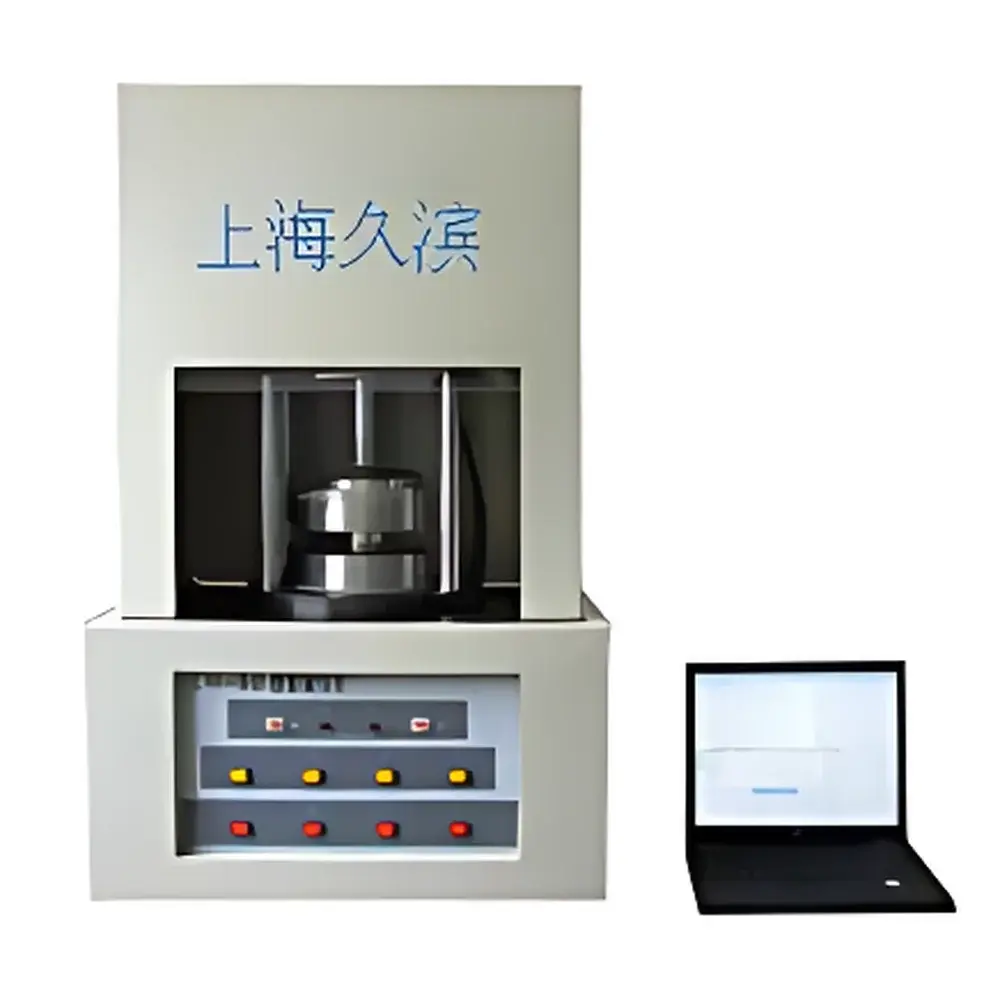
Jiubin BJ-236 Rubber Curemeter (Oscillating Disk Rheometer)
| Brand | Jiubin |
|---|---|
| Model | BJ-236 |
| Type | Oscillating Disk Curemeter (ODR) / Rotorless Curemeter |
| Temperature Range | 100–200 °C |
| Heating Rate | <10 min to setpoint |
| Oscillation Frequency | 1.7 Hz (100 rpm) |
| Oscillation Angle | ±0.5° |
| Rotor Diameter (rotor-type) | 35.55 ±0.07 mm |
| Torque Range | 0–30 N·m |
| Torque Resolution | 0.01 N·m |
| Power Supply | 220 V AC |
| Pneumatic Pressure | 0.5 MPa |
| Data Output | Date, Time, Temperature, Lab ID, Cure Curve, Temperature Profile, ML, MH, t₉₀, ts₁, tc₅₀ |
Overview
The Jiubin BJ-236 Rubber Curemeter is a precision oscillating disk rheometer engineered for standardized vulcanization characterization of raw and compounded elastomers. Operating on the principle of controlled sinusoidal shear deformation under isothermal or programmed temperature conditions, it measures torque response as rubber transitions from uncured compound to crosslinked network. This instrument complies with ASTM D5289, ISO 6502, and GB/T 16584—international standards governing cure kinetics evaluation in rubber compounding laboratories. Unlike capillary or capstan rheometers, the BJ-236 employs either rotorless (oscillating disk) or rotor-based configurations to minimize material slippage and maximize reproducibility in determining scorch safety, optimal cure time (t₉₀), and crosslink density via minimum (ML) and maximum (MH) torque values. Its modular architecture integrates real-time thermal regulation, high-fidelity torque transduction, and synchronized data acquisition—enabling traceable, GLP-compliant testing across R&D, QC, and production environments.
Key Features
- Modular dual-mode operation: switchable between rotorless (ODR) and rotor-type (MDR) configurations for broad compatibility with ASTM D5289 and ISO 6502 test protocols
- Precision temperature control system with ±0.3 °C stability across 100–200 °C range; achieves target setpoint in under 10 minutes
- High-resolution torque sensing with 0.01 N·m resolution and full-scale range of 0–30 N·m, calibrated per ISO 17025-accredited procedures
- Fixed oscillation frequency of 1.7 Hz (100 rpm) and amplitude of ±0.5°, ensuring strict adherence to standard test conditions
- Integrated pneumatic actuation (0.5 MPa supply) for consistent cavity closure force and uniform sample compression
- Embedded microprocessor with non-volatile memory for autonomous test execution, parameter recall, and timestamped data logging
- RS-232 and USB interfaces support direct connection to LIMS or third-party analytical software for automated reporting
Sample Compatibility & Compliance
The BJ-236 accommodates standard 3.5–4.5 g rubber specimens in ASTM D5289-compliant molds (typically 38.1 mm diameter × 1.5 mm thickness). It supports natural rubber (NR), styrene-butadiene rubber (SBR), ethylene propylene diene monomer (EPDM), nitrile rubber (NBR), silicone (VMQ), and fluoroelastomers (FKM), including filled and oil-extended compounds. All hardware components contacting the sample are constructed from corrosion-resistant, low-thermal-expansion stainless steel to prevent catalytic interference. The instrument meets electromagnetic compatibility (EMC) requirements per IEC 61326-1 and electrical safety standards per IEC 61010-1. Calibration certificates include traceability to NIST-traceable torque and temperature references.
Software & Data Management
The BJ-236 operates with proprietary Windows-based analysis software supporting multi-curve overlay, derivative curve generation (dTorque/dt), and automatic extraction of critical cure parameters: ts₁ (scorch time), t₅₀ (half-life cure time), t₉₀ (optimal cure time), ML, MH, and ΔM (MH−ML). Raw data exports in CSV and XML formats ensure interoperability with statistical process control (SPC) platforms such as Minitab or JMP. Audit trail functionality records operator ID, method version, calibration status, and environmental logs—fully compliant with FDA 21 CFR Part 11 requirements when deployed with electronic signature modules. Data integrity safeguards include write-protected storage, cyclic redundancy checksums, and user-level access controls (admin/operator/viewer).
Applications
- Rubber formulation development: quantitative comparison of accelerator systems, sulfur donors, and curatives
- Quality assurance of incoming raw materials (e.g., polymer viscosity, filler dispersion, plasticizer content)
- Process validation for extrusion, calendering, and molding operations where scorch resistance directly impacts line stability
- Accelerated aging studies correlating cure state with post-vulcanization properties (compression set, tensile strength, hardness)
- Regulatory submission support for medical-grade elastomers (ISO 10993-12), aerospace seals (SAE AMS3320), and automotive hose compounds (SAE J200)
- Educational use in polymer science curricula for hands-on demonstration of network formation kinetics
FAQ
What standards does the BJ-236 comply with for rubber cure testing?
ASTM D5289, ISO 6502, GB/T 16584, and DIN 53529-3.
Can the instrument operate in both rotorless and rotor modes without hardware modification?
Yes—the BJ-236 features interchangeable mold assemblies; switching between ODR and MDR configurations requires only manual replacement of the die and rotor assembly.
Is temperature calibration performed at multiple points across the operating range?
Yes—factory calibration includes verification at 100 °C, 150 °C, and 200 °C using NIST-traceable RTD probes, with certificate of calibration provided.
Does the software support automated pass/fail decision logic based on specification limits?
Yes—users can define upper/lower tolerance bands for t₉₀, ML, MH, and ΔM; the system flags out-of-spec results during real-time acquisition and generates PDF reports with red/green status indicators.
What maintenance intervals are recommended for torque sensor and heating elements?
Torque sensor zero-point verification every 3 months; full recalibration annually; heater block inspection and cleaning every 6 months or after 500 test cycles.



