
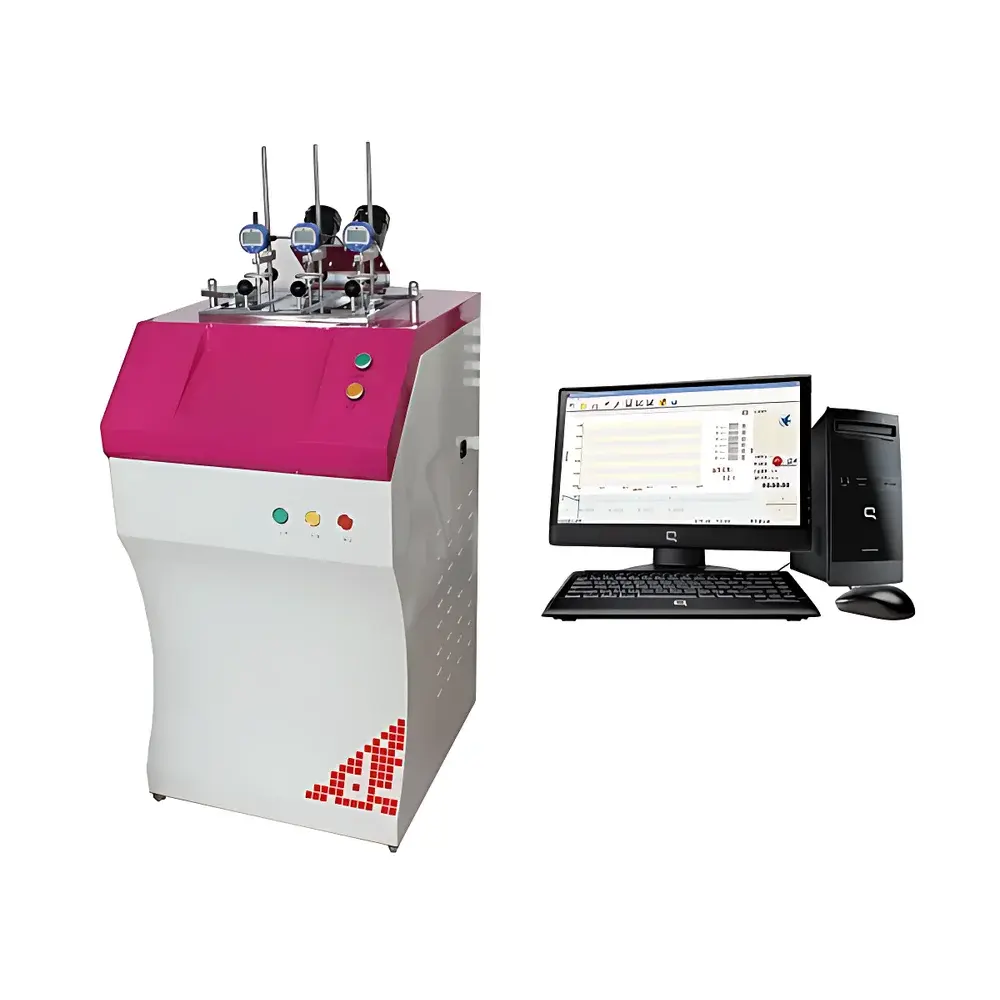
Jiubin Instruments JB-282 Heat Deflection Temperature (HDT) and Vicat Softening Temperature (VST) Tester
| Brand | Jiubin Instruments |
|---|---|
| Origin | Shanghai, China |
| Model | JB-282 |
| Temperature Control Range | Ambient to 300 °C |
| Temperature Accuracy | ±0.1 °C |
| Heating Rate Options | 5 ±0.5 °C/6 min (ISO 75–1 Method A) or 12 ±1 °C/6 min (ISO 75–1 Method B) |
| Vicat Load | 10 N ±0.2 N (Method A) or 50 N ±1 N (Method B) |
| Deflection Measurement Range | 0–1 mm |
| Deflection Resolution | ±0.001 mm |
| Standard Span Lengths | 64 mm and 100 mm |
| Heating Power | ≤3800 W |
| Compliant with GB/T 1633–2000, GB/T 1643–1979, ISO 75–1 | 2013, ISO 306:2020 |
Overview
The Jiubin Instruments JB-282 Heat Deflection Temperature (HDT) and Vicat Softening Temperature (VST) Tester is a dual-function thermal analysis instrument engineered for precision evaluation of thermoplastic and thermosetting polymer performance under controlled thermal and mechanical loading. It operates on two standardized physical principles: the heat deflection test—measuring the temperature at which a standardized test specimen deflects by 0.34 mm under a specified flexural load—and the Vicat softening test—determining the temperature at which a needle of 1 mm² cross-section penetrates 1 mm into the material under defined load and heating rate. Both methods are governed by internationally harmonized test protocols, including ISO 75–1:2013 (Plastics — Determination of temperature of deflection under load), ISO 306:2020 (Plastics — Thermoplastic materials — Determination of Vicat softening temperature), and corresponding Chinese national standards GB/T 1633–2000 and GB/T 1643–1979. The JB-282 integrates PID-controlled oil-bath heating, high-stability mechanical loading assemblies, and real-time digital displacement sensing to ensure repeatability across laboratories and production environments.
Key Features
- Dual-test capability: Simultaneous configuration support for both HDT (ASTM D648 / ISO 75) and VST (ASTM D1525 / ISO 306) determinations within a single platform
- Precise thermal management: Programmable heating rates compliant with ISO-defined Methods A (5 °C/6 min) and B (12 °C/6 min), with ±0.1 °C temperature stability maintained across the full 20–300 °C operating range
- High-resolution deformation monitoring: Digital micrometer-based transducers with ±0.001 mm resolution and 0–1 mm linear measurement range, calibrated traceable to national metrology institutes
- Modular mechanical fixtures: Interchangeable test frames supporting standard span lengths of 64 mm and 100 mm; load application verified per ISO 75–2 for bending stress and ISO 306 Annex A for needle penetration force
- Integrated cooling system: Closed-loop water circulation unit enabling rapid thermal recovery between successive tests, reducing cycle time and improving throughput in QC labs
- Computer-controlled operation: Embedded industrial PC with dedicated test software for automated temperature ramping, real-time curve plotting (temperature vs. deflection), automatic endpoint detection, and PDF report generation with embedded metadata (operator ID, sample ID, test date, calibration status)
Sample Compatibility & Compliance
The JB-282 accommodates rigid and semi-crystalline polymer specimens conforming to ISO 75–2 and ISO 306 dimensional requirements—including bars (80 × 10 × 4 mm), molded plaques, and extruded profiles—with minimal surface preparation. It supports both flat-bar and cylindrical test geometries for Vicat testing. All mechanical and thermal subsystems meet essential safety and electromagnetic compatibility requirements per IEC 61000-6-2 and IEC 61000-6-4. Test data output complies with GLP documentation standards, including electronic audit trails, user-access controls, and timestamped result logs—enabling alignment with FDA 21 CFR Part 11 readiness when deployed with validated software configurations. Routine verification procedures follow ISO/IEC 17025–recommended practices for equipment qualification (IQ/OQ/PQ).
Software & Data Management
The proprietary JB-282 TestSuite software provides a Windows-based interface with role-based access control (administrator, technician, viewer). It records raw sensor data at ≥10 Hz sampling frequency, applies linear interpolation for precise inflection point calculation, and generates reports containing full traceability: test parameters, calibration certificates (temperature sensor, load cell, displacement transducer), environmental conditions (lab temperature/humidity), and operator annotations. Export formats include CSV (for LIMS integration), XML (for enterprise QA systems), and print-ready PDF with embedded digital signatures. Software validation documentation—including risk assessment (FMEA), requirement specifications, and test protocol summaries—is available upon request for regulated environments.
Applications
- Quality control of polypropylene (PP), polyethylene (PE), polycarbonate (PC), ABS, and engineering thermoplastics in injection molding and extrusion facilities
- R&D screening of polymer blends, filled composites (e.g., glass-fiber-reinforced PA6), and flame-retardant formulations
- Regulatory submission support for automotive (SAE J2334), electrical insulation (UL 746B), and construction material certifications
- Comparative thermal stability assessment during material substitution studies or supplier qualification audits
- Teaching laboratories for polymer science curricula requiring hands-on instruction in standardized thermal mechanical testing methodology
FAQ
What standards does the JB-282 comply with?
It fully supports ISO 75–1:2013 (HDT), ISO 306:2020 (VST), ASTM D648, ASTM D1525, GB/T 1633–2000, and GB/T 1643–1979.
Is the system suitable for GLP-regulated laboratories?
Yes—when configured with validated software and documented calibration procedures, it meets core GLP requirements for data integrity, audit trail, and operator accountability.
Can test results be exported to LIMS?
Yes—CSV and XML export options enable seamless integration with major laboratory information management systems.
What maintenance is required for long-term accuracy?
Annual recalibration of temperature sensors and displacement transducers is recommended; load cells require biannual verification using NIST-traceable deadweight standards.
Does the system support multi-specimen parallel testing?
No—the JB-282 performs sequential tests; however, its rapid cool-down cycle (<15 min from 300 °C to 50 °C) enables high-throughput batch processing.






