
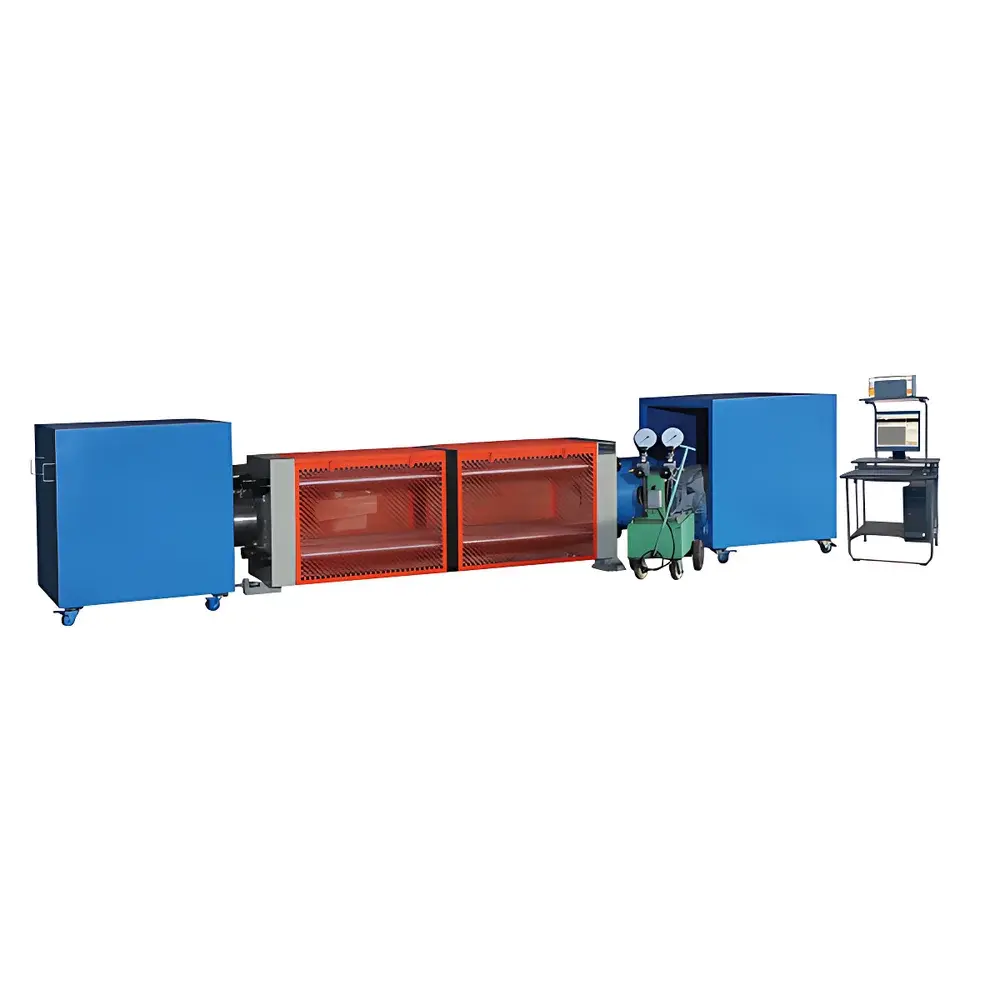
Jiubin Instruments JB-4000 / JB-5000 / JB-6500 Microcomputer-Controlled Static Load Anchor Testing Machine for Prestressed Steel Strands
| Brand | Jiubin Instruments |
|---|---|
| Origin | Shanghai, China |
| Model | JB-4000 / JB-5000 / JB-6500 |
| Test Load Capacity | 4000 kN / 5000 kN / 6500 kN |
| Displacement Sensor Range | 0–300 mm |
| Load Measurement Accuracy | ±1% FS |
| Piston Stroke | 200 mm |
| Maximum Test Span (Center-to-Center) | 3400 mm |
| Control System | PC-based Real-Time Data Acquisition & Closed-Loop Hydraulic Control |
Overview
The Jiubin Instruments JB-4000 / JB-5000 / JB-6500 Microcomputer-Controlled Static Load Anchor Testing Machine is a high-capacity, hydraulically actuated test system engineered for the standardized static load anchorage performance evaluation of prestressed steel strand anchorages. Designed in strict accordance with ISO 6934-4, GB/T 14370–2015 (Chinese National Standard for Prestressing Anchorages, Clamps and Connectors), and aligned with ASTM A416/A416M requirements for strand anchorage efficiency, this machine quantifies anchorage efficiency coefficient (ηa) and ultimate tensile strain (εapu) under controlled quasi-static loading. The system operates on the principle of synchronized dual-actuator tensioning—applying axial force to both the anchored strand assembly and the reaction frame while precisely measuring load-displacement hysteresis across the anchorage zone. Its robust structural architecture ensures minimal frame deflection (<0.05% of full-scale span), preserving measurement integrity during multi-cycle loading protocols required by regulatory acceptance testing.
Key Features
- Triple-capacity modular design: Interchangeable hydraulic power units and load cells support JB-4000 (4000 kN), JB-5000 (5000 kN), and JB-6500 (6500 kN) configurations—enabling scalability across laboratory, precast yard, and third-party certification facility workflows.
- High-stiffness dual-column steel frame with 3400 mm maximum test span, optimized for full-length multi-strand assemblies (up to 19×Φ15.2 mm strands) without mid-span support interference.
- Real-time closed-loop hydraulic control via servo-proportional valves, maintaining load ramp rates within ±0.5% of setpoint throughout the entire 0–100% FS range per ISO 7500-1 Class 1 compliance.
- Integrated high-resolution displacement sensing (0–300 mm, resolution ≤1 µm) co-located with load transducers at both anchor grip points to capture relative slip and embedment deformation.
- Microcomputer control system featuring Windows-based software with audit-trail-enabled operation logs, automatic calculation of ηa = (Fapu/n·Fptk) and εapu, and export-ready reports compliant with GLP documentation standards.
Sample Compatibility & Compliance
The system accommodates standard post-tensioning anchor systems—including wedge-type, compression-type, and swage anchors—for 7-wire low-relaxation steel strands (Φ12.7 mm to Φ15.7 mm). It supports single-anchor, multi-anchor, and serial-anchor configurations per GB/T 14370 Annex B test sequences. All mechanical and data acquisition components meet CE Machinery Directive 2006/42/EC essential health and safety requirements. Load cell calibration certificates are traceable to CNAS-accredited national metrology institutes (equivalent to ISO/IEC 17025). Software complies with FDA 21 CFR Part 11 for electronic records and signatures when configured with user authentication and event logging.
Software & Data Management
The proprietary Jiubin TestSuite v4.2 software provides real-time visualization of load–displacement curves, automatic detection of Fapu (maximum force before 2% slippage), and dynamic calculation of anchorage efficiency. Raw data streams (100 Hz sampling) are stored in encrypted .jbd binary format with embedded metadata (operator ID, calibration date, environmental temperature/humidity tags). Export options include CSV, PDF (with digital signature fields), and XML for LIMS integration. Audit trails record all parameter modifications, test aborts, and report revisions—retained for ≥15 years per internal QA policy. Remote diagnostics and firmware updates are supported via TLS-secured Ethernet connection.
Applications
This system serves as the primary verification tool for anchor manufacturers seeking CCC certification, precast concrete producers validating batch-release criteria, and independent testing laboratories performing Type Approval per EN 10138-3 or MoRTH (India) Clause 905.3. It is routinely deployed in QA/QC workflows for bridge cable-stayed systems, high-speed rail viaducts, nuclear containment structures, and offshore wind turbine foundations—where anchorage reliability directly governs service-life prediction models and fatigue life assessment under cyclic service loads.
FAQ
What standards does this machine validate against?
It fully implements GB/T 14370–2015, ISO 6934-4, and ASTM A416/A416M Annex A2 for static anchorage efficiency testing.
Can it perform cyclic fatigue pre-conditioning before static load testing?
No—this is a dedicated static load system; fatigue testing requires a separate electro-hydraulic servo machine per ISO 1099.
Is third-party calibration support available outside China?
Yes—Jiubin maintains service partnerships with TÜV SÜD, SGS, and Bureau Veritas for on-site verification and ISO/IEC 17025-compliant recalibration.
Does the software support multi-language UI and report generation?
English and Spanish UIs are standard; report templates are customizable via XML schema, supporting localized regulatory footers and bilingual annotations.
What maintenance intervals are recommended for hydraulic components?
Oil filtration and pressure valve inspection every 500 operational hours; annual replacement of seals and load cell zero-drift verification per ISO 376.



