
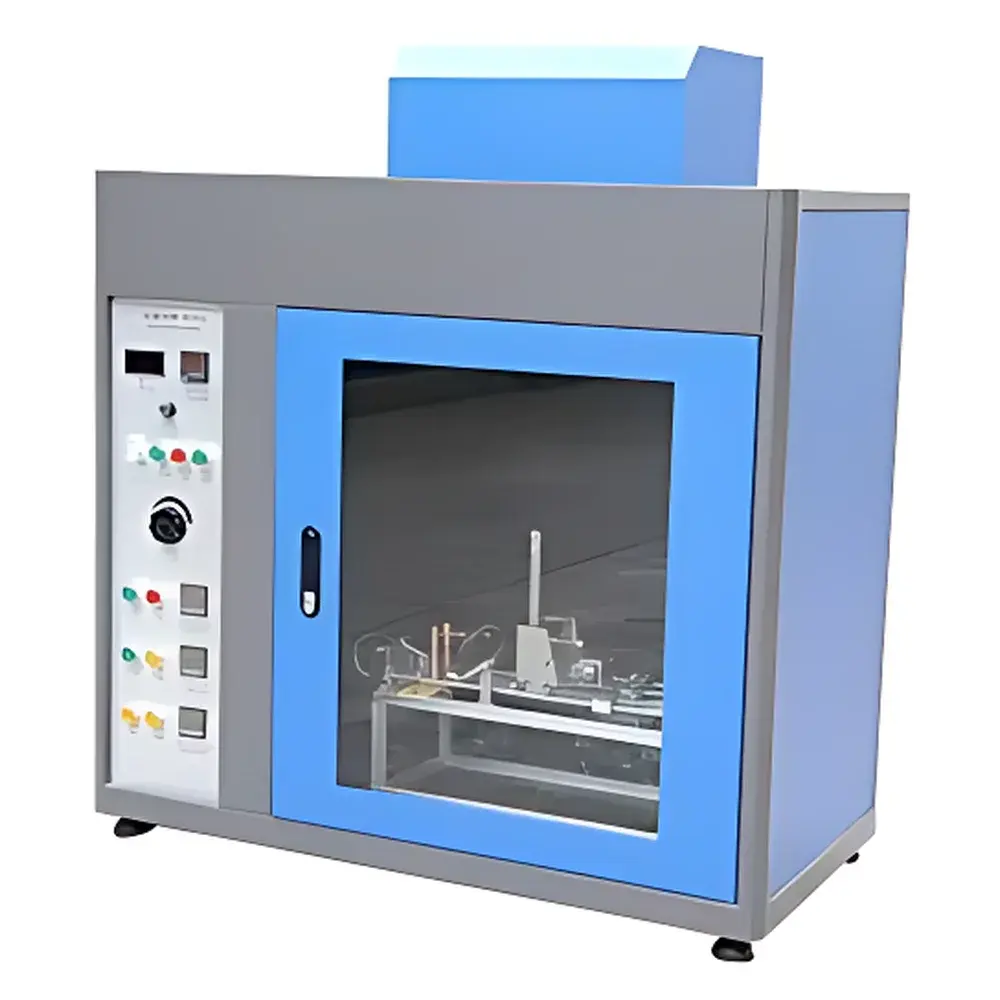
Jiubin Instruments JB-5202A Glow-Wire Test Apparatus
| Brand | Jiubin Instruments |
|---|---|
| Origin | Shanghai, China |
| Model | JB-5202A |
| Chamber Volume | 0.5 m³ |
| External Dimensions (W×L×H) | 600 × 1200 × 1000 mm |
| Glow Wire Material | Ni/Cr (80/20), Ø4 mm |
| Thermocouple Type | K-type armored, Ø0.5 mm |
| Maximum Operating Temperature | ≥1050 °C |
| Temperature Accuracy at 960 °C | ±3 °C |
| Temperature Control | PID microprocessor-based, 0–1300 °C range, 1 °C resolution, stability <0.5 °C |
| Heating Current | 110–130 A |
| Applied Force | 1 N |
| Glow Wire Penetration Depth | 7 mm (mechanically constrained) |
| Minimum Retraction Distance after Test | >7 mm |
| Automatic Sample Disengagement | Yes |
| Distance from Glow Wire Tip to Pine Board Surface | 200 ± 5 mm |
| Pine Board Thickness | 10 mm |
Overview
The Jiubin Instruments JB-5202A Glow-Wire Test Apparatus is a precision-engineered compliance testing system designed to evaluate the fire hazard potential of non-metallic materials and components used in electrical and electronic equipment. It operates in strict accordance with internationally harmonized standards—including IEC 60695-2-10:2021, IEC 60695-2-11:2021, IEC 60695-2-12:2021, and GB/T 5169.10–2017—which define the glow-wire ignition temperature (GWIT), glow-wire flammability index (GWFI), and material performance under controlled thermal stress without flame involvement. The apparatus employs a standardized nickel-chromium (80/20) resistive loop—preheated electrically to precise target temperatures—to simulate abnormal heat conditions such as those arising from overheated components or fault currents. Upon contact with the test specimen under a defined mechanical load (1 N), thermal transfer initiates surface degradation; observation of ignition, flaming duration, or char depth determines pass/fail status per standard-defined criteria.
Key Features
- Robust stainless-steel test chamber with internal volume of 0.5 m³, compliant with ventilation and containment requirements for smoke and combustion by-product management.
- Precision-engineered glow wire assembly: Ø4 mm Ni/Cr (80/20) resistance wire, mounted on a rigid, thermally stable support structure with repeatable axial alignment.
- K-type armored thermocouple (Ø0.5 mm) integrated directly into the glow wire tip for real-time, high-fidelity temperature feedback and closed-loop PID control.
- Digital microprocessor-based temperature controller offering 0–1300 °C range, 1 °C resolution, and thermal stability better than ±0.5 °C—ensuring repeatability across sequential tests.
- Automated mechanical actuation system delivering consistent 1 N contact force and precisely limiting penetration depth to 7 mm via physical stop mechanism.
- Full-cycle automation: motor-driven forward contact, dwell time initiation, post-test retraction (>7 mm), and specimen disengagement—all programmable and reproducible.
- Integrated pine board support fixture maintaining fixed 200 ± 5 mm vertical clearance between glow wire tip and 10 mm-thick white pine substrate—meeting exact dimensional tolerances specified in IEC 60695-2-10.
Sample Compatibility & Compliance
The JB-5202A accommodates flat, rigid, or semi-rigid specimens up to 100 mm × 100 mm × 12 mm in dimension, including housings, insulators, connectors, printed circuit board substrates, and polymer enclosures. Specimens are mounted vertically on a non-combustible holder aligned perpendicular to the glow wire axis. The apparatus satisfies functional requirements for third-party certification bodies conducting UL 746A, EN 60335-1, EN 60695-2-10/11/12, and GB 4706.1 evaluations. Its design supports full traceability in GLP and GMP-aligned laboratories through calibrated instrumentation logs and operator-auditable mechanical settings. All thermal and mechanical parameters are verifiable against national metrological standards (e.g., CNAS-accredited calibration protocols).
Software & Data Management
While the JB-5202A operates via embedded hardware controls (no PC dependency), it features RS-485 serial output for integration into centralized lab data acquisition systems. Temperature setpoints, actual tip readings, dwell durations, and pass/fail flags can be logged externally using SCADA-compatible software. Optional digital interface modules support CSV export, timestamped event logging, and audit trail generation compliant with FDA 21 CFR Part 11 requirements when deployed in regulated quality assurance environments. Calibration records, user access logs, and maintenance history may be maintained separately in accordance with ISO/IEC 17025 documentation frameworks.
Applications
- Fire safety qualification of polymeric materials (e.g., ABS, PC, PBT, PA66) prior to use in consumer electronics enclosures.
- Verification of flame-retardant additive efficacy in thermoplastics and thermosets under standardized thermal stress.
- Pre-certification screening for CE marking, CCC, and UL recognition programs requiring GWIT/GWFI classification.
- Root-cause analysis of field failures linked to thermal runaway or localized overheating in power supplies and control modules.
- Material selection support during early-stage product development—enabling comparative assessment of candidate resins under identical thermal loading conditions.
FAQ
What standards does the JB-5202A fully support?
IEC 60695-2-10:2021 (GWIT), IEC 60695-2-11:2021 (GWFI), IEC 60695-2-12:2021 (flammability under glow-wire), GB/T 5169.10–2017, and UL 746A Annex C.
Is the temperature calibration traceable to national standards?
Yes—the integrated K-type thermocouple and PID controller are compatible with external reference calibrators traceable to CNAS or ILAC-MRA accredited laboratories.
Can the apparatus be used for both GWIT and GWFI testing?
Yes—by adjusting temperature setpoint, dwell time (30 s for GWIT, 60 s for GWFI), and evaluation criteria per Clause 9 of IEC 60695-2-10.
Does the system include flame detection or optical monitoring?
No—the JB-5202A is a manual observation-based apparatus; flame onset, extinction time, and char formation must be recorded visually by trained operators per standard procedure.
What maintenance intervals are recommended for sustained accuracy?
Glow wire replacement after 100 test cycles or visible deformation; thermocouple verification every 3 months; mechanical alignment check before each daily test session.
Related Products



