
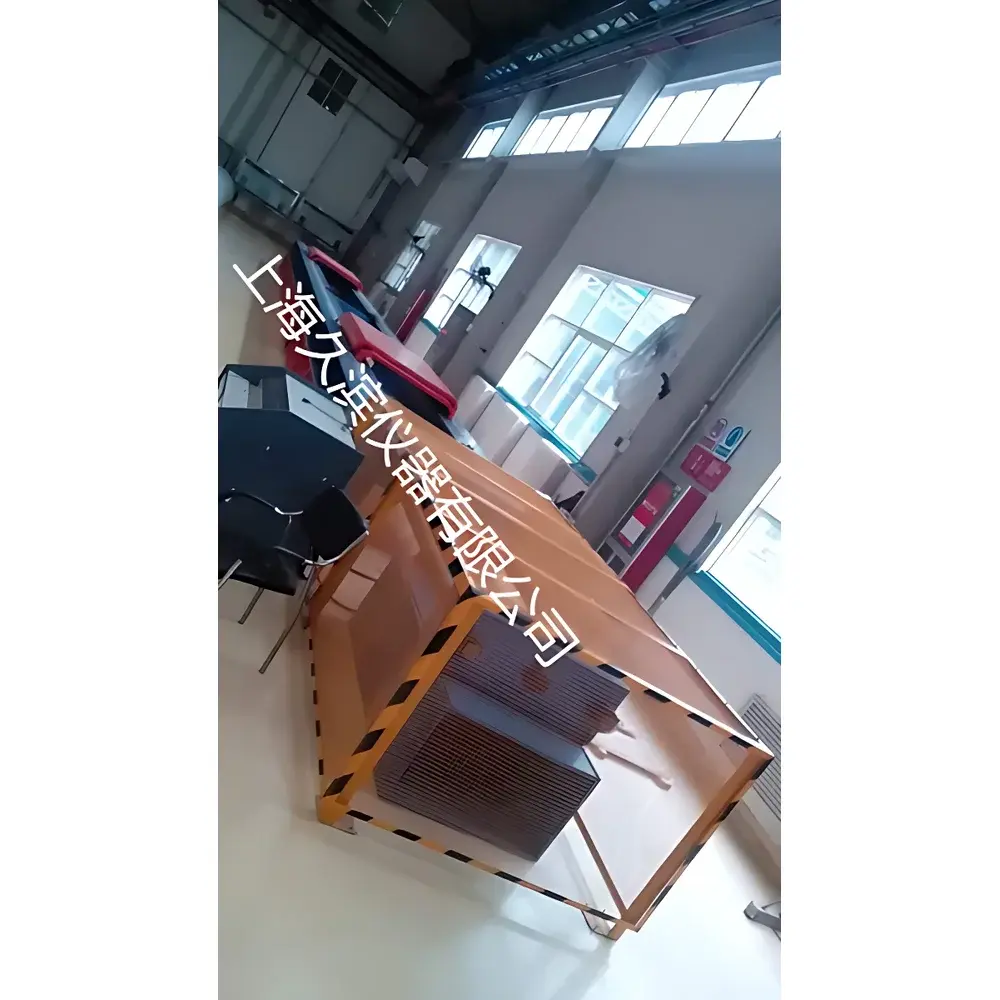
Jiubin JB-1000KN Horizontal Hydraulic Tensile Testing Machine for Ropes, Slings, Cables and Rigging
| Brand | Jiubin Instruments |
|---|---|
| Origin | Shanghai, China |
| Model | JB-1000KN |
| Max Test Force | 1000 kN (optional: 300 / 600 / 2000 kN) |
| Force Measurement Range | 2–100% FS |
| Force Accuracy | ≤ ±1% of reading |
| Stroke Adjustment Options | 5 / 8 / 10 / 12 m (customizable) |
| Displacement Resolution | ≤ ±0.5% of reading |
| Frame Width | 1200 mm |
| Test Height | 800 mm |
| Crosshead Travel Speed | 0.005–50 mm/min |
| Load Cell Type | Through-hole 1000 kN load cell (AC Sensors, USA) |
| Control System | Full-digital single-channel electro-hydraulic servo controller |
| Compliance | GB/T 228.1–2021, GB/T 2611–2007, JJG 139–2014, GB/T 7314–2017 |
Overview
The Jiubin JB-1000KN Horizontal Hydraulic Tensile Testing Machine is an industrial-grade static tensile testing system engineered for high-force mechanical evaluation of flexible load-bearing components—including synthetic fiber ropes, wire rope slings, lifting straps, towing cables, anchor chains, and rigging hardware. Designed for horizontal configuration, it eliminates gravitational bending moments and enables true axial loading of long, heavy, or high-stiffness specimens—critical for accurate determination of ultimate tensile strength (UTS), yield behavior, elongation at break, modulus of elasticity, and creep resistance under sustained loads. The system employs a dual-frame welded steel structure with a top-mounted double-acting hydraulic cylinder, direct-load-path force transmission via through-hole load cell, and high-resolution optical encoder-based displacement measurement. Its load frame accommodates test lengths up to 5 meters (excluding cylinder stroke), supporting full-scale qualification per ISO 10542, EN 1492-1, ASME B30.9, and OSHA-compliant sling certification protocols.
Key Features
- Robust dual-beam welded frame with modular crosshead adjustment (500 mm pitch, pin-lock mechanism) for rapid reconfiguration across specimen geometries and test lengths.
- High-stability electro-hydraulic servo control system featuring a Parker hydraulic power unit, precision FF113-95 servo valve, and dual-stage pressure-compensated oil circuit—enabling low-noise (<65 dB(A)) operation and stable force regulation even at sub-1% FS loading.
- Full-digital single-channel controller with 6 kHz data refresh rate, 24-bit A/D & D/A resolution, and seamless switching between force-controlled, displacement-controlled, and hold-mode test profiles.
- Integrated safety architecture including dual-limit mechanical stops, programmable load upper/lower bounds, rupture-triggered auto-stop, thermal/level monitoring (10–55 °C range), and 110% overload cut-off with audible alarm.
- Through-hole 1000 kN load cell (AC Sensors, USA) calibrated traceable to NIST standards; displacement measured via linear optical encoder with ≤0.2 µm resolution and ≤±0.5% FS accuracy.
- Manual override capability via push-button panel for emergency start/stop and local hydraulic flow control—complementing automated software operation without compromising operational flexibility.
Sample Compatibility & Compliance
The JB-1000KN is optimized for specimens requiring extended gauge lengths and high axial stiffness, including braided polyester/Nylon slings, Dyneema® and Aramid-based mooring lines, galvanized steel wire ropes (6×19, 6×36, 8×19 constructions), chain assemblies (Grade 80/100), and composite tow ropes used in marine, energy, and infrastructure applications. Its plug-in style gripping system supports rapid tooling changeover for flat webbing, round slings, cable terminations, and thimble-secured ends. The machine meets structural and metrological requirements of GB/T 228.1–2021 (equivalent to ISO 6892-1), GB/T 2611–2007 (general testing machine specifications), JJG 139–2014 (verification regulation for universal testing machines), and GB/T 7314–2017 (compression testing). It supports GLP-compliant audit trails when operated with optional 21 CFR Part 11–enabled software modules.
Software & Data Management
ADS800-based control software provides a Windows-native interface with intuitive drag-and-drop test sequencing, real-time dual-channel oscilloscope visualization, and multi-curve overlay functionality. Users define custom test methods—including ramp-hold-ramp cycles, stepwise force targeting, and time-dependent relaxation protocols—without programming. All raw data (force, displacement, time) are timestamped and stored in ASCII-compatible .csv format with metadata headers for LIMS integration. The system supports automatic report generation per ASTM E8/E8M or ISO 6892 templates, with configurable fields for operator ID, calibration certificate number, environmental conditions, and specimen identification. Optional network-enabled remote monitoring allows secure access to live test status, historical datasets, and predictive maintenance alerts via HTTPS-encrypted web dashboard.
Applications
This tester serves quality assurance laboratories in rope manufacturing, offshore equipment certification bodies, port authority inspection departments, defense logistics centers, and wind turbine installation contractors. Typical use cases include: qualification testing of lifting slings prior to field deployment; fatigue life assessment of mooring lines under cyclic tension; verification of splice efficiency in synthetic fiber ropes; validation of termination integrity (e.g., swaged sockets, Flemish eyes); and compliance verification against DNV-OS-E301, API RP 2R, or EN 13411-2 standards. Its horizontal layout permits direct coupling to auxiliary devices such as creep chambers, environmental enclosures, or inline video extensometers for strain-field analysis.
FAQ
What types of grips are available for rope and sling testing?
Standard configurations include pin-type jaw grips for webbing and wire rope, U-bolt clamps for large-diameter cables, and custom-machined socket fixtures for terminated ends. All grips are designed to prevent premature slippage or crushing damage per ISO 12947-2 guidelines.
Can the machine perform constant-load hold tests for creep evaluation?
Yes—the controller supports indefinite force-hold modes with real-time drift compensation and automatic logging of time-to-failure or strain accumulation at user-defined load levels.
Is third-party calibration and certification supported?
The system ships with factory calibration certificates traceable to CNAS-accredited labs. Optional on-site verification by TÜV SÜD, SGS, or BV is available upon request, including uncertainty budget documentation.
How is data integrity ensured during long-duration tests?
All measurements undergo continuous checksum validation; power-loss recovery preserves last valid state; and non-volatile memory buffers ensure zero data loss during unexpected shutdowns.
Does the system comply with FDA or pharmaceutical industry requirements?
While primarily deployed in industrial QA, the optional 21 CFR Part 11 module provides electronic signature support, audit trail logging, and role-based access control—enabling use in regulated GMP environments where mechanical testing of medical device tethering systems is required.



