
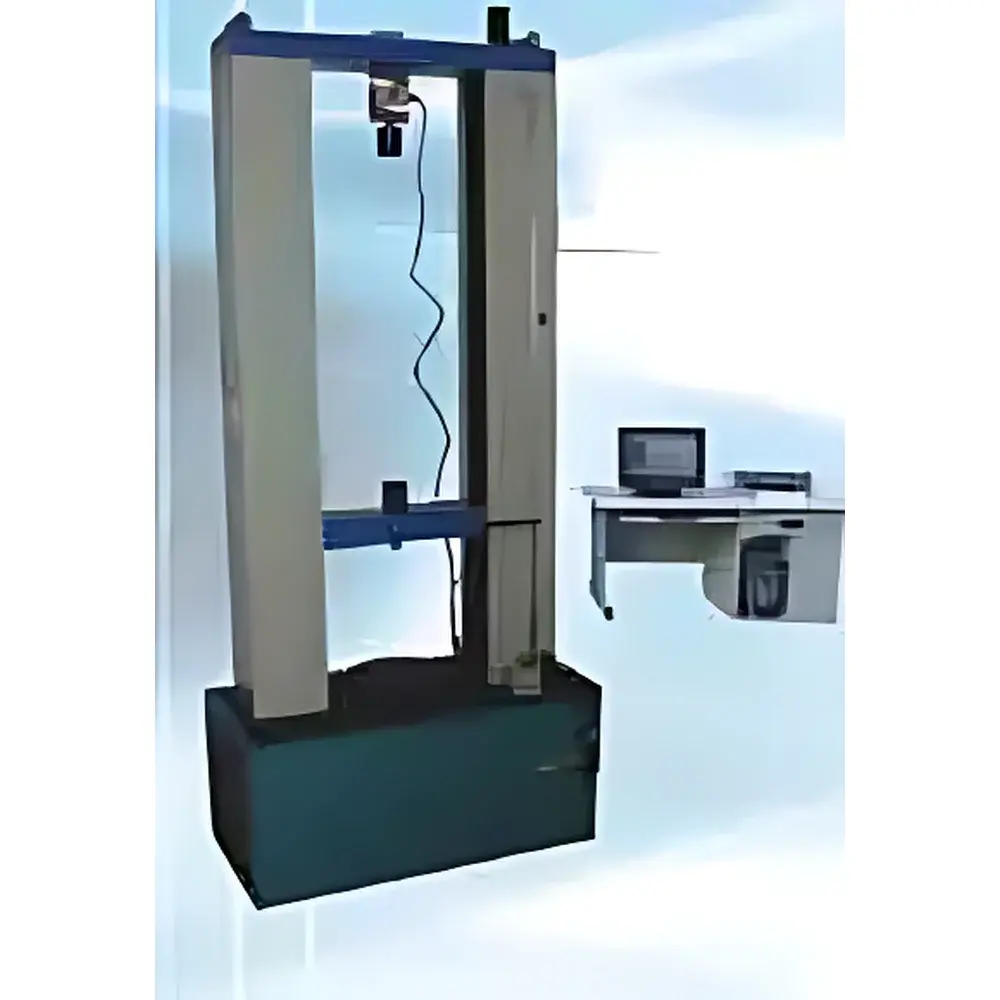
Jiubin JB-118 Advanced Universal Tensile Testing Machine
| Brand | Jiubin Instruments |
|---|---|
| Origin | Shanghai, China |
| Model | JB-118 |
| Load Capacity | 0–5 kN (user-selectable) |
| Force Sensing | High-precision load cell (USA-manufactured) |
| Force Accuracy | ±0.5% of full scale |
| Effective Test Width | 380 mm |
| Max. Tensile Stroke | 1000 mm |
| Drive System | Servo motor (Japan-made) + AC motor (Taiwan-made) |
| Mechanical Transmission | Precision ground ball screw (Taiwan-made) + High-strength backlash-free lead screw (Korea-made) |
| Test Speed Range | 0.001–500 mm/min (infinitely variable) |
| Displacement Resolution | 0.005% |
| Position Resolution | 1/200,000 |
| Safety Features | Upper/lower mechanical limits, emergency stop button |
| Display Interface | Dual-mode — PC-based software + embedded microcomputer display |
| Power Supply | 220 V, 50 Hz |
| Net Weight | 1180 kg |
| Dimensions (W×D×H) | 1280 × 950 × 1800 mm |
| Unit Options | g, kg, N, kN, lb, lbf |
Overview
The Jiubin JB-118 Advanced Universal Tensile Testing Machine is an electromechanically integrated materials testing system engineered for precision mechanical property evaluation across R&D laboratories, quality control departments, and production facilities. Based on the fundamental principles of uniaxial static loading, the system applies controlled tensile, compressive, flexural, peel, tear, and shear forces to specimens while continuously measuring force, displacement, and strain in real time. Its modular architecture integrates a high-fidelity load cell (calibrated to ASTM E4 and ISO 7500-1 Class 0.5), a closed-loop servo-controlled actuation system, and dual-mode data acquisition—enabling traceable, repeatable, and auditable test execution under ISO/IEC 17025-compliant environments. Designed as a floor-standing unit with industrial-grade structural rigidity, the JB-118 meets mechanical stability requirements for low-noise force measurement at sub-newton resolution and maintains geometric alignment over extended operational cycles.
Key Features
- Modular load capacity configuration: User-selectable range from 0–5 kN, optimized for metallic alloys, polymers, composites, textiles, elastomers, and thin-film substrates.
- Dual-drive architecture: Hybrid motion control combining Japanese servo motors (for high-accuracy low-speed testing) and Taiwan-sourced AC motors (for robust mid-to-high speed operation).
- High-precision mechanical transmission: Dual-screw system featuring Taiwan-manufactured ground ball screws and Korean-made zero-backlash lead screws—ensuring axial runout < 5 µm over full stroke.
- Infinitely variable speed control: Programmable test velocity from 0.001 mm/min (creep/stress-relaxation studies) to 500 mm/min (high-rate impact simulation), compliant with ASTM D638, ISO 527, and GB/T 1040 test standards.
- Redundant safety architecture: Dual-limit mechanical stops, Category 3 emergency stop circuit per IEC 60204-1, and automatic load cutoff at preset thresholds.
- Multi-interface data acquisition: Simultaneous output via RS-232/USB to host PC and embedded microcontroller display—supporting synchronized waveform capture and real-time curve overlay.
Sample Compatibility & Compliance
The JB-118 accommodates standardized and custom specimen geometries—including dog-bone, dumbbell, strip, and disc formats—via interchangeable jaw systems (e.g., pneumatic wedge grips, serrated flat grips, and peel fixtures). It supports ASTM D882 (thin plastic films), ASTM D1445 (yarn tensile), ISO 179 (Izod impact pre-test conditioning), and EN 13924 (adhesive peel strength). All force and displacement calibrations are traceable to NIST-certified reference standards. The system’s mechanical design conforms to CE machinery directive 2006/42/EC, and its electrical subsystem complies with EMC Directive 2014/30/EU. Optional configurations support GLP/GMP audit readiness through timestamped test logs, user-access controls, and electronic signature capability (aligned with FDA 21 CFR Part 11 Annex 11 principles).
Software & Data Management
The JB-118 operates with Jiubin’s proprietary TensilePro v3.2 software suite, compatible with Windows 10/11 (64-bit). The application enables full test method scripting (including multi-step ramp-hold cycles), real-time stress–strain curve rendering, modulus calculation (secant, tangent, chord), yield point detection (0.2% offset), and fracture energy integration. Data export supports CSV, PDF, XML, and ASTM E1432-compliant .tdf formats. Audit trails record operator ID, calibration history, environmental metadata (optional temperature/humidity input), and parameter modification timestamps. Network deployment allows centralized database archiving via SQL Server or cloud-synced NAS—facilitating cross-site QC comparison and SPC chart generation.
Applications
- Metals & Alloys: Yield strength, ultimate tensile strength (UTS), elongation at break, and reduction in area per ASTM E8/E21.
- Polymers & Plastics: Tensile modulus, ductility transition analysis, and creep compliance modeling (ISO 899-1).
- Textiles & Nonwovens: Burst strength (ASTM D3786), seam slippage (ASTM D434), and yarn tenacity (ASTM D2256).
- Medical Devices: Suture tensile integrity (ISO 10555-1), catheter column strength (ISO 5840-3), and packaging seal peel resistance (ASTM F88).
- Electronics: Bond wire pull strength (MIL-STD-883 Method 2011), PCB flexural fatigue (IPC-TM-650 2.4.1), and connector retention force.
FAQ
What standards does the JB-118 comply with for force calibration?
The load cell is factory-calibrated to ISO 7500-1 Class 0.5 and ASTM E4; optional third-party certification to UKAS or DAkkS is available upon request.
Can the system perform cyclic loading or fatigue tests?
Standard configuration supports static and quasi-static tests only; fatigue-capable variants (JB-118F) with hydraulic/pneumatic actuators and waveform generator modules are offered separately.
Is test data export compatible with LIMS or ERP systems?
Yes—via configurable ODBC drivers and REST API endpoints, enabling direct ingestion into LabWare, Thermo Fisher SampleManager, or SAP QM modules.
What maintenance intervals are recommended for long-term accuracy?
Load cell verification every 6 months; ball screw lubrication every 1,000 operational hours; annual full-system metrological recalibration advised.
Does the system support ASTM/ISO-compliant reporting templates?
Preloaded templates for ASTM D638, ISO 527-2, EN ISO 1210, and GB/T 1040.1–1040.5 are included; custom report builders allow institutional branding and regulatory clause referencing.



