
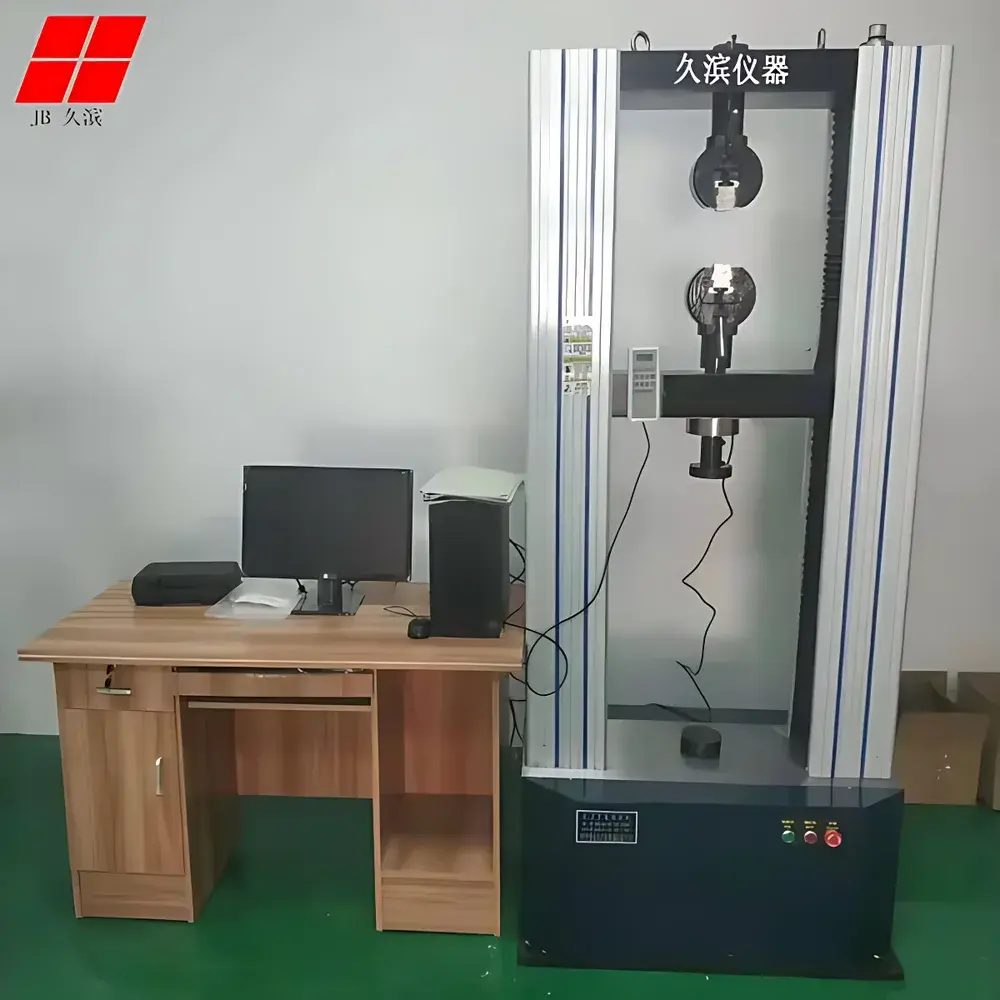
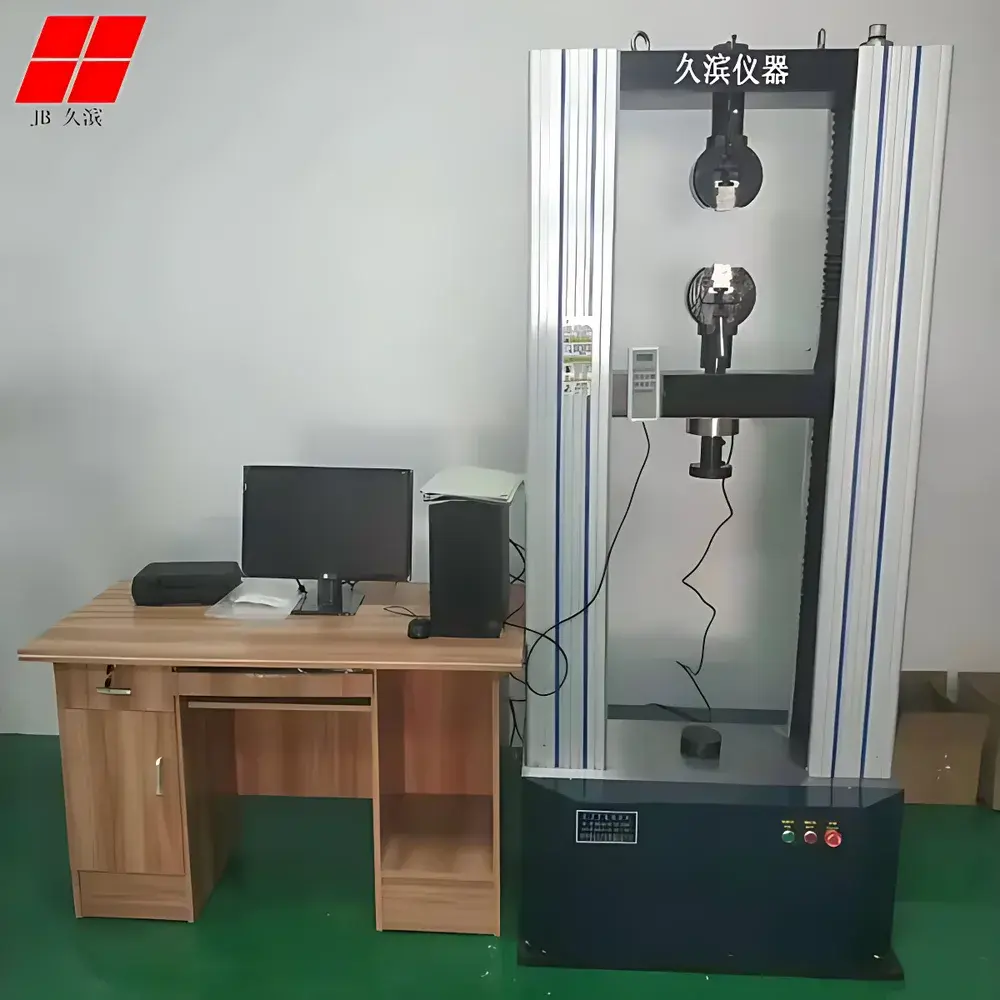
Jiubin JB-119 Brake Cable Tensile Testing Machine
| Brand | Jiubin (JByq) |
|---|---|
| Origin | Shanghai, China |
| Manufacturer Type | Authorized Distributor |
| Country of Origin | China |
| Model | JB-119 |
| Instrument Type | Electromechanical Tensile Testing Machine |
| Maximum Test Load | Customizable (Standard Configuration: 100 kN) |
| Load Accuracy | ±0.5% of full scale |
| Force Resolution | 1/200,000 FS |
| Displacement Accuracy | ±0.5% of reading |
| Test Speed Range | 0.001–500 mm/min |
| Effective Travel | 700 mm |
| Dimensions (W×D×H) | 600 × 360 × 1850 mm |
| Power Supply | AC 220 V ±10%, 50 Hz |
| Weight | ~600 kg |
Overview
The Jiubin JB-119 Brake Cable Tensile Testing Machine is a high-precision electromechanical universal testing system engineered for static mechanical characterization of brake cables, cable assemblies, and their terminations used in automotive, motorcycle, and e-bike braking systems. It operates on the principle of controlled uniaxial tension application, measuring force-displacement response to determine critical mechanical performance parameters—including ultimate tensile strength, yield strength, elongation at break, modulus of elasticity, and peel or pull-out strength of crimped or swaged end fittings. The machine complies with standardized test methodologies defined in ISO 6892-1 (metallic materials – tensile testing), ASTM D638 (plastics), ASTM D412 (rubber), and GB/T 228.1 (Chinese national standard for metallic materials). Its closed-loop servo control architecture ensures consistent loading rates, precise strain rate regulation, and high reproducibility across repeated tests—essential for quality assurance in Tier-1 supplier validation and OEM component certification workflows.
Key Features
- Robust dual-column steel frame with preloaded ball-screw drive system for minimal deflection and long-term dimensional stability under cyclic loading.
- High-resolution load cell (±0.5% FS accuracy) integrated with real-time digital signal conditioning and 24-bit ADC for noise-immune data acquisition.
- Programmable test sequences supporting multi-step protocols: preload → ramp-to-load → hold → ramp-to-failure → unloading, with user-defined dwell times and slope limits.
- Automatic calibration traceability via internal reference standards; supports external verification per ISO/IEC 17025 requirements.
- Modular grip interface accommodating wedge-type, pneumatic, and hydraulic fixtures—optimized for cylindrical brake cable ends (Ø1.2–6.0 mm), ferrules, and overmolded terminations.
- Integrated safety interlocks including emergency stop circuitry, upper/lower travel limit switches, and overload cut-off at 110% FS.
Sample Compatibility & Compliance
The JB-119 accommodates a broad spectrum of linear components beyond brake cables—including metallic wires (stainless steel, galvanized steel), polymer-coated cables, braided synthetic ropes, and composite-reinforced control lines. Its standardized test fixture geometry enables direct comparison against OEM specification sheets referencing SAE J1140 (Brake System Components), ISO 15622 (Brake Cable Performance Requirements), and ECE R13-H (Braking Systems for Motor Vehicles). All test reports include metadata compliant with GLP and GMP documentation practices, with optional audit trails meeting FDA 21 CFR Part 11 requirements when paired with validated software modules.
Software & Data Management
Equipped with Jiubin’s proprietary TestMaster v4.2 software, the system delivers ISO 17025-aligned data handling: automatic calculation of engineering stress-strain curves, offset yield points (0.2% proof stress), reduction in area, and secant modulus. Raw data export is supported in CSV, XML, and PDF formats—with embedded digital signatures for integrity verification. The software includes built-in report templates aligned with CNAS-accredited laboratory formats and supports batch processing for statistical analysis (mean, SD, CV%, CPK) across production lots. Optional network deployment enables centralized database synchronization and remote monitoring via secure HTTPS API endpoints.
Applications
- Validation of brake cable assembly integrity during new product introduction (NPI) in Tier-2 automotive suppliers.
- Periodic conformance testing of incoming raw materials (e.g., stainless steel wire tensile grade 304 vs. 316).
- Failure mode analysis (FMA) of premature cable breakage, crimp slippage, or jacket delamination in field-return investigations.
- Material substitution studies comparing traditional steel cables versus high-strength polymer alternatives under identical environmental preconditioning (e.g., salt fog exposure per ASTM B117).
- Research-grade mechanical property mapping for novel termination geometries—supporting finite element model (FEM) boundary condition definition.
- Third-party certification testing for CE marking compliance under Machinery Directive 2006/42/EC Annex IV essential health and safety requirements.
FAQ
What international standards does the JB-119 support out-of-the-box?
It natively implements test routines conforming to ISO 6892-1, ASTM D638, ASTM D412, GB/T 228.1, and ISO 15622—with additional method templates available upon request.
Can the system perform cyclic fatigue testing?
No—the JB-119 is configured for static monotonic loading only. For dynamic or high-cycle fatigue applications, we recommend the complementary Jiubin JB-FAT series with electrodynamic actuation.
Is third-party calibration certification included with purchase?
A factory calibration certificate traceable to NIM (National Institute of Metrology, China) is provided; ISO/IEC 17025-accredited calibration by an external body may be arranged separately.
What is the lead time for custom load capacity configurations?
Standard 100 kN units ship within 4 weeks; non-standard capacities (e.g., 200 kN or 50 kN low-force variants) require 8–10 weeks for mechanical redesign and validation.
Does the software meet regulatory requirements for electronic records in regulated industries?
Yes—when deployed with the optional 21 CFR Part 11 Module, it provides role-based access control, electronic signatures, and immutable audit logs required for pharmaceutical or medical device QMS compliance.



