
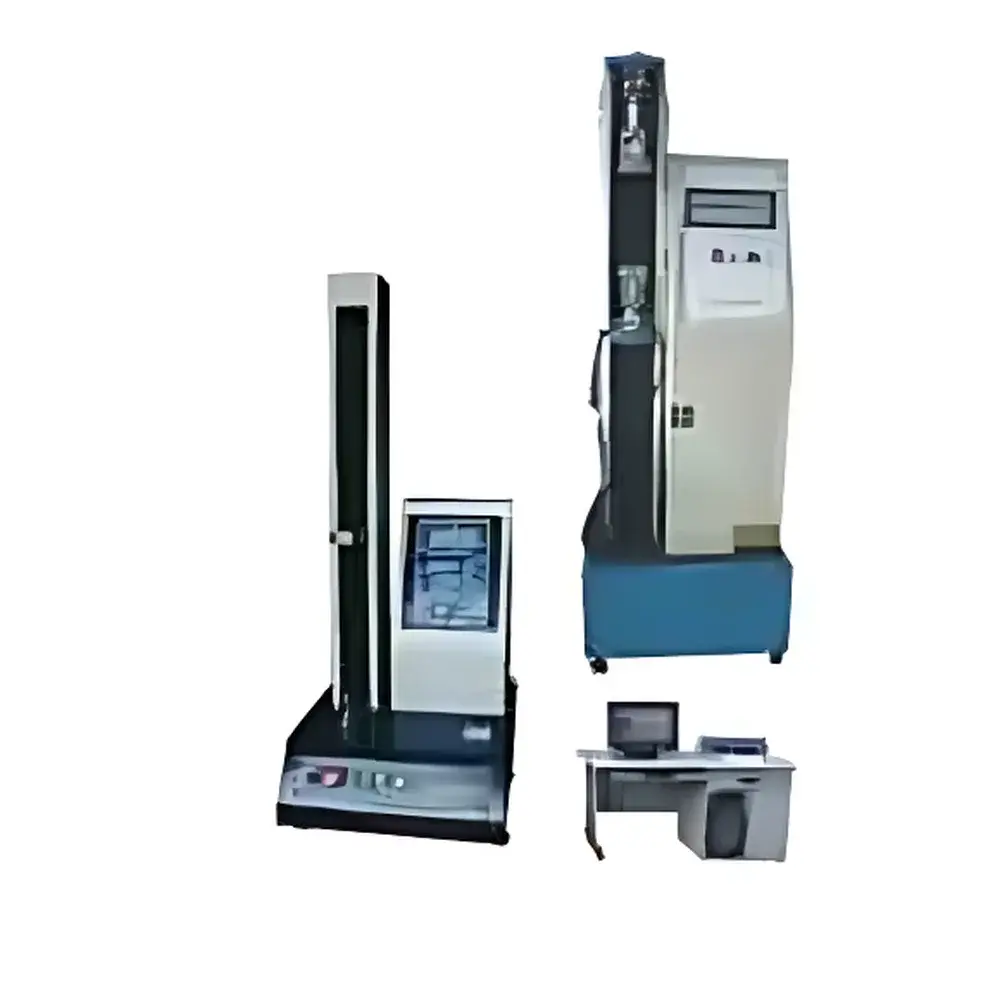
Jiubin JB-126A Fiber Optic Materials Universal Testing Machine
| Brand | Jiubin |
|---|---|
| Origin | Taiwan |
| Model | JB-126A |
| Instrument Type | Electromechanical Universal Testing Machine |
| Load Capacity | 0–200 kg (user-selectable) |
| Load Cell Accuracy | ≤0.5% FS |
| Effective Test Width | 380 mm |
| Max. Stroke for Tensile Testing | 1000 mm |
| Drive System | Servo Motor (Japan-made) |
| Transmission | Precision Ball Screw (Taiwan-made) |
| Speed Range | 0.001–500 mm/min (infinitely variable, programmable) |
| Displacement Resolution | 0.005% of full scale |
| Force Resolution | 1/200,000 |
| Safety Features | Upper/Lower Mechanical Limits, Emergency Stop Button |
| Display Interface | Dual-mode — PC-based software + Embedded Microcomputer Display |
| Unit Options | g, kg, N, kN, lb |
| Power Supply | 220 V, 50 Hz |
| Net Weight | 160 kg |
| Dimensions (W×D×H) | 450 × 450 × 900 mm |
| Clamping Fixture | Custom-configurable per sample geometry and standard requirement |
Overview
The Jiubin JB-126A Fiber Optic Materials Universal Testing Machine is an electromechanical, servo-controlled static mechanical testing system engineered for high-reproducibility tensile, compression, flexural (3-point bend), and shear characterization of low-to-medium stiffness materials—including optical fiber preforms, polymer-coated fibers, buffer tubes, strength members (e.g., aramid yarns), and cable assemblies. Designed in accordance with fundamental principles of uniaxial mechanical metrology, the system implements closed-loop force and displacement control via a calibrated load cell (U.S.-manufactured, ±0.5% full-scale accuracy) and high-resolution encoder feedback (0.005% displacement resolution). Its rigid frame architecture—featuring ground-mounted construction, precision-ground ball screws (Taiwan-sourced), and anti-backlash transmission—ensures minimal compliance and long-term dimensional stability during repeated loading cycles. The JB-126A complies with core mechanical test methodology frameworks defined in ASTM D638, ISO 527-1, IEC 60794-1-2, and Telcordia GR-20, making it suitable for R&D labs, cable manufacturing QA/QC departments, and third-party certification facilities requiring traceable, auditable mechanical data.
Key Features
- Servo-driven actuation system (Japan-sourced motor) enabling precise, noise-free speed control across 0.001–500 mm/min—fully programmable for ramp, hold, cyclic, or multi-step profiles
- Dual-display architecture: embedded microcomputer interface for real-time force/displacement monitoring + Windows-based PC software for advanced analysis, report generation, and data archival
- Modular fixture platform supporting standardized grips (pneumatic, wedge, pin, vise-type) and custom tooling for fragile or irregular cross-sections (e.g., 250 µm coated fiber, ribbon cables, or loose-tube structures)
- Integrated safety subsystem including dual mechanical end-stop limits, hardware-triggered emergency stop, and automatic overload cutoff to protect both specimen integrity and operator safety
- High-force resolution (1/200,000 full scale) and sub-micron displacement fidelity—critical for detecting subtle yield transitions in polymer coatings or interfacial delamination onset in composite strength members
- Compliance-ready architecture: supports audit trails, user-level access control, electronic signatures, and raw-data export formats compatible with FDA 21 CFR Part 11 and GLP/GMP documentation workflows
Sample Compatibility & Compliance
The JB-126A accommodates specimens ranging from bare silica fibers (125 µm cladding) to armored outdoor cables (up to Ø20 mm). Standardized fixtures meet ISO 11566 (optical fiber proof testing), IEC 60794-1-2-E1 (tensile), -E3 (crush), and -E11 (torsion) requirements. Optional accessories include extensometers for strain measurement (ASTM E83 Class B-1), environmental chambers (−40°C to +85°C), and peel-test fixtures compliant with ASTM D903 and ISO 8510-2. All calibration certificates are traceable to NIST or national metrology institutes (NMI-Taiwan). System validation protocols align with ISO/IEC 17025 clause 5.5 and ASTM E4 for verification of force-measuring systems.
Software & Data Management
The bundled Jiubin TestSuite™ v4.2 provides ISO/IEC 17025-compliant test method templates, automated pass/fail evaluation against user-defined limits, and statistical process control (SPC) charting. Raw data streams are stored in encrypted .jts binary format with embedded metadata (operator ID, timestamp, calibration ID, environmental conditions). Export options include CSV, PDF (with digital signature), XML (for LIMS integration), and image-annotated stress–strain curves. Audit logs record all parameter modifications, test executions, and report revisions—enabling full forensic reconstruction per FDA 21 CFR Part 11 §11.10(a).
Applications
- Tensile strength and elongation-at-break testing of acrylate-coated single-mode fibers per ITU-T G.652.D
- Proof testing of preforms and drawn fibers at 1% strain (100 kpsi equivalent) under controlled humidity
- Compression resistance evaluation of gel-filled loose-tube cables (IEC 60794-1-2-E3)
- Peel adhesion assessment of jacket-to-buffer bonding in indoor/outdoor hybrid cables
- Three-point bending stiffness (flexural modulus) of FRP strength members (ASTM D790)
- Shear strength quantification of splice protector sleeves and heat-shrink tubing interfaces
FAQ
Does the JB-126A support automated sequential testing across multiple specimens without manual intervention?
Yes—via batch mode scripting in TestSuite™, users can define multi-specimen sequences with auto-grip positioning, preset speed profiles, and conditional branching (e.g., abort on overload, continue on pass).
Can the system be integrated into an existing MES or SAP QA module?
Yes—through OPC UA or REST API interfaces, raw test records and summary statistics can be pushed directly to enterprise quality databases.
Is calibration verification required before each test session?
No—routine verification uses internal reference standards per ISO 7500-1; full recalibration is recommended annually or after 10,000 cycles, documented per ISO/IEC 17025.
What is the minimum measurable force resolution for sub-gram fiber specimens?
With optional 10 kg load cell configuration, resolution reaches 0.05 g (0.5 mN) at 1/200,000 scale—sufficient for evaluating coating adhesion forces on 125 µm fibers.
Are firmware updates provided post-purchase, and how are they validated?
Yes—free lifetime firmware updates are delivered quarterly, each accompanied by a validation protocol report confirming compliance with original performance specifications and regulatory clauses.



