
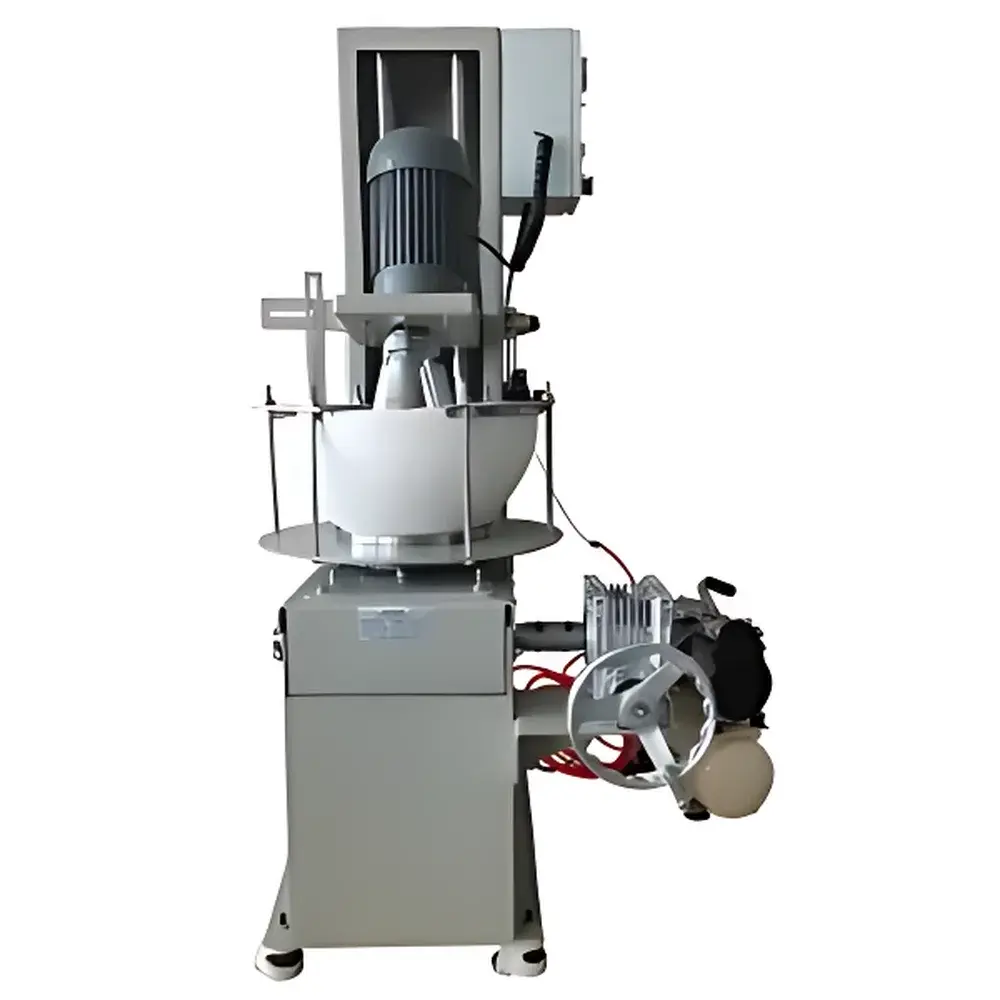
Jiubin JB-400 Pneumatically Actuated Ceramic Mortar Grinder
| Brand | Jiubin |
|---|---|
| Origin | Shanghai, China |
| Model | JB-400 |
| Grinding Principle | Mortar-and-pestle with triple ceramic pestles driven by adjustable-speed motor |
| Drive Type | Pneumatic lift + electric rotation |
| Grinding Chamber Material | High-purity alumina ceramic (95% Al₂O₃) |
| Sample Type | Hard and brittle solids, pastes, and viscous suspensions |
| Max Batch Capacity | 5 L |
| Final Particle Size | ≤10 µm (dry grinding), sub-micron achievable under optimized wet-grinding conditions |
| Temperature Rise | <8 °C after 30 min continuous operation |
| Compliance | Designed to meet ISO 17025 laboratory environment requirements for mechanical stability and contamination control |
| Safety | Integrated pneumatic pressure monitoring, emergency stop, and interlocked lid sensor |
Overview
The Jiubin JB-400 is a heavy-duty, pneumatically actuated ceramic mortar grinder engineered for reproducible, low-contamination size reduction of hard, abrasive, and temperature-sensitive materials. Unlike conventional ball mills or jaw crushers, the JB-400 employs a precision-engineered mortar-and-pestle configuration: three high-density alumina ceramic pestles rotate synchronously within a fixed 95% alumina ceramic mortar bowl under controlled axial pressure. This geometry enables shear-dominated comminution with minimal impact energy—critical for preserving crystal structure in pharmaceutical actives, avoiding amorphization in piezoelectric ceramics, and preventing thermal degradation in thermolabile polymers. The pneumatic lifting system ensures repeatable pestle-to-mortar clearance (±0.1 mm), eliminating manual adjustment variability and enabling consistent force application across batches. Designed for integration into GMP-compliant QC labs and R&D pilot lines, the JB-400 delivers deterministic particle size distribution (PSD) profiles suitable for downstream characterization via laser diffraction (ISO 13320) or SEM imaging.
Key Features
- Triple-ceramic-pestle architecture with independent rotational symmetry—ensures uniform stress distribution and eliminates preferential wear zones.
- Pneumatic vertical actuation (0.2–0.6 MPa adjustable) coupled with digital pressure feedback loop for force consistency across 5-L batch loads.
- Alumina ceramic grinding chamber (≥95% Al₂O₃, Vickers hardness >1800 HV) provides chemical inertness against HF, strong alkalis, and organic solvents—validated per ASTM C704 for abrasion resistance.
- Brushless DC motor with 0–300 rpm continuous variable speed control (0.1 rpm resolution) and torque monitoring output for process signature logging.
- Integrated scraper assembly mounted on rotating shaft automatically clears adhered material from mortar walls during operation—reducing cross-contamination and improving yield recovery to >98.5%.
- Modular base frame with lockable castor wheels (ISO 2862 compliant) and leveling feet supports rapid repositioning without recalibration.
Sample Compatibility & Compliance
The JB-400 accommodates dry powders (e.g., silicon carbide, tungsten carbide, zirconia), semi-solids (dental composites, conductive pastes), and liquid suspensions (pigment dispersions, battery slurry precursors). Its all-ceramic wetted path meets USP requirements for extractables testing and is compatible with cleaning validation protocols per ASTM E3106. Batch-to-batch repeatability has been verified per ISO 5725-2:2019 (intermediate precision ≤3.2% RSD for D₉₀ in quartz powder). The unit operates within ambient lab conditions (15–30 °C, ≤70% RH) and conforms to IEC 61000-6-2/6-4 for electromagnetic compatibility. CE marking documentation includes Declaration of Conformity to Machinery Directive 2006/42/EC and Low Voltage Directive 2014/35/EU.
Software & Data Management
The JB-400 interfaces via RS-485 Modbus RTU or optional USB-C to standalone control software (Windows 10/11 compatible). Each grinding cycle logs timestamp, setpoint rpm, actual torque curve, pneumatic pressure profile, and runtime—exportable as CSV or PDF reports with digital signature. Audit trail functionality complies with FDA 21 CFR Part 11 requirements when paired with validated user access controls (role-based permissions, electronic signatures, and immutable log archiving). Raw data files retain metadata including operator ID, batch ID, and environmental sensor readings (optional external temperature/humidity probe integration).
Applications
- Pharmaceutical: Milling of API crystals (e.g., griseofulvin, ritonavir) to enhance dissolution rate while maintaining polymorphic integrity.
- Advanced Ceramics: Preparing sub-10 µm feedstock powders for tape casting of LTCC substrates and solid oxide fuel cell electrolytes.
- Electronics: Dispersing conductive carbon black or silver flakes in polymer binders without agglomerate regeneration.
- Dentistry: Homogenizing methyl methacrylate-based resin pastes for CAD/CAM crown fabrication with ≤0.5% viscosity drift over 10 consecutive batches.
- Academic Research: Generating reference standards for nanoparticle toxicity assays where metal leaching must be <0.1 ppb (ICP-MS confirmed).
FAQ
What materials are compatible with the ceramic grinding chamber?
Alumina ceramic construction resists corrosion from acids (except hydrofluoric), bases, and organic solvents—suitable for grinding SiC, AlN, borosilicate glass, and epoxy-resin composites.
Can the JB-400 perform wet grinding with solvents like ethanol or acetone?
Yes—sealed mortar lid with Viton gasket (standard) ensures compatibility with common organic solvents; optional Kalrez gasket available for aggressive media such as THF or chlorinated hydrocarbons.
Is calibration required before first use?
No factory calibration is needed; however, users must perform initial verification using NIST-traceable stainless steel test weights (supplied) to confirm pneumatic force linearity per ISO 7500-1.
How is cross-contamination prevented between batches?
The integrated scraper removes >95% residue in situ; residual mass is quantified via gravimetric wipe test (ASTM D4294) and must be ≤50 µg/cm² prior to next run.
Does the system support 21 CFR Part 11 compliance out-of-the-box?
Full compliance requires installation of validated software version v3.2+, configured user roles, and external time-server synchronization—documentation package includes IQ/OQ protocols and risk assessment report.



