
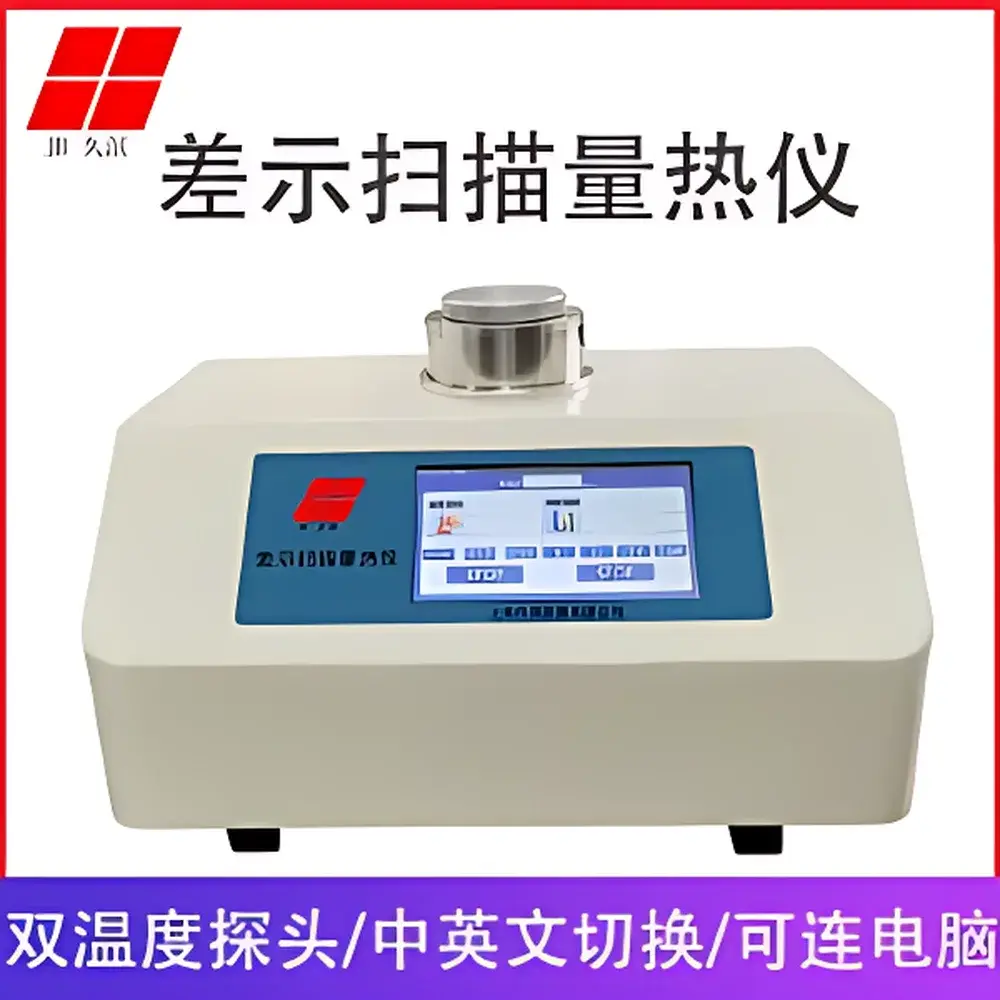
Jiubin JB-DSC-600 Differential Scanning Calorimeter
| Brand | Jiubin |
|---|---|
| Origin | Shanghai, China |
| Manufacturer Type | Authorized Distributor |
| Product Category | Domestic |
| Model | JB-DSC-600 |
| Price Range | USD 7,000–14,000 (FOB) |
| Sample Capacity | Single-position |
| Instrument Type | DSC |
| Temperature Range | Ambient to 600 °C |
| Heating/Cooling Rate | 0.1–100 K/min |
| DSC Sensitivity | 0.01 mW |
| DSC Noise Level | 0.001 mW |
| DSC Resolution | 0.001 mW |
| DSC Accuracy | 0.01 mW |
| Temperature Repeatability | ±0.1 °C |
| Temperature Resolution | 0.1 °C |
| Gas Flow Control | 0–200 mL/min |
| Gas Pressure Rating | 0.2 MPa |
| Display | 7-inch 24-bit LCD touchscreen |
| Data Interface | Standard USB |
| Calibration | Integrated with certified reference materials and one-click thermal & enthalpy calibration |
| Power Supply | AC 220 V, 50 Hz |
| Max Power Consumption | 600 W |
Overview
The Jiubin JB-DSC-600 is a high-stability, single-cell differential scanning calorimeter engineered for precise quantification of thermal transitions and reaction enthalpies in solid and semi-crystalline materials. Operating on the principle of heat-flux DSC, the instrument measures the differential heat flow between a sample and an inert reference as both are subjected to identical, programmable temperature profiles under controlled atmosphere. This enables direct determination of endothermic and exothermic events—including glass transition temperature (Tg), melting point (Tm), crystallization onset (Tc), oxidative induction time (OIT), and crosslinking enthalpy—with reproducible baseline stability and low thermal noise. Designed for routine QC laboratories and R&D environments in polymer science, pharmaceutical development, food chemistry, and advanced materials research, the JB-DSC-600 complies with core methodology standards referenced in ASTM E794, ISO 11357, and USP <1151> for thermal characterization.
Key Features
- Programmable temperature control from ambient to 600 °C with linear ramp rates adjustable from 0.1 to 100 K/min—enabling both slow-scan high-resolution analysis and rapid screening protocols.
- High-sensitivity dual-sensor heat-flux detection system with <0.001 mW baseline noise and 0.001 mW resolution, ensuring reliable detection of subtle thermal events such as secondary relaxations or weak crystallization peaks.
- Integrated gas management module supporting automatic switching between inert (N2, Ar) and oxidative (air, O2) atmospheres, with digitally regulated mass flow (0–200 mL/min) and pressure monitoring up to 0.2 MPa.
- Self-calibrating architecture featuring NIST-traceable reference materials (e.g., indium, zinc, tin) and one-click thermal/enthalpy alignment—reducing operator dependency and supporting GLP-compliant documentation workflows.
- Embedded 7-inch capacitive touchscreen interface with real-time curve overlay, multi-step program editing, and local data storage—eliminating reliance on external PCs for basic operation.
- Robust mechanical design with thermally isolated furnace assembly and optimized sensor geometry to minimize thermal lag and improve positional repeatability (±0.1 °C temperature repeatability).
Sample Compatibility & Compliance
The JB-DSC-600 accommodates standard aluminum, gold-plated aluminum, or hermetic stainless-steel crucibles (40 µL capacity), supporting solids, powders, films, gels, and viscous pastes—including adhesives, thermosets, pharmaceutical excipients, and lipid-based formulations. Its sealed crucible option enables quantitative OIT testing per ASTM D3895 and ISO 11357-6, while open-pan configurations support Tg measurement of amorphous polymers per ISO 11357-2. The system meets essential electrical safety requirements (IEC 61010-1) and electromagnetic compatibility (EN 61326-1). Optional audit-trail logging and user-access controls align with FDA 21 CFR Part 11 readiness when paired with validated PC software.
Software & Data Management
Data acquisition and analysis are supported via optional Windows-based software (JB-ThermalSuite), which provides peak deconvolution, baseline correction, kinetic modeling (e.g., Ozawa-Flynn-Wall), and comparative overlay of up to 16 curves. Raw data export is available in ASCII (.txt), CSV, and universal thermal analysis (.q5) formats. All calibration logs, method parameters, and raw thermograms are timestamped and stored with operator ID—facilitating traceability in GMP/GLP-regulated environments. USB 2.0 interface enables direct transfer to LIMS or ELN systems without proprietary drivers.
Applications
- Determination of glass transition temperature (Tg) in pressure-sensitive adhesives, epoxy resins, and acrylic polymers—critical for predicting service temperature limits and shelf-life stability.
- Oxidative induction time (OIT) assessment of polyolefins and rubber compounds under accelerated aging conditions, per ASTM D3895 and ISO 11357-6.
- Quantification of crystallinity, melt enthalpy, and cold-crystallization behavior in semicrystalline thermoplastics (e.g., PP, PET, PEEK).
- Polymorph screening and solid-state stability profiling of active pharmaceutical ingredients (APIs), including hydrate/anhydrate transitions and eutectic behavior.
- Thermal degradation onset, decomposition kinetics, and residual solvent quantification in composite matrices and battery electrode materials.
- Quality control of food-grade fats and oils via solid fat content (SFC) profile derivation from cooling/heating scans.
FAQ
What sample mass is recommended for optimal Tg measurement?
Typical mass range is 3–10 mg for polymers and adhesives; smaller masses (<2 mg) may increase signal-to-noise ratio but reduce thermal inertia matching—consult ISO 11357-2 for guidance.
Can the JB-DSC-600 perform modulated DSC (MDSC)?
No—this is a conventional heat-flux DSC platform; MDSC capability requires specialized hardware not included in the JB-DSC-600 configuration.
Is nitrogen purging mandatory for all measurements?
Inert purge is required for oxidation-sensitive samples (e.g., OIT, polymer stability); air may be used for robust materials like metals or ceramics during melting point analysis.
How often should calibration be performed?
Initial calibration upon installation and after major maintenance; periodic verification (e.g., weekly or per batch) using indium is recommended for regulated environments.
Does the system support automated sample changers?
The JB-DSC-600 is a manual-load platform; robotic autosamplers are not available as factory options but may be integrated via third-party OEM interfaces.



