
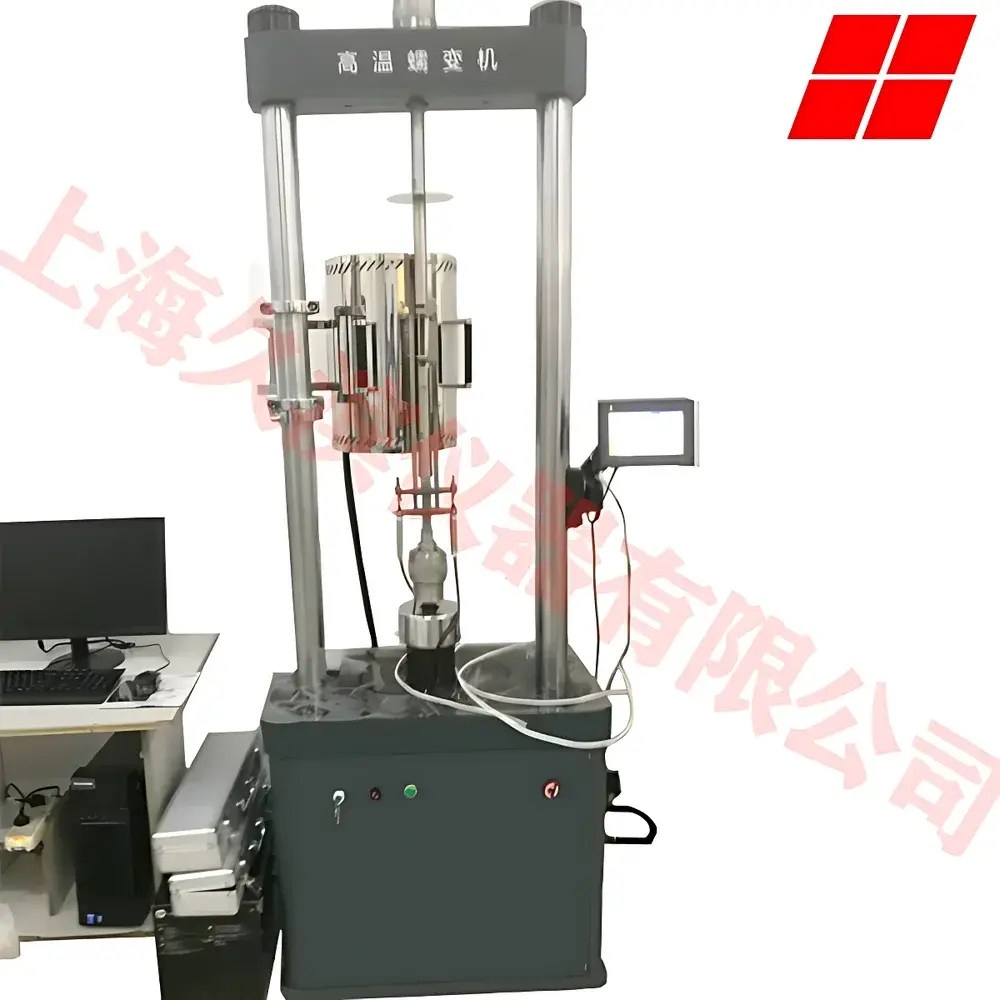
Jiubin JB/RD High-Temperature Creep and Stress-Rupture Testing Machine
| Brand | Jiubin |
|---|---|
| Origin | Shanghai, China |
| Model | JB/RD |
| Force Accuracy | ±0.5% |
| Compliance | JJG 276–2009, JJF 1298–2011, GB/T 2039–1997 |
Overview
The Jiubin JB/RD High-Temperature Creep and Stress-Rupture Testing Machine is an electromechanical testing system engineered for precision measurement of time-dependent deformation and failure behavior of metallic materials under sustained mechanical load at elevated temperatures. It operates on the fundamental principles of uniaxial tensile creep testing—where specimens are subjected to constant axial load (or constant stress) while maintained within a controlled high-temperature furnace environment—and records strain evolution over extended durations (hours to thousands of hours). This instrument supports both creep testing (strain vs. time under constant load/temperature) and stress-rupture (or stress-rupture life) testing (time-to-failure at defined stress levels), fulfilling core requirements for material qualification in high-temperature structural applications such as turbine blades, boiler tubes, nuclear reactor components, and aerospace fasteners.
Key Features
- Full digital closed-loop control architecture with real-time feedback of load, displacement, and temperature—enabling stable load maintenance within ±0.5% of setpoint throughout test duration.
- Integrated high-temperature furnace capable of operation from ambient up to 1200 °C (configurable range depending on furnace type), with uniformity ≤±3 °C across gauge length per ASTM E220.
- Modular load frame with rigid four-column design and preloaded ball-screw actuation, minimizing compliance and ensuring mechanical stability during long-term creep holds.
- Dual-channel high-resolution extensometry: one for high-precision axial strain measurement (capable of sub-micrometer resolution via LVDT or clip-on extensometer), and another for furnace-relative thermal expansion compensation.
- Independent temperature monitoring via multiple calibrated Type-S thermocouples positioned at specimen mid-gauge and furnace hot zone—data logged synchronously with mechanical signals.
- Compliance with national metrological verification protocols: fully aligned with JJG 276–2009 (Verification Regulation for High-Temperature Creep and Stress-Rupture Testing Machines) and JJF 1298–2011 (Type Evaluation Outline for Creep and Stress-Rupture Testing Machines).
Sample Compatibility & Compliance
The JB/RD accommodates standard cylindrical or flat-sheet tensile specimens per GB/T 2039–1997, ASTM E139, ISO 204, and ASTM E292. Specimen dimensions typically range from Ø3–10 mm round bars to 1–3 mm thick sheet coupons, with gauge lengths from 10–50 mm. The system supports both fixed-load (creep) and step-load (stress-rupture) test profiles. All mechanical and thermal calibration procedures adhere to traceable standards referenced in ISO/IEC 17025-accredited laboratories. Data acquisition meets GLP and GMP documentation requirements, including audit-trail-enabled event logging and user-access-controlled parameter locking—compatible with FDA 21 CFR Part 11 readiness when deployed with validated software configuration.
Software & Data Management
The proprietary test control and analysis software provides ISO-compliant test sequence definition, real-time curve overlay (load–time, strain–time, strain–load), automatic rupture detection, and multi-stage ramp-hold programming. Raw data is exported in CSV and XML formats with embedded metadata (operator ID, calibration certificate IDs, environmental timestamps). Software supports statistical post-processing per ASTM E139 Annex A1—including minimum creep rate calculation, Larson–Miller parameter derivation, and Monkman–Grant relationship plotting. All test files include digital signatures and immutable timestamping to satisfy regulatory review requirements in power generation and defense sectors.
Applications
- Long-term creep property characterization of superalloys (e.g., Inconel 718, GH4169) and ferritic/martensitic steels (e.g., P91, P92) for fossil fuel and nuclear power plant component life assessment.
- Stress-rupture life prediction for aerospace engine materials operating above 0.4Tm (melting temperature ratio).
- Interlaboratory comparison studies under ISO/IEC 17043 proficiency testing schemes.
- Validation of constitutive models (e.g., Norton–Bailey power law, Garofalo hyperbolic sine law) used in finite element-based high-temperature structural simulation.
- Quality assurance testing of weldments and heat-affected zones in pressure vessel fabrication per ASME BPVC Section II and Section VIII.
FAQ
What standards does the JB/RD comply with for creep testing?
It conforms to GB/T 2039–1997, ASTM E139, ISO 204, and JJG 276–2009 for mechanical and thermal performance verification.
Can the system perform both creep and stress-rupture tests in a single setup?
Yes—the same hardware configuration supports constant-load creep tests and stepped-stress rupture tests without reconfiguration.
Is furnace temperature uniformity verified and documented?
Yes—temperature mapping reports per ASTM E220 are generated during factory acceptance testing and available upon request.
Does the software support 21 CFR Part 11 compliance?
When deployed with role-based user authentication, electronic signature modules, and audit-trail configuration, it meets foundational Part 11 requirements for regulated environments.
What is the maximum recommended test duration?
The system is validated for uninterrupted operation up to 10,000 hours under typical load and temperature conditions, subject to periodic calibration and maintenance per manufacturer guidelines.
Related Products



