
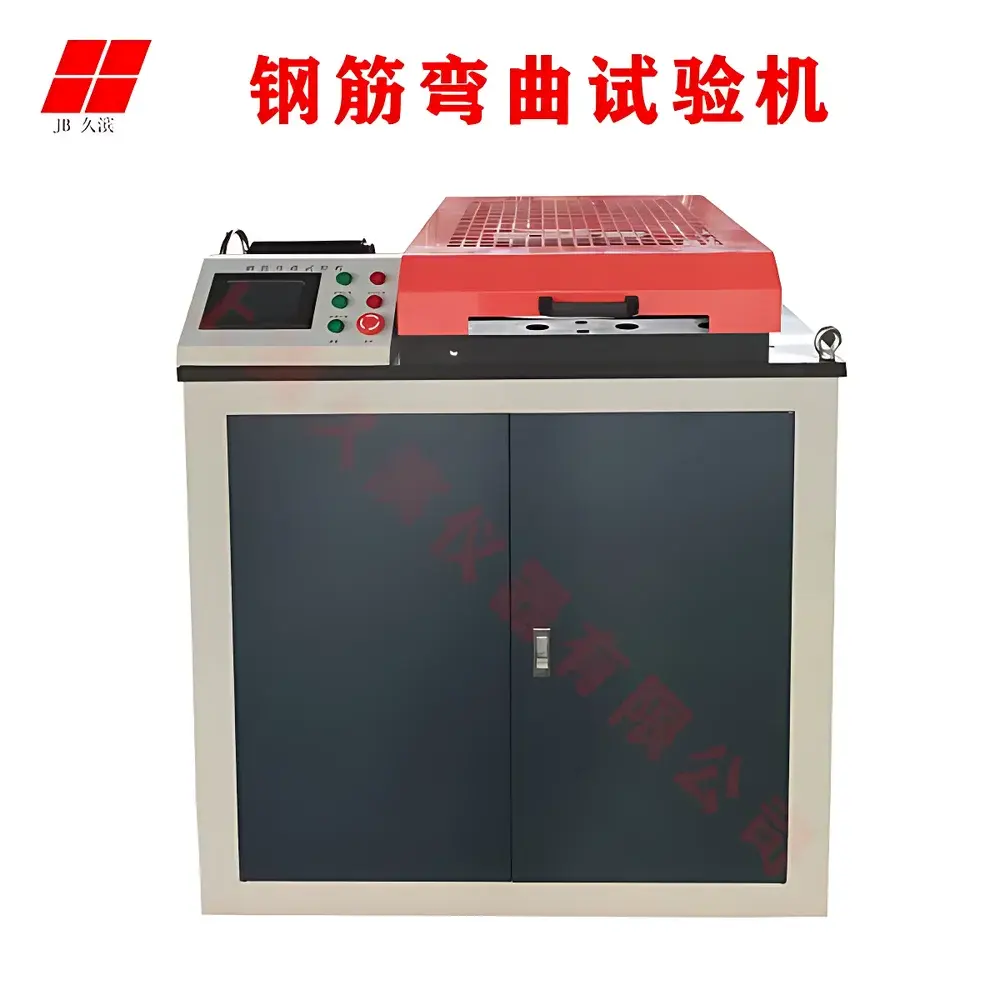
Jiubin JB- Reinforcement Bar Bend and Reverse Bend Testing Machine
| Brand | Jiubin |
|---|---|
| Origin | Shanghai, China |
| Manufacturer Type | Authorized Distributor |
| Origin Category | Domestic (China) |
| Model | JB- |
| Price | USD 6,300 (FOB Shanghai) |
Overview
The Jiubin JB- Reinforcement Bar Bend and Reverse Bend Testing Machine is a mechanically driven, dual-mode static bending apparatus engineered for standardized mechanical evaluation of steel reinforcing bars (rebar) in accordance with ASTM A615/A615M, ISO 15630-1, GB/T 232–2023, and EN 10080. It operates on the principle of controlled angular displacement under quasi-static loading, where a fixed-diameter mandrel (bending former) serves as the central pivot point around which the rebar specimen is plastically deformed. The machine supports both forward bending—used to assess ductility and surface integrity—and reverse bending—employed to evaluate strain aging resistance and post-deformation structural stability after thermal exposure. Its robust frame construction ensures minimal deflection during load application, while precision-machined mandrels and calibrated angle feedback systems guarantee repeatability across test cycles.
Key Features
- Two-in-one functional design: Integrated forward bend and reverse bend capability within a single mechanical platform, eliminating need for secondary fixtures or manual repositioning.
- Adjustable bending mandrel system: Interchangeable mandrels conforming to standard diameters (e.g., 4d, 5d, 6d per GB/T 1499.2), each precisely ground and certified for dimensional tolerance ≤ ±0.1 mm.
- Angle-controlled actuation: Electromechanical drive with programmable angular velocity (≤ 20°/s), real-time digital angle display, and automatic stop at user-defined α (e.g., 90°, 180°), ensuring compliance with timing and positioning requirements in ASTM E290 and ISO 7438.
- Thermal coordination readiness: Designed to interface with external laboratory ovens (not included) for standardized aging treatment at 100 °C ± 5 °C for ≥30 min prior to reverse bending, as specified in GB/T 232–2023 Clause 7.3.
- Structural rigidity: Heavy-duty welded steel base frame with reinforced support columns and hardened guide rails, minimizing parasitic deformation during high-load bending (up to 40 mm nominal diameter rebar).
- Operator safety compliance: Full-guard enclosure with interlocked door switch, emergency stop button meeting IEC 60204-1, and CE-compliant electrical architecture.
Sample Compatibility & Compliance
The JB- accommodates deformed and plain carbon steel rebars with nominal diameters ranging from 6 mm to 40 mm, including grades HRB400, HRB500, and ASTM Grade 60/75. Specimen length requirements align with ISO 15630-1 (minimum 500 mm) and GB/T 232–2023 (≥ 5d + 200 mm). All test procedures satisfy mandatory clauses for visual crack assessment under daylight illumination (≥ 500 lux), with pass/fail determination based solely on absence of macroscopic surface fissures detectable by unaided eye at 0.25 m distance. The system supports audit-ready documentation when used in conjunction with GLP-compliant lab notebooks or LIMS-integrated reporting workflows.
Software & Data Management
The JB- operates in standalone mode without embedded software; however, its digital angle encoder outputs RS-485 signals compatible with third-party data acquisition systems (e.g., LabVIEW, MATLAB, or custom SCADA platforms). Angle/time stamp logs can be exported in CSV format for traceability. When deployed in regulated environments (e.g., precast concrete QA labs under ISO/IEC 17025), users may implement electronic records management per FDA 21 CFR Part 11 requirements using validated external software—provided audit trails, electronic signatures, and version-controlled procedure files are maintained independently.
Applications
- Quality conformance testing of hot-rolled deformed bars supplied to infrastructure projects (bridges, high-rises, tunnels).
- In-process verification in rolling mill QC laboratories prior to shipment.
- Third-party certification testing per CNAS-accredited scopes (e.g., CMA reports for GB/T 1499.2–2018 compliance).
- Research on cold working effects and strain aging behavior in microalloyed steels.
- Validation of welding joint ductility when combined with transverse tensile specimens per AWS D1.4.
FAQ
What standards does the JB- machine directly support?
ASTM A615/A615M, ISO 15630-1, GB/T 232–2023, GB/T 1499.2–2018, EN 10080, and JIS G 3112.
Is thermal aging integrated into the machine?
No—the JB- does not include an oven. Users must perform the 100 °C × 30 min aging step externally using a calibrated laboratory furnace meeting ASTM E220 specifications.
Can the machine test epoxy-coated rebar?
Yes—provided coating integrity is verified pre-test and mandrel geometry avoids localized coating rupture unrelated to substrate ductility.
What maintenance is required for long-term accuracy?
Biannual calibration of the angle encoder against a traceable optical protractor (±0.5° uncertainty), annual inspection of mandrel roundness (per ISO 1101), and lubrication of linear guides per OEM schedule.
Does the system provide test report templates?
Standardized test record forms compliant with GB/T 27025–2019 are available upon request in English and Chinese, but require manual completion unless interfaced with external LIMS.



