
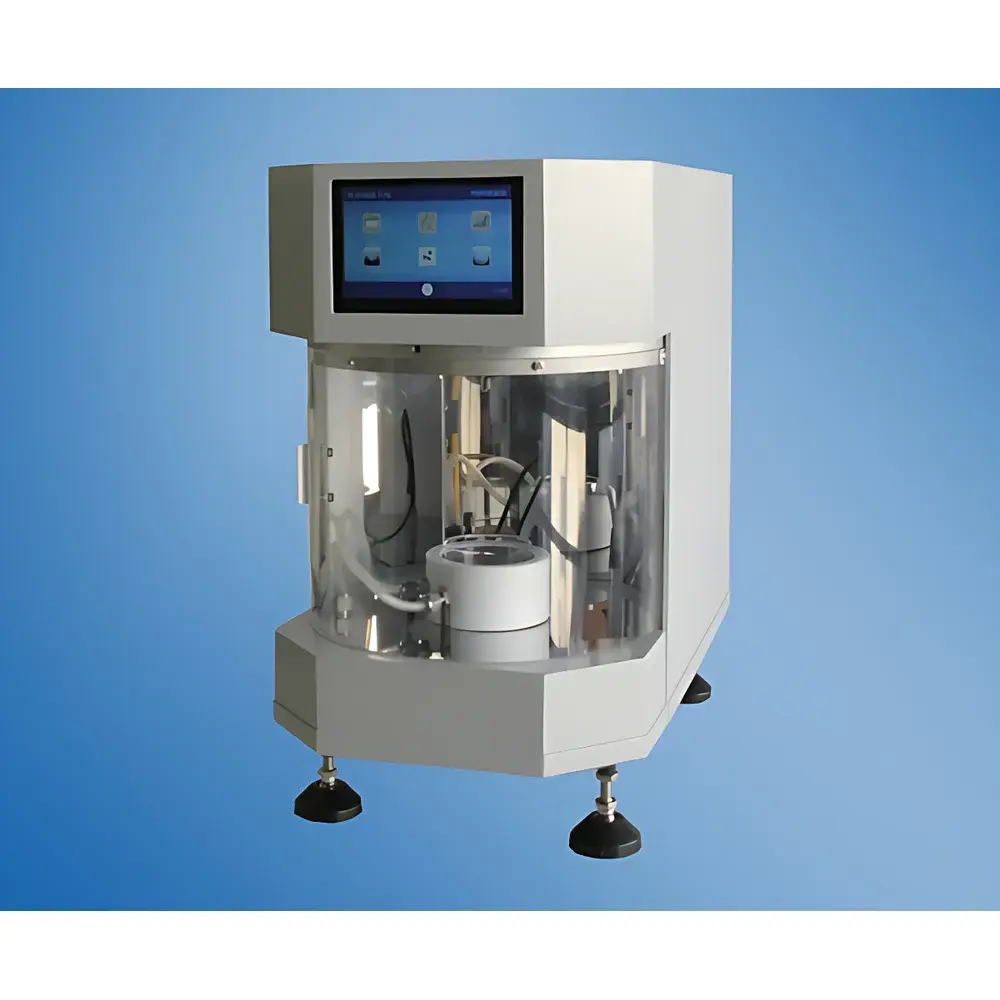
JK99MS Fully Automated Adhesion Force & Surface/Interfacial Tensiometer
| Origin | Beijing, China |
|---|---|
| Manufacturer Type | Authorized Distributor |
| Origin Category | Domestic (China) |
| Model | JK99MS |
| Price Range | USD 7,000–14,000 (FOB) |
| Measurement Range | 0–999.999 mN/m |
| Resolution | 0.001 mN/m |
| Accuracy | ±0.01 mN/m |
| Temperature Display Range | Ambient to 200 °C |
| Temperature Accuracy | ±0.1 °C |
| Measurement Methods | Du Noüy Ring Method & Wilhelmy Plate Method |
| Mass Measurement Range | 0–210 g (optional 0.01 mg resolution) |
| Vertical Stage Travel | 0–30 mm (speed: 0.1–2 mm/s |
| positioning accuracy | 0.1 mm) |
| Data Acquisition Rate | 0.1 Hz (0.02 Hz optional) |
| Magnetic Stirring | Integrated |
| Compliance | GB/T 22237–2008, GB/T 5549–2010, GB/T 6541–1986, SY/T 5370–1999 |
Overview
The JK99MS Fully Automated Adhesion Force & Surface/Interfacial Tensiometer is an engineered precision instrument designed for quantitative characterization of solid–liquid interfacial adhesion and liquid–gas/liquid–liquid interfacial tension. It operates on the fundamental principles of Wilhelmy plate and Du Noüy ring methodologies—both standardized techniques grounded in Young–Laplace capillary force equilibrium. Adhesion force is measured directly as the maximum detachment force required to separate a pendant liquid drop (or sessile droplet) from a solid substrate under controlled vertical displacement, captured in real time via a high-stability electromagnetic balance. Simultaneously, surface and interfacial tensions are determined by measuring the wetting force exerted on a vertically immersed platinum probe—either a calibrated ring (Du Noüy) or a rectangular plate (Wilhelmy)—with corrections applied for buoyancy, geometry, and dynamic meniscus effects. The system integrates thermally stabilized stage control, programmable motion profiles, and synchronized force–displacement data logging—enabling reproducible quantification of interfacial energetics critical to formulation science, coating development, and functional surface design.
Key Features
- High-resolution electromagnetic force sensor (METTLER Toledo OEM grade), delivering 0.001 mN/m resolution and ±0.01 mN/m absolute accuracy across the full 0–999.999 mN/m range
- Dual-method compliance: fully supports both ASTM D971–19 (ring method) and ISO 1409:2016 (plate method) protocols with automatic correction algorithms embedded in firmware
- Integrated temperature-controlled platform with ambient-to-200 °C operational range and ±0.1 °C sensor accuracy; compatible with external recirculating chillers or heating baths via standardized fluid ports
- Precision vertical stage driven by servo-controlled stepper motor and ground stainless-steel lead screw, enabling repeatable 0.1 mm positioning and smooth 0.1–2 mm/s translation for controlled detachment kinematics
- Onboard 7-inch capacitive touchscreen interface with standalone operation—no PC required for routine measurements; includes one-touch zeroing, auto-calibration prompts, and real-time curve visualization
- Optional high-speed imaging module (100 fps, 100× optical magnification) for dynamic morphological analysis of three-phase contact line evolution during adhesion testing
- Modular expandability: supports CMC determination, density measurement, static/dynamic contact angle analysis (solid, powder, fiber), and mass measurement up to 210 g (0.1 mg standard, 0.01 mg optional)
Sample Compatibility & Compliance
The JK99MS accommodates a broad spectrum of sample types—including low-, medium-, and high-viscosity liquids (e.g., surfactant solutions, crude oils, polymer melts, inks, and emulsions)—without requiring dilution or pre-treatment. Solid substrates may be rigid (glass, silicon wafers, metals) or flexible (polymers, textiles), provided they fit within the 100 mm × 100 mm sample stage aperture. All measurement modes comply with internationally recognized standards: GB/T 22237–2008 (determination of surface tension by ring method), GB/T 5549–2010 (Wilhelmy plate method), GB/T 6541–1986 (interfacial tension of oil–water systems), and SY/T 5370–1999 (petroleum industry applications). Data traceability meets GLP requirements, with audit-ready timestamped logs, user authentication, and electronic signature support in the Windows-based software suite.
Software & Data Management
The included Windows application provides comprehensive control, real-time plotting, and post-acquisition analysis. It records force–distance curves at user-defined sampling rates (0.1 Hz standard, 0.02 Hz optional), automatically identifies peak adhesion force, computes surface/interfacial tension using manufacturer-validated correction factors (Harkins–Jordan for rings; Zuidema–Waters for plates), and exports CSV, PDF, and image formats. Software features include batch processing, multi-curve overlay, statistical reporting (mean, SD, CV%), and customizable report templates compliant with internal QA documentation workflows. Full 21 CFR Part 11 readiness is available upon configuration—supporting role-based access control, electronic signatures, and immutable audit trails for regulated environments.
Applications
This instrument serves core R&D and QC functions across multiple sectors: evaluation of anti-fouling and self-cleaning coatings via low-adhesion surface screening; optimization of enhanced oil recovery (EOR) formulations through interfacial tension reduction assessment; stability analysis of foams, emulsions, and microemulsions in personal care and agrochemical formulations; characterization of ink–substrate affinity in digital printing; and quality control of surfactant purity and critical micelle concentration (CMC). In academic research, it supports fundamental studies in wetting dynamics, contact angle hysteresis, and nanomaterial dispersion behavior at interfaces.
FAQ
What measurement methods does the JK99MS support?
It supports both the Du Noüy ring method and Wilhelmy plate method for surface and interfacial tension, plus direct force-based adhesion measurement using a calibrated liquid–solid detachment protocol.
Can the system operate without a connected PC?
Yes—the integrated touchscreen enables full standalone operation including measurement initiation, real-time visualization, result display, and thermal calibration.
Is temperature control internal or external?
The base platform includes an embedded temperature sensor and fluid circulation ports; users supply an external thermostatic bath (e.g., Huber, Julabo) for precise thermal regulation.
How is sensor calibration performed?
A certified stainless-steel calibration weight set is supplied, allowing rapid two-point verification (zero and span) directly on the instrument—traceable to national metrology standards.
Does the software support automated compliance reporting?
Yes—templates conform to GB, ISO, and ASTM reporting conventions; optional 21 CFR Part 11 modules provide electronic signature, change history, and audit trail functionality.



