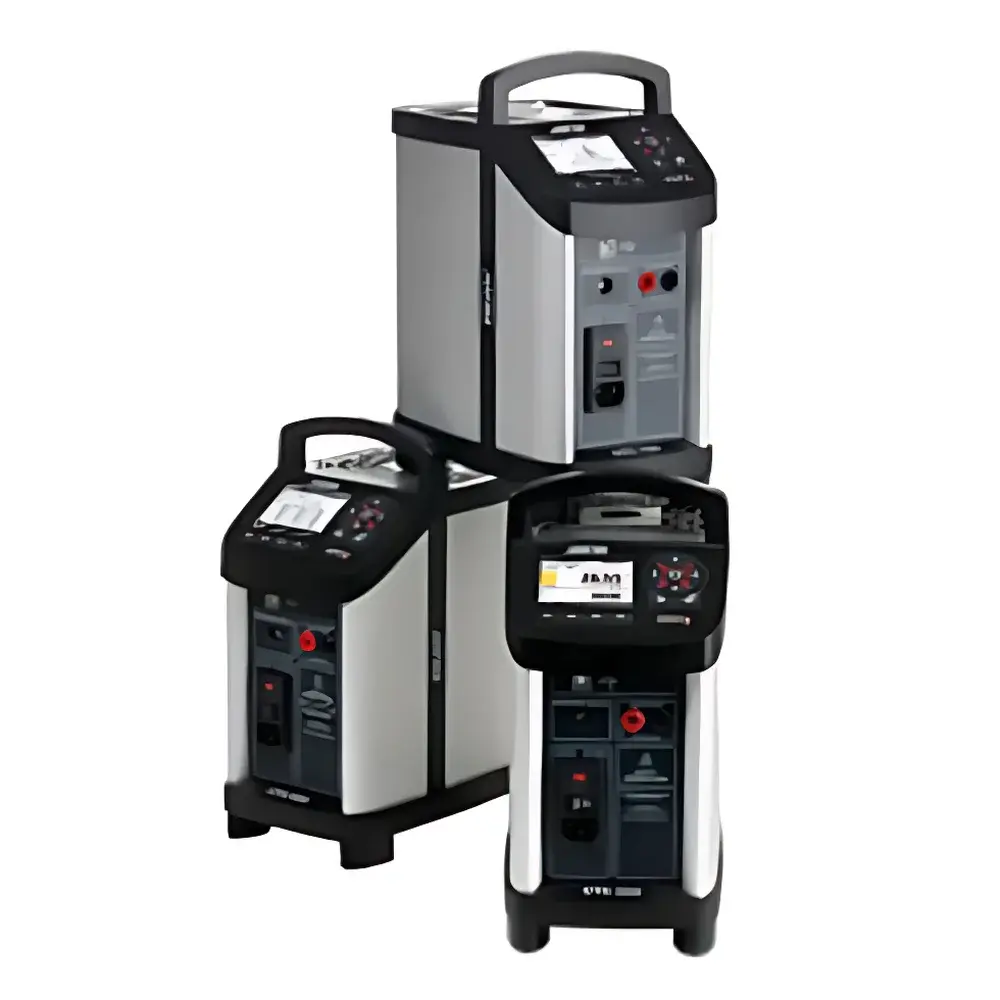
JOFRA CTC Series Compact Dry-Block Calibrator
| Brand | JOFRA |
|---|---|
| Origin | Denmark |
| Model | CTC Series |
| Calibration Temperature Range | -25 to 1205°C (-13 to 2201°F) |
| Stability | ±0.04°C |
| Accuracy | up to ±0.2°C |
| Insertion Depth (CTC-652) | 190 mm |
| Power Fluctuation Immunity | MVI Active Compensation Technology |
| Portability | Lightweight, Field-Optimized Design |
| Probe Compatibility | Multi-hole Inserts & Insert Kits Available |
| External Reference Interface | C-Type Models Only |
Overview
The JOFRA CTC Series Compact Dry-Block Calibrator is an engineered solution for high-fidelity temperature calibration in field, workshop, and quality control environments. Based on precision resistive heating and advanced thermal mass design, the CTC series employs dry-block technology—eliminating reliance on liquid media—to deliver rapid thermal equilibration, minimal maintenance, and contamination-free operation. Unlike fluid baths, dry-block calibrators operate without consumables, reduce safety hazards associated with hot oils or silicone fluids, and enable stable temperature generation across an exceptionally wide range: from cryogenic conditions at –25°C to high-temperature industrial applications up to 1205°C. Each of the five CTC models (CTC-150, CTC-350, CTC-652, CTC-952, and CTC-1205) is optimized for a specific segment of this range, ensuring optimal thermal uniformity, axial gradient control, and long-term repeatability under variable ambient conditions.
Key Features
- Thermal stability of ±0.04°C (1σ, over 30 minutes), verified per ISO/IEC 17025-compliant procedures
- Calibration accuracy up to ±0.2°C (traceable to NIST-traceable reference standards)
- Large, high-contrast color display with intuitive icon-based interface and real-time status feedback
- Dedicated one-button functionality for automated test sequences—including auto-step ramping, soak-and-hold cycles, and multi-point calibration routines
- MVI (Micro-Voltage Interference) active power fluctuation compensation—maintains setpoint integrity during line voltage variations of ±10%
- CTC-652 variant features 190 mm insertion depth, enabling full immersion calibration of extended-length RTDs, thermocouples, and digital probes
- Ruggedized aluminum housing with integrated carrying handle; total unit weight < 6.5 kg depending on model
- Modular insert system supporting interchangeable multi-hole blocks (e.g., 6×3.2 mm, 4×6.4 mm) and custom bore configurations for diverse probe diameters
- C-type models include dedicated external reference input for simultaneous monitoring of a traceable PRT or thermistor reference sensor
Sample Compatibility & Compliance
The CTC series accommodates a broad spectrum of contact temperature sensors, including J-, K-, T-, E-, R-, S-, B-, and N-type thermocouples; Pt100 and Pt1000 RTDs; thermistors (2.2 kΩ, 10 kΩ); and digital temperature transmitters with analog outputs. All inserts are manufactured from high-purity aluminum or Inconel® alloys, selected for optimal thermal conductivity and oxidation resistance within respective operating ranges. The calibrator complies with international metrological requirements defined in ASTM E2877 (Standard Guide for Calibration of Temperature Calibration Baths), IEC 60584 (thermocouple reference tables), and ISO 17025 clause 6.4.3 (equipment suitability for calibration tasks). It supports GLP/GMP documentation workflows via optional software integration and meets electromagnetic compatibility (EMC) requirements per EN 61326-1:2013.
Software & Data Management
When paired with JOFRA’s CalSuite™ PC software (v5.2+), the CTC series enables fully automated calibration reporting compliant with FDA 21 CFR Part 11 requirements—including electronic signatures, audit trails, and user access controls. Calibration data—including setpoint, measured reference value, DUT reading, deviation, uncertainty budget, and environmental parameters—is exported in CSV, PDF, or XML formats. The instrument’s internal memory stores up to 100 calibration sessions with timestamps and operator IDs. USB and RS-232 interfaces support direct connection to laboratory information management systems (LIMS) or enterprise asset management platforms for centralized calibration scheduling and certificate archival.
Applications
- On-site verification of process temperature sensors in pharmaceutical cleanrooms, food processing lines, and HVAC commissioning
- Periodic recalibration of handheld thermometers, infrared calibrators, and fixed-mount temperature transmitters
- Factory acceptance testing (FAT) of temperature-controlled equipment prior to commissioning
- Supporting ISO 9001, ISO 13485, and AS9100 quality system audits through documented traceability and uncertainty statements
- Education and training labs requiring robust, low-maintenance calibration hardware for thermometry fundamentals
- Field service teams performing preventive maintenance on turbine inlet sensors, furnace thermocouples, and reactor vessel RTDs
FAQ
What is the typical warm-up time to reach 650°C on the CTC-652 model?
Typical stabilization time from ambient to 650°C is ≤18 minutes, verified per manufacturer test protocol under standard laboratory conditions (23 ±2°C, <60% RH).
Can the CTC calibrate two sensors simultaneously?
Yes—multi-hole inserts allow concurrent calibration of up to six sensors of identical or mixed types, provided their diameters match the selected bore configuration and thermal mass loading remains within specification limits.
Is the CTC series suitable for accredited calibration laboratories?
Yes—when operated with certified reference standards, validated inserts, and documented uncertainty budgets, the CTC series fulfills technical requirements for ISO/IEC 17025 accreditation scope in temperature calibration up to 1205°C.
Does the instrument support external temperature references during calibration?
Only C-type models (e.g., CTC-652-C) provide a dedicated 4-wire RTD input for real-time comparison against an external reference sensor, enabling dual-sensor differential analysis and enhanced uncertainty reduction.
How often does the CTC require recalibration?
JOFRA recommends annual functional verification using traceable reference standards; full recalibration by an accredited lab is advised every 24 months or after any event affecting thermal or electrical integrity (e.g., mechanical shock, sustained overtemperature exposure).