
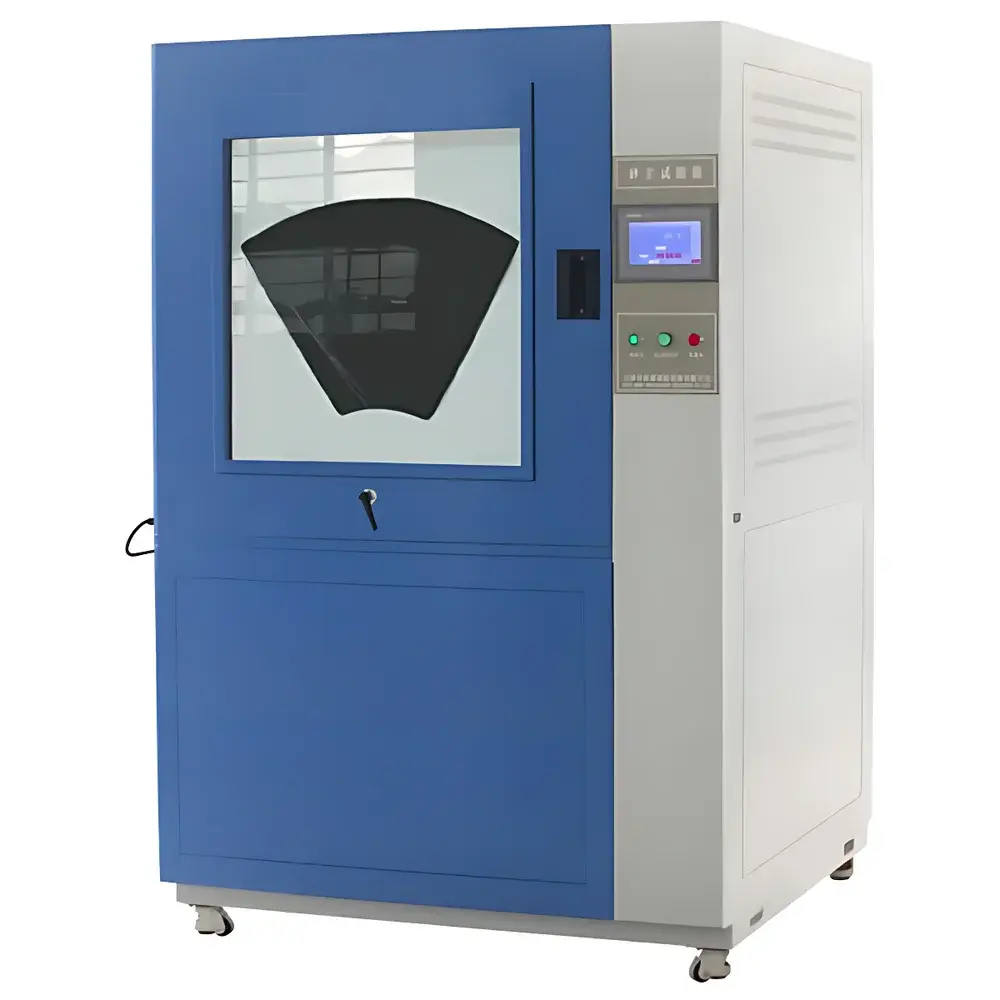
JuBin JB-1000 Programmable Dust and Sand Aging Test Chamber
| Brand | JuBin |
|---|---|
| Model | JB-1000 |
| Chamber Dimensions (W×D×H) | 800 × 800 × 800 mm |
| Temperature Range | RT to +60 °C |
| Sieve Mesh | Stainless Steel, Wire Diameter 50 µm, Aperture 75 µm |
| Test Dust | Dry Talc Powder |
| Dust Concentration | 2 kg/m³ |
| Airflow Velocity | 2 m/s |
| Power Supply | AC 380 V / 50 Hz |
| Interior Material | 1.2 mm 304 Stainless Steel |
| Exterior Material | 1.5 mm Cold-Rolled Steel with Electrostatic Powder Coating |
| Heating System | Integrated Resistive Heater |
| Dust Dispersion | Centrifugal Blower + Eccentric Vibrator Mechanism |
| Observation Window | Tempered Glass with Manual Wiper |
| Sealing | High-Performance Silicone Gasket |
| Adjustable Shelf | 1 Layer |
| Dust-Resistant Socket | IP54 Rated |
| Mobility | Four Locking Casters |
Overview
The JuBin JB-1000 Programmable Dust and Sand Aging Test Chamber is an engineered environmental simulation system designed to evaluate the ingress protection (IP) performance of enclosures, seals, gaskets, and structural components under controlled airborne particulate stress. It operates on the principle of forced-air suspension and gravitational settling of standardized talc powder—per IEC 60529 Annex B (IP5X/IP6X), ISO 20653:2013 (Road Vehicles – Degrees of Protection), and MIL-STD-810H Method 510.7 (Sand and Dust). Unlike static dust deposition methods, the JB-1000 replicates dynamic exposure conditions encountered during vehicle operation, outdoor storage, or arid-region transportation. Its programmable logic controller (PLC) enables precise sequencing of test cycles—including temperature ramping, dust injection duration, airflow modulation, and rest periods—ensuring repeatable, auditable, and standards-aligned test execution for R&D validation, quality assurance, and regulatory compliance documentation.
Key Features
- Programmable test profiles supporting multi-stage sequences: temperature hold, dust dispersion timing, airflow velocity control, and dwell intervals—fully configurable via intuitive touchscreen HMI.
- Stainless steel interior chamber (1.2 mm 304 SUS) ensures corrosion resistance against abrasive talc and long-term thermal cycling stability.
- Precision-engineered dust dispersion system: centrifugal blower generates consistent 2 m/s laminar airflow; eccentric vibratory mechanism agitates settled talc to maintain uniform particle suspension and prevent clumping.
- Calibrated 50 µm wire diameter / 75 µm aperture stainless steel sieve included for pre-test talc conditioning—ensuring compliance with particle size distribution requirements per IEC 60529 and ISO 20653.
- Integrated resistive heating system maintains stable ambient temperature from room temperature up to +60 °C, mitigating moisture-induced talc agglomeration and enabling combined thermal-dust stress testing.
- Tempered glass observation window with manual wiper allows real-time visual monitoring without compromising chamber integrity or operator safety.
- IP54-rated dust-resistant socket installed inside chamber facilitates live electrical testing of powered devices under dust exposure—critical for evaluating connector sealing, vent membrane integrity, and PCB-level contamination resistance.
Sample Compatibility & Compliance
The JB-1000 accommodates samples up to 700 mm (L) × 700 mm (W) × 700 mm (H), with a single adjustable stainless steel shelf supporting variable mounting configurations. It is routinely deployed for testing automotive lighting assemblies, EV battery enclosures, industrial control cabinets, aerospace avionics housings, and consumer electronics rated for IP5X or IP6X protection. The chamber meets mechanical and operational requirements of IEC 60529 (Ingress Protection Code), ISO 20653:2013 (Road vehicles – Degrees of protection against foreign objects, water, and access), and aligns with test condition definitions in SAE J2232 (Automotive Electrical Systems Dust Ingress Testing). While not certified as a standalone test laboratory, its design supports traceable calibration of airflow velocity (via calibrated anemometer), temperature uniformity (±2 °C tolerance across working volume), and dust concentration (verified gravimetrically per ISO 12103-1 A4 Fine Test Dust protocol equivalents).
Software & Data Management
The embedded PLC-based controller logs time-stamped operational data—including chamber temperature, cycle phase status, total dust injection time, and heater duty cycle—to internal non-volatile memory. Optional RS485/Modbus RTU interface enables integration into centralized test management systems (e.g., LabVIEW, TestStand, or custom MES platforms). All test parameters are password-protected and support user-level access control (operator, engineer, administrator). Audit trail functionality records parameter changes, start/stop events, and alarm triggers—supporting GLP-compliant documentation workflows. Raw log files export in CSV format for post-test statistical analysis, trend reporting, and inclusion in regulatory submission dossiers (e.g., UN ECE R100, GB/T 4208, or customer-specific PPAP documentation).
Applications
- Validation of IP5X (dust-protected) and IP6X (dust-tight) ratings for electronic enclosures prior to CE, CCC, or E-Mark certification.
- Evaluation of seal degradation kinetics under cyclic dust exposure and elevated temperature—supporting accelerated aging studies per ASTM F1980.
- Comparative assessment of gasket material performance (silicone, EPDM, fluorocarbon) in preventing talc infiltration over extended durations (e.g., 8–72 hour continuous tests).
- Functional testing of active cooling vents, pressure-equalization membranes, and filtered breather systems under simulated desert or off-road operating conditions.
- Root-cause analysis of field failures attributed to particulate ingress—reproducing failure modes such as relay contact abrasion, optical sensor obscuration, or motor bearing wear.
FAQ
What type of test dust is specified for use with the JB-1000?
Dry talc powder conforming to ISO 12103-1 A4 specification (or equivalent fine-grade industrial talc) is recommended. Particle size must be verified using the supplied 50 µm wire / 75 µm aperture stainless steel sieve prior to each test.
Can the JB-1000 perform combined temperature-dust testing?
Yes—the integrated heating system enables simultaneous control of chamber temperature (RT to +60 °C) and dust exposure, allowing evaluation of thermal-accelerated dust ingress mechanisms.
Is the chamber suitable for testing powered devices?
Yes—its internal IP54-rated dust-resistant socket supports live electrical operation during testing, provided external power supplies and instrumentation are appropriately rated for dusty environments.
How is dust concentration maintained at 2 kg/m³?
Concentration is achieved through volumetric dosing (2–4 kg/m³ initial loading) and sustained by the blower/vibrator system’s ability to re-suspend settled particles; gravimetric verification is recommended before formal qualification runs.
Does the JB-1000 comply with IEC 60529 Annex B requirements?
Its physical configuration, airflow profile, and dust handling methodology are aligned with the procedural intent of IEC 60529 Annex B for IP5X/IP6X testing; final compliance determination rests with the accredited test laboratory performing the evaluation.



