
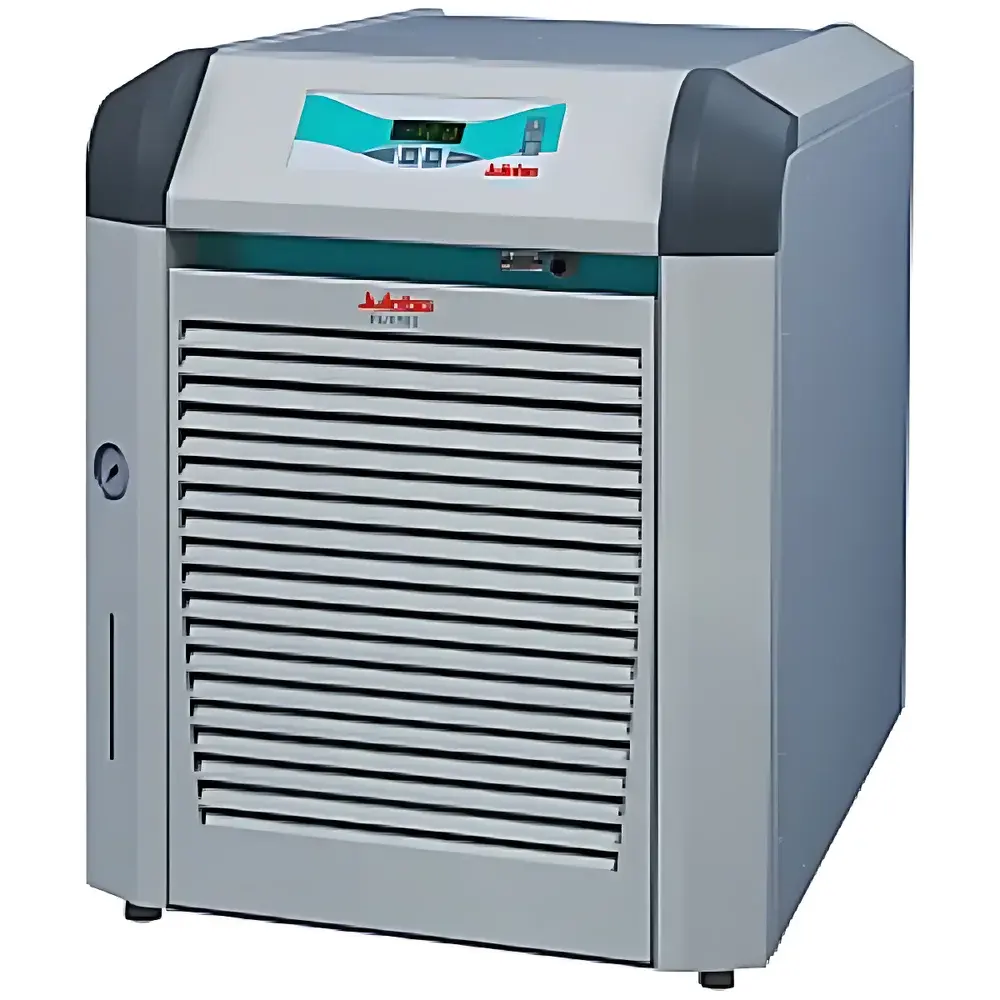
Julabo FL1701 Circulating Chiller
| Brand | Julabo |
|---|---|
| Origin | Germany |
| Model | FL1701 |
| Instrument Type | Integrated Circulating Chiller |
| Cooling Method | Air-Cooled |
| Temperature Range | -20 to +40 °C |
| Temperature Stability | ±0.5 °C |
| Refrigeration Capacity | 1.7 kW @ 20 °C |
| Pump Flow Rate | 23 L/min |
| Pump Pressure | 1.0 bar |
| Reservoir Volume | 12–17 L |
| Operating Mode | Continuous |
| Refrigerant | R404A (GWP = 3922) |
| Compressor | Single-Stage Hermetic |
| Communication Interface | RS232 (Optional), Profibus (Optional) |
| Ambient Operating Temperature | 5–40 °C |
| Dimensions (W×L×H) | 50 × 76 × 64 cm |
| Weight | 85 kg |
| Sound Pressure Level (1 m) | ≤62 dBA |
| Compatible Fluids | Deionized Water, Water/Glycol Mixtures, JULABO Thermal Bath Fluids |
| Max. Return Fluid Temperature | ≤80 °C |
| Hose Connections | Dual Quick-Connect Fittings (ID 8 mm & 12 mm), M16×1 Male Thread |
Overview
The Julabo FL1701 Circulating Chiller is a high-performance, air-cooled, integrated refrigeration system engineered for precise temperature control and stable heat removal in demanding laboratory and pilot-scale industrial applications. Based on vapor-compression refrigeration with a single-stage hermetic compressor and R404A refrigerant, the FL1701 delivers consistent cooling capacity of up to 1.7 kW at 20 °C ambient—scalable across its operating range from –20 °C to +40 °C. Designed as part of Julabo’s FL Series—optimized for high flow rates and elevated thermal loads—the unit replaces inefficient tap-water cooling, reducing water consumption and eliminating risks associated with unregulated supply temperature or pressure fluctuations. Its compact footprint (50 × 76 × 64 cm), robust stainless-steel reservoir, and dual-hose interface support seamless integration with spectrometers, laser systems, rotary evaporators, calorimeters, and other heat-generating instrumentation requiring continuous, closed-loop thermal management.
Key Features
- Stable temperature control with ±0.5 °C stability across the full –20 to +40 °C range, supported by PID-controlled refrigeration and high-resolution (0.1 °C) LED display
- Air-cooled condenser design eliminates dependency on facility water lines; suitable for labs lacking chilled water infrastructure
- High-flow circulation pump delivering 23 L/min at 1.0 bar pressure—engineered for low-pressure-drop external loops up to 30 m total length
- Large 12–17 L reservoir with integrated level indicator and optional pressure gauge (standard on FL1201 and above)
- Compatibility with multiple heat-transfer fluids: deionized water, water/ethylene glycol mixtures (up to 50 % v/v), and JULABO-certified Thermal Bath Fluids for extended low-temperature operation and corrosion resistance
- Maximum allowable return fluid temperature of 80 °C enables safe integration with exothermic reactors or high-waste-heat equipment
- Top-fill reservoir access simplifies maintenance and minimizes spill risk during refilling
- RS232 serial interface (optional) supports remote parameter setting, real-time data logging, and alarm status monitoring via PC-based software; Profibus option available for PLC-integrated process environments
Sample Compatibility & Compliance
The FL1701 is designed for use with non-corrosive, non-flammable, and non-viscous heat-transfer media meeting ISO 8502-2 and ASTM D1121 specifications for glycol-based coolants. It complies with EU Directive 2014/68/EU (PED) for pressure equipment, EN 61000-6-3 (EMC emission limits), and EN 61000-6-2 (immunity). The R404A refrigerant charge (690 g) adheres to F-Gas Regulation (EU) No. 517/2014 reporting requirements. Units are CE-marked and manufactured under ISO 9001-certified quality management systems. While not intrinsically rated for hazardous locations, the FL1701 meets general laboratory safety standards per IEC 61010-1 and is routinely deployed in GLP-compliant analytical laboratories where traceable temperature control and audit-ready operational records are required.
Software & Data Management
When equipped with the RS232 interface, the FL1701 supports bidirectional communication using ASCII protocol. Julabo’s optional LabView-compatible drivers and terminal emulation tools enable automated setpoint scheduling, time-stamped temperature logging, and event-triggered alerts (e.g., low-level, over-temperature, or pump failure). Data export is compatible with CSV and Excel formats for downstream analysis in LIMS or statistical process control platforms. Though the base unit does not include FDA 21 CFR Part 11-compliant electronic signatures or audit trail functionality, third-party SCADA or MES integrations—when implemented with validated middleware—can satisfy GMP documentation requirements for regulated pharmaceutical or biotech workflows.
Applications
- Continuous cooling of NMR spectrometer probes and X-ray diffractometers requiring stable thermal baselines
- Temperature stabilization of high-power lasers (CO₂, diode, solid-state) and optical benches sensitive to thermal drift
- Condenser cooling in rotary evaporation systems operating under vacuum and variable load conditions
- Thermal conditioning of reaction blocks, jacketed reactors, and calorimetric cells in synthetic chemistry and materials science labs
- Supporting environmental stress screening chambers and accelerated aging test setups in reliability engineering
- Backup cooling for critical HVAC or process chillers in small-scale pilot plants
FAQ
What is the maximum allowable inlet temperature for the FL1701’s return fluid?
The unit accepts return fluid temperatures up to 80 °C—enabling compatibility with high-exotherm processes without internal thermal shock.
Can the FL1701 operate continuously at –20 °C ambient temperature?
No. The specified ambient operating range is 5–40 °C. Operation below 5 °C may impair compressor oil viscosity and refrigerant return, requiring external enclosure heating or site-specific derating.
Is glycol mixture concentration limited for low-temperature operation?
For reliable operation down to –20 °C, a minimum 35 % (v/v) ethylene glycol/water mixture is recommended; higher concentrations improve freeze protection but reduce specific heat and increase pumping power requirements.
Does the FL1701 support external temperature sensor feedback for process-coupled control?
Yes—via optional PT100 input (not standard), enabling cascade control modes where chiller output responds directly to an external process sensor rather than internal bath temperature.
How often should the air filter and condenser coil be maintained?
In typical clean-lab environments, inspection is recommended every 3 months; cleaning frequency increases in dusty or high-particulate settings to maintain nominal refrigeration capacity and prevent compressor overload.



