
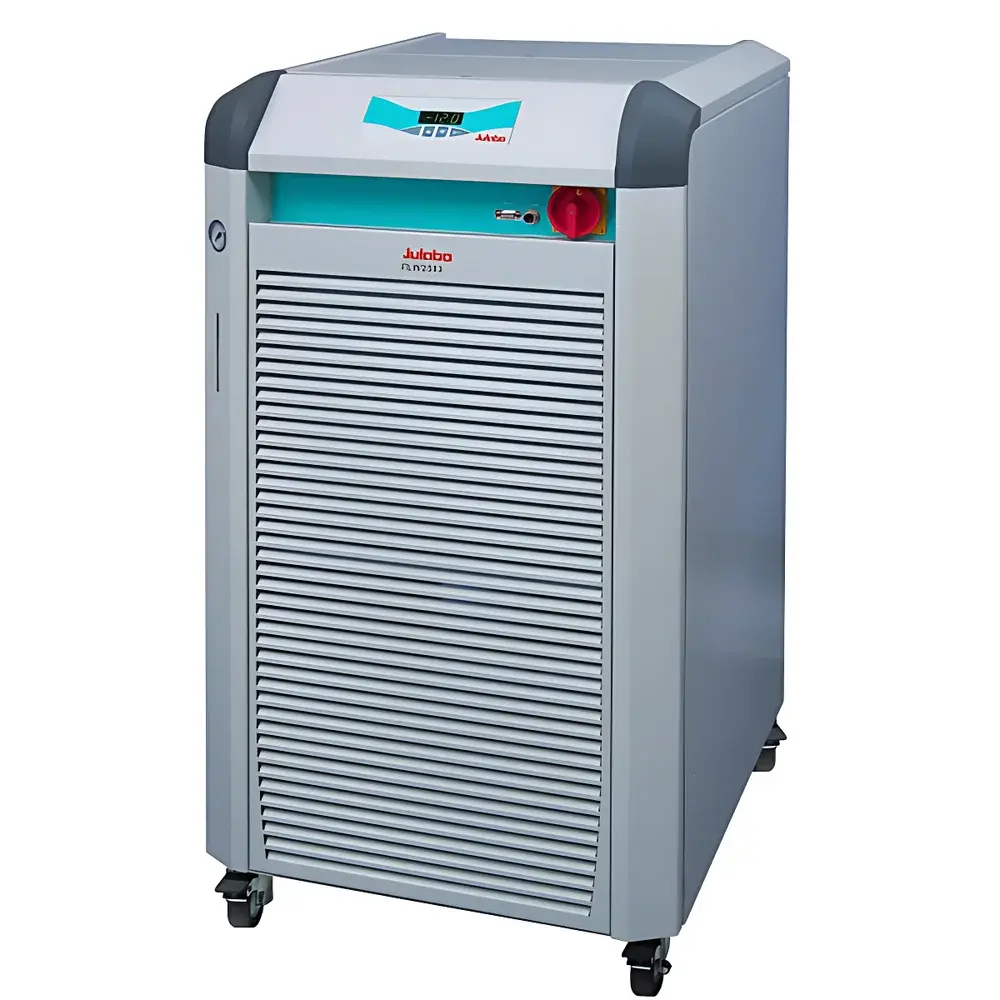
Julabo FLW2503 Circulating Chiller
| Brand | Julabo |
|---|---|
| Origin | Germany |
| Model | FLW2503 |
| Cooling Method | Water-Cooled |
| Temperature Range | -20 to +40 °C |
| Temperature Stability | ±0.5 °C |
| Refrigeration Capacity | 2700 W |
| Pump Flow Rate | 40 L/min |
| Pump Pressure | 0.5–3.0 bar |
| Reservoir Volume | 24–30 L |
| Refrigerant | R404A (GWP 3922) |
| Compressor | Single-Stage |
| Communication Interface | RS232 (optional), Profibus (optional) |
| Ambient Operating Temperature | 5–40 °C |
| Dimensions (W×L×H) | 60 × 76 × 115 cm |
| Weight | 143 kg |
| Sound Pressure Level (1 m) | ≤61 dBA |
| Fluid Compatibility | Water, Water/Glycol Mixtures, JULABO Thermal Bath Fluids |
| Inlet/Outlet Connection | G 3/4" male thread |
| Cooling Water Connection | G 3/4" male to 1/2" barb adapter |
Overview
The Julabo FLW2503 Circulating Chiller is a high-capacity, water-cooled temperature control system engineered for precision thermal management in demanding laboratory and pilot-scale industrial applications. Based on vapor-compression refrigeration with a single-stage R404A compressor, the FLW2503 delivers stable, continuous cooling across a wide operational range of −20 °C to +40 °C. Its design eliminates reliance on municipal tap water for heat rejection—replacing inefficient, wasteful, and environmentally unsustainable open-loop cooling with a closed-loop, recirculating architecture. With a nominal refrigeration capacity of 2700 W at 20 °C and a maximum pump flow rate of 40 L/min at adjustable pressure (0.5–3.0 bar), the unit supports high-heat-load instruments including NMR spectrometers, laser systems, X-ray diffractometers, vacuum pumps, and reaction calorimeters. The integrated 24–30 L reservoir ensures thermal inertia and minimizes frequent top-ups, while its robust steel enclosure and IP20-rated electronics meet IEC 61000-6-2/6-4 immunity and emission requirements for laboratory environments.
Key Features
- Water-cooled condenser enabling operation in ambient temperatures up to 40 °C without performance derating—ideal for facilities with limited ventilation or elevated room temperatures.
- Precision temperature stability of ±0.5 °C across the full setpoint range, supported by PID-controlled refrigeration and high-resolution (0.1 °C) LED display.
- Dual G 3/4″ male-threaded fluid ports compatible with standard 3/4″ barb fittings; dedicated cooling water inlet/outlet configured as G 3/4″ male to 1/2″ barb for flexible plumbing integration.
- Maximum return fluid temperature tolerance of ≤80 °C—enabling safe coupling with exothermic processes or high-temperature jacketed reactors.
- Full compatibility with aqueous glycol mixtures (up to 50% v/v) and JULABO-certified Thermal Bath Fluids, ensuring corrosion resistance, low viscosity at sub-zero temperatures, and extended service life.
- Optional digital communication interfaces (RS232 and Profibus) support integration into centralized lab automation platforms and enable remote monitoring, setpoint scheduling, and event logging per GLP/GMP data integrity guidelines.
Sample Compatibility & Compliance
The FLW2503 is designed for use with non-aggressive, non-flammable heat transfer fluids only: deionized water, water/propylene glycol or ethylene glycol blends (≤50%), and JULABO Thermal G series bath fluids. It is not rated for organic solvents, oils, or corrosive media. The unit complies with EU directives 2014/30/EU (EMC), 2014/35/EU (LVD), and 2009/125/EC (ErP). Refrigerant handling adheres to F-Gas Regulation (EU) No. 517/2014, with certified technician documentation required for R404A charging and recovery. While not intrinsically safe, its electrical safety certification (EN 61010-1) and CE marking confirm suitability for installation in standard ISO 14644 Class 8 cleanrooms and general-purpose analytical laboratories under EN 61326-1.
Software & Data Management
When equipped with RS232 or Profibus options, the FLW2503 supports bidirectional ASCII protocol communication. Lab managers may integrate it into SCADA or LIMS environments for automated temperature logging, alarm forwarding (e.g., high-temp, low-level, flow fault), and audit-trail generation. All parameter changes—including setpoint adjustments, pump activation, and hold/start commands—are timestamped and stored in non-volatile memory. Optional software tools (e.g., Julabo WinPC software) facilitate trend analysis, export to CSV/Excel, and alignment with FDA 21 CFR Part 11 requirements when paired with validated user access controls and electronic signature workflows.
Applications
- Continuous cooling of high-power lasers (CO₂, solid-state, diode-pumped) requiring stable junction temperature control.
- Thermal regulation of NMR probe preamplifiers and cryo-coolers where vibration isolation and low-noise operation are critical.
- Heat removal from rotary evaporators, distillation columns, and jacketed glass reactors during exothermic synthesis.
- Supporting HPLC column ovens and detector cells under regulated ambient conditions per USP and ASTM E2910.
- Environmental stress screening (ESS) chambers and material testing rigs requiring reproducible thermal cycling between −20 °C and +40 °C.
FAQ
What is the maximum allowable inlet fluid temperature when using the FLW2503 in recirculation mode?
The unit accepts return fluid at temperatures up to 80 °C—enabling direct connection to reactor jackets or condenser loops without external pre-cooling.
Can the FLW2503 operate unattended for extended periods?
Yes. Its continuous-duty compressor, auto-refill-ready reservoir design, and comprehensive safety interlocks (dry-run protection, overtemperature cutoff, high-pressure shutdown) support 24/7 operation in validated environments.
Is R404A refrigerant compliant with current environmental regulations?
R404A is permitted for servicing existing equipment under EU F-Gas Regulation until 2030, but new installations must comply with GWP limits; users should consult local regulatory authorities and consider future transition paths to lower-GWP alternatives.
Does the FLW2503 require external water treatment for the condenser circuit?
Yes. Closed-loop cooling water must be treated with biocide and scale inhibitor per VDI 2047 and maintained at pH 7.0–8.5 to prevent fouling and corrosion of the water-cooled condenser.
How is calibration traceability maintained for temperature control accuracy?
Julabo provides factory calibration certificates traceable to PTB (Physikalisch-Technische Bundesanstalt); field verification can be performed using NIST-traceable PRTs inserted into the reservoir or inline sensor ports per ISO/IEC 17025 procedures.



