
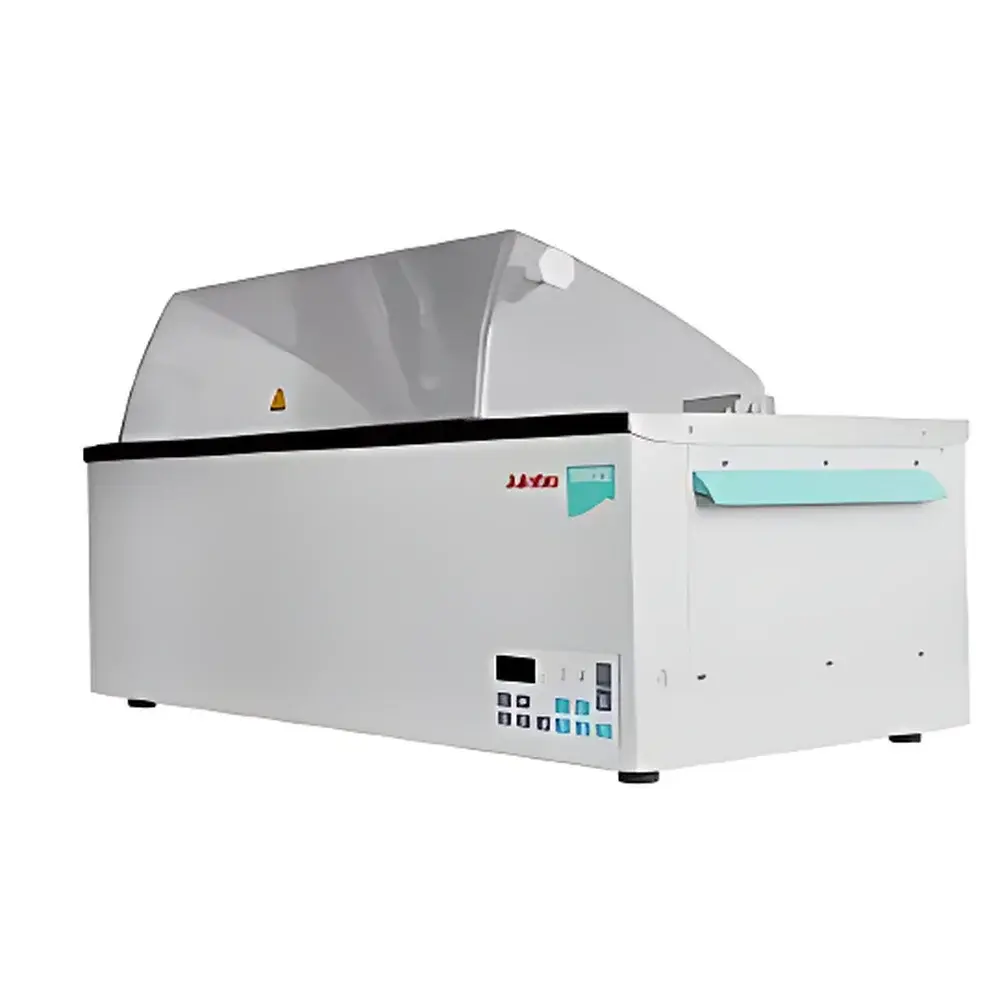
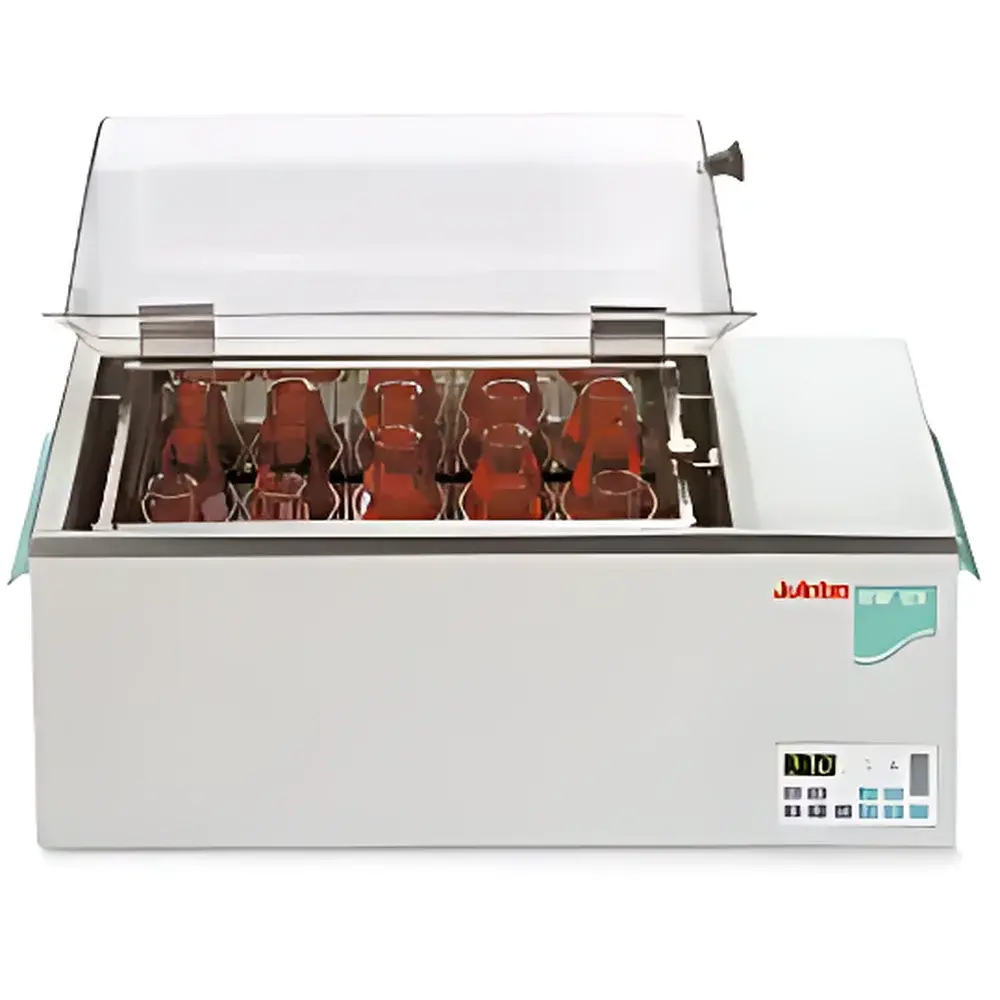
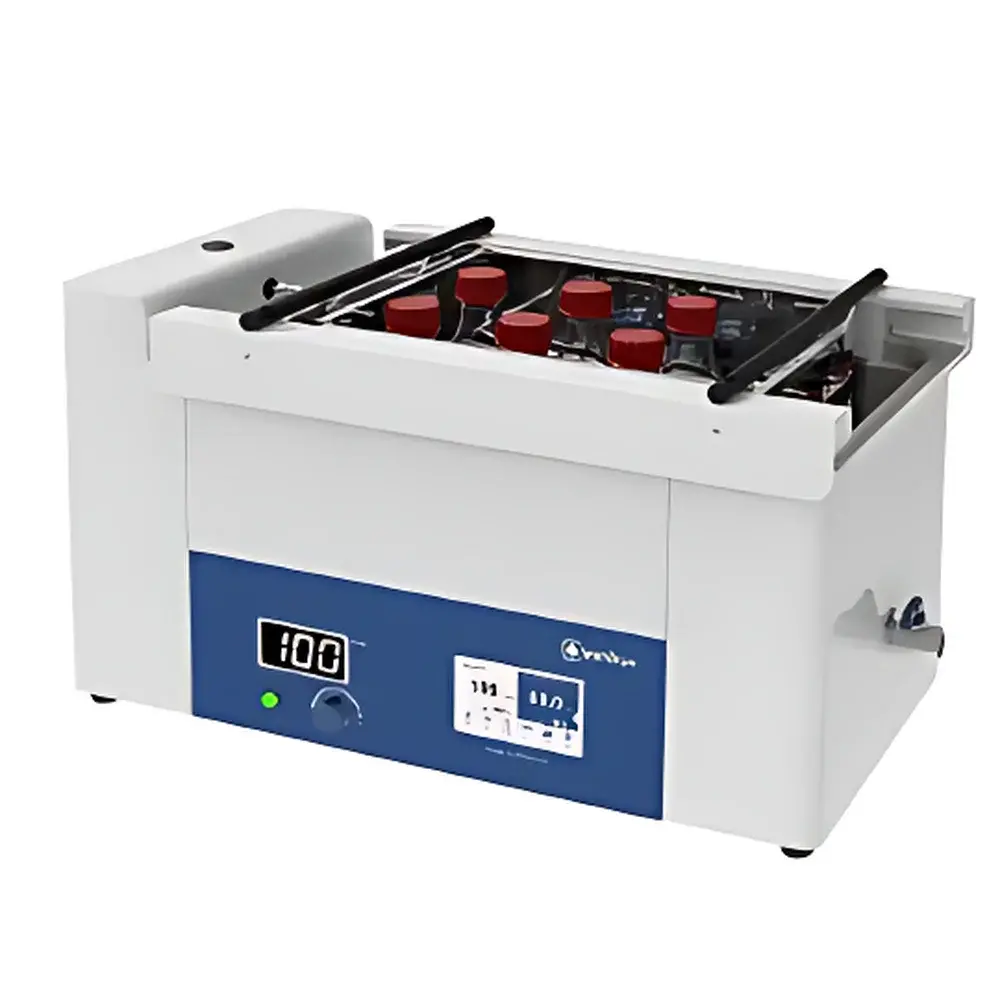
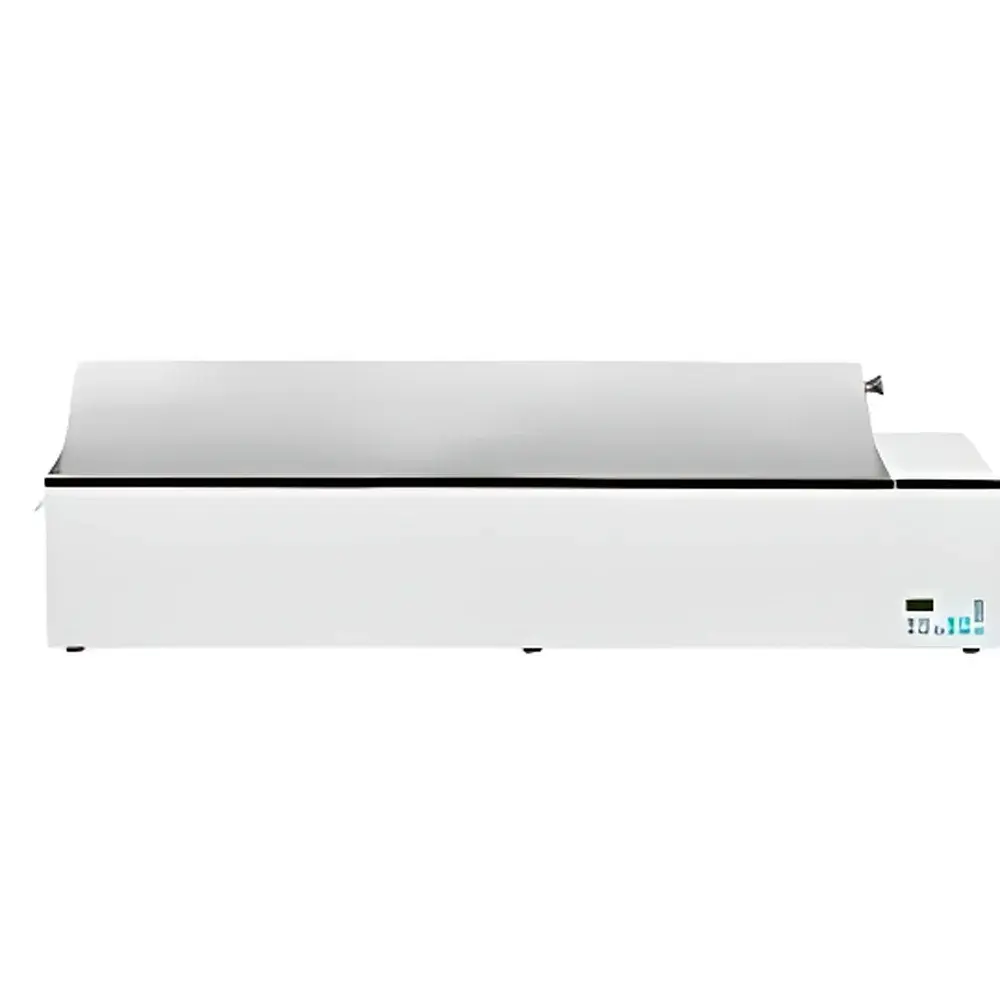
JULABO SW24 Ultrasonic Thermostatic Shaking Bath
| Brand | JULABO |
|---|---|
| Origin | Germany |
| Model | SW24 |
| Bath Volume | 22 L |
| Temperature Range | +5 °C above ambient to 80 °C |
| Temperature Stability | ±0.02 °C |
| Heating Power | 650 W |
| Ultrasonic Frequency | 40 / 59 kHz |
| Ultrasonic Power Output | Up to 400 W (adjustable 40–100 %) |
| Shaking Speed | 20–200 rpm |
| Shaking Amplitude | 15 / 25 mm (selectable) |
| Display Resolution | 0.1 °C, 1 rpm |
| Timer Range | 1–199 min |
| Degassing Function | Yes |
| Communication Interface | RS232 |
| Internal Dimensions (W × L × H) | 50 × 30 × 15 cm |
| Compliance | DIN 12876-1 Class I (NFL) |
Overview
The JULABO SW24 Ultrasonic Thermostatic Shaking Bath is an integrated laboratory platform engineered for simultaneous, independent, or sequential operation of thermostatic control, mechanical shaking, and high-frequency ultrasonication. It operates on the principle of coupled energy delivery: precise Peltier-assisted heating (no refrigeration) maintains bath temperature within ±0.02 °C stability across a range of +5 °C above ambient to 80 °C; a brushless DC motor drives linear reciprocating motion with selectable amplitudes (15 mm or 25 mm) and speed control from 20 to 200 rpm; and a built-in ultrasonic transducer system—operating at dual fixed frequencies (40 kHz or 59 kHz)—delivers up to 400 W of adjustable acoustic power (40–100 %). This tri-functional architecture enables reproducible sample processing in applications where thermal homogeneity, mechanical dispersion, and cavitation-induced lysis or degassing must be rigorously controlled and decoupled. The unit complies with DIN 12876-1 Class I (NFL) safety standards for laboratory equipment and features a stainless-steel bath chamber rated for aqueous and mild solvent use.
Key Features
- Precision thermostatic control with ±0.02 °C stability over full operating range (+5 °C above ambient to 80 °C), achieved via PID-controlled resistive heating and high-resolution NTC sensing
- Independent operational modes: pure ultrasonication, pure shaking, pure temperature control, or any two- or three-function combination
- Dual-frequency ultrasonic generator (40 kHz / 59 kHz) with digital power regulation (40–100 %), supporting both gentle emulsification and aggressive cell disruption
- Degassing (DEGAS) mode optimized for rapid removal of dissolved gases from solvents or viscous matrices prior to analysis or reaction
- Linear reciprocating shaker mechanism with selectable amplitude (15 mm or 25 mm) and fine-speed resolution (1 rpm)
- Full-featured LED interface: displays setpoint & actual temperature, shaking speed, ultrasonic power level, timer, and alarm thresholds simultaneously
- Integrated safety architecture including dry-run detection, overtemperature cutoff, audible/visual alarms, and automatic power interruption
- RS232 serial interface for remote parameter setting, real-time data logging, and integration into automated lab workflows
Sample Compatibility & Compliance
The SW24 accommodates standard laboratory vessels—including Erlenmeyer flasks (up to 2 L), centrifuge tubes (15–50 mL), microtiter plates, and custom jigs—within its 22 L stainless-steel bath (internal dimensions: 50 × 30 × 15 cm). Its Class I (NFL) classification per DIN 12876-1 confirms suitability for general laboratory use under normal environmental conditions (ambient 5–40 °C). While not rated for explosive atmospheres or corrosive halogenated solvents, it supports aqueous buffers, alcohols, glycerol-water mixtures, and low-viscosity organic media compatible with 316 stainless steel and EPDM seals. For extended low-temperature operation (down to +6 °C), optional JULABO FD200 or FD400 external chillers can be connected via the integrated circulation port—enabling ultrasonic processing under precisely stabilized sub-ambient conditions without internal compressor integration.
Software & Data Management
The SW24 includes native RS232 communication capability compliant with standard ASCII command protocols. When interfaced with JULABO’s optional LabSoft software or third-party SCADA/LIMS platforms, users may configure multi-step protocols (e.g., pre-degassing → temperature equilibration → ultrasonic lysis → post-shake incubation), log timestamped temperature, speed, and power values at user-defined intervals, and generate audit-ready CSV reports. All parameter changes, alarm events, and safety interventions are time-stamped and retained in non-volatile memory—supporting GLP-compliant documentation requirements. While the device itself does not implement FDA 21 CFR Part 11 electronic signature functionality, its deterministic behavior, traceable calibration points, and event-logging capacity align with foundational GMP data integrity expectations for method development and routine QC testing.
Applications
- Environmental analysis: Extraction of PAHs, PCBs, and heavy metals from soil/sediment using ultrasonic-assisted leaching followed by temperature-controlled agitation
- Clinical diagnostics: Homogenization of tissue biopsies and blood-derived exosomes under defined thermal and mechanical stress profiles
- Food microbiology: Rapid resuspension and lysis of bacterial colonies from selective agar plates prior to PCR or MALDI-TOF preparation
- Pharmaceutical R&D: Solubility enhancement studies of poorly water-soluble APIs via sonomechanical dispersion in temperature-regulated media
- Materials science: Dispersion stabilization of nanocellulose, graphene oxide, or metal-organic frameworks in aqueous colloids
- Quality control labs: Standardized degassing of HPLC mobile phases and viscosity reference oils prior to rheological measurement
FAQ
Can the SW24 operate below ambient temperature?
No—the SW24 is a heating-only system. However, when paired with an external JULABO FD200 or FD400 recirculating chiller, the bath can maintain temperatures as low as +6 °C via external cooling loop integration.
Is ultrasonic frequency selectable during operation?
Yes—40 kHz and 59 kHz modes are manually switchable via front-panel menu; frequency remains fixed during a given run but may be changed between cycles.
What is the maximum recommended fill volume for optimal ultrasonic coupling?
For uniform acoustic energy distribution, maintain liquid level between 12 L and 22 L; operation below 10 L risks transducer overheating and reduced cavitation efficiency.
Does the unit support programmable multi-stage protocols?
Standalone operation supports single-step timing (1–199 min); full multi-stage sequencing requires RS232 connection and external control software.
Are calibration certificates available for temperature and ultrasonic output?
JULABO provides optional factory calibration certificates (traceable to DKD/DAkkS standards) for temperature sensors; ultrasonic power calibration requires third-party acoustic calorimetry and is not offered as a standard service.



