
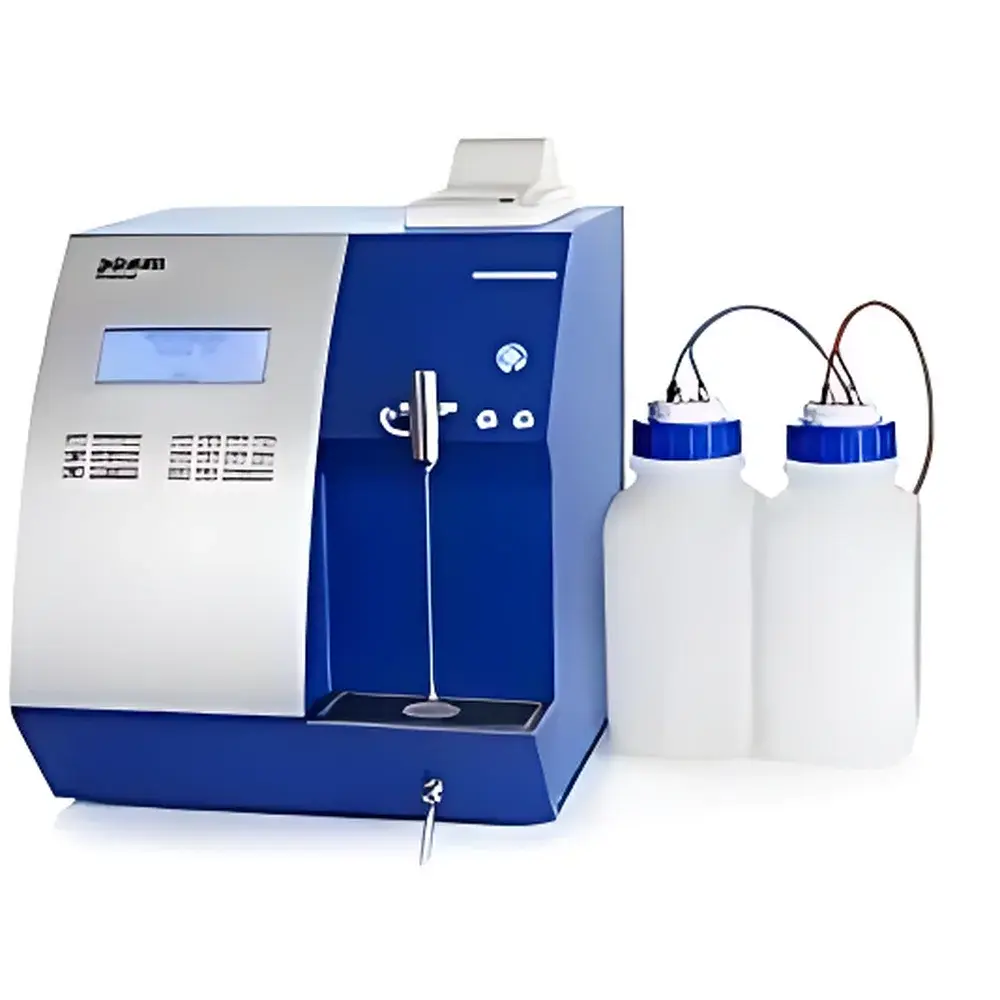
Julie Z9 High-Precision Dairy Analyzer
| Origin | Germany |
|---|---|
| Manufacturer Type | Authorized Distributor |
| Origin Category | Imported |
| Model | Z9 |
| Pricing | Available Upon Request |
Overview
The Julie Z9 High-Precision Dairy Analyzer is a fully automated, benchtop analytical platform engineered for regulatory-grade compositional analysis of dairy and dairy-like fluids. It employs a hybrid multi-sensor architecture—integrating dedicated physical and wet-chemical measurement modules—to deliver direct, non-inferential quantification of key nutritional and quality parameters. Unlike conventional ultrasonic or near-infrared (NIR) milk analyzers that rely on multivariate calibration models and indirect estimation, the Z9 implements reference-method-aligned detection principles—including Gerber–Rozycki fat extraction, Kjeldahl nitrogen conversion for protein, polarimetric lactose determination, gravimetric ash analysis, hydrostatic density measurement, cryoscopic freezing point depression, and calibrated pH potentiometry. This design ensures traceability to ISO 9622 (milk fat), ISO 8968 (protein), ISO 5725 (accuracy and precision), and IDF Standard 141 (lactose), making it suitable for ISO/IEC 17025-accredited laboratories, national reference labs, and GMP-compliant R&D environments.
Key Features
- Direct Multi-Parameter Detection: Each analyte—fat, protein, lactose, non-fat solids, ash, density, freezing point, and pH—is measured via its respective primary reference method sensor, eliminating algorithmic interpolation and minimizing systematic bias.
- Fully Automated Fluidic Management: Integrated peristaltic and diaphragm pump system performs complete sample aspiration, reagent delivery, reaction chamber conditioning, and post-analysis cleaning without manual intervention.
- Cold-Sample Compatibility: Designed to accept raw or refrigerated samples (5–30 °C) without pre-conditioning; thermal stabilization occurs within sealed, temperature-controlled flow cells to preserve native matrix integrity and ensure metrological consistency.
- Self-Diagnostic Maintenance System: Onboard optical and conductive sensors monitor wash solution levels, tubing integrity, and fluid path pressure; audible and visual alerts activate when consumables require replenishment or maintenance is due.
- Zero-Drift Calibration Protocol: Daily automated recalibration uses certified reference standards traceable to NIST and BAM (Bundesanstalt für Materialforschung und -prüfung), with audit-trail logging compliant with FDA 21 CFR Part 11 requirements.
- Extended Component Lifespan: All internal pumps utilize chemically resistant elastomers and brushless DC motors rated for >50,000 operational cycles; no scheduled replacement intervals are specified under normal laboratory use conditions.
Sample Compatibility & Compliance
The Z9 accepts bovine, caprine, ovine, buffalo, camelid, and human breast milk—as well as soy-, almond-, oat-, and coconut-based乳液 (dairy-alternative emulsions) within defined viscosity and particulate limits (≤5 cP, <50 µm suspended solids). Sample introduction is via standardized 10–25 mL aliquots in polypropylene tubes. The instrument complies with IEC 61010-1 (safety), EN 61326-1 (EMC), and meets the mechanical and procedural requirements of ISO/IEC 17025:2017 Clause 6.4.2 for equipment verification. All measurement procedures align with AOAC Official Methods 989.10 (fat), 991.20 (protein), and IDF 103A:2019 (freezing point), supporting accreditation readiness for food safety and nutritional labeling compliance.
Software & Data Management
The Z9 operates under Julie Analytical Suite v4.2—a Windows-based application supporting dual-language UI (English/German), role-based user access control, electronic signature workflows, and full ALCOA+ data integrity governance. Raw sensor outputs, calibration logs, QC check records, and report exports are stored in encrypted SQLite databases with SHA-256 hashing. Audit trails capture operator ID, timestamp, parameter values, and any modification events—including deletion prevention and immutable archiving. Export formats include CSV, PDF/A-2b, and XML for LIMS integration (HL7 v2.5 and ASTM E1384 compatible). Optional 21 CFR Part 11 Module enables electronic signatures, biometric authentication, and configurable retention policies.
Applications
- Regulatory testing for nutritional labeling compliance (EU Regulation No. 1169/2011, FDA 21 CFR §101.9)
- Raw milk payment grading based on fat, protein, and somatic cell count proxy metrics
- Quality assurance of infant formula and medical nutrition products
- Stability assessment of plant-based dairy alternatives during shelf-life studies
- Research into lactation physiology and maternal nutrition using human milk composition profiling
- Process validation and troubleshooting in UHT, membrane filtration, and standardization lines
FAQ
Does the Z9 require daily calibration with external standards?
Yes—automated calibration is executed at startup and after every 20 samples using onboard certified reference materials; manual verification with NIST-traceable standards is recommended weekly.
Can the Z9 analyze homogenized or ultra-high-temperature (UHT) treated milk?
Yes, provided samples are cooled to ≤30 °C prior to loading; thermal history does not interfere with sensor response due to real-time matrix compensation algorithms.
Is the freezing point module compliant with IDF Standard 103A for adulteration screening?
Yes—the cryoscope achieves ±0.005 °C resolution over −0.400 to −0.700 °C and reports results in accordance with IDF 103A:2019 Annex B for water addition detection.
What sample volume is required per analysis?
12 mL minimum per run; the system supports batch processing of up to 48 samples unattended using optional carousel autosampler.
Is GLP-compliant documentation available for audit purposes?
Yes—full electronic records, including raw sensor voltages, calibration curves, QC charts, and deviation reports, are generated and exportable in PDF/A format with embedded digital signatures.






