
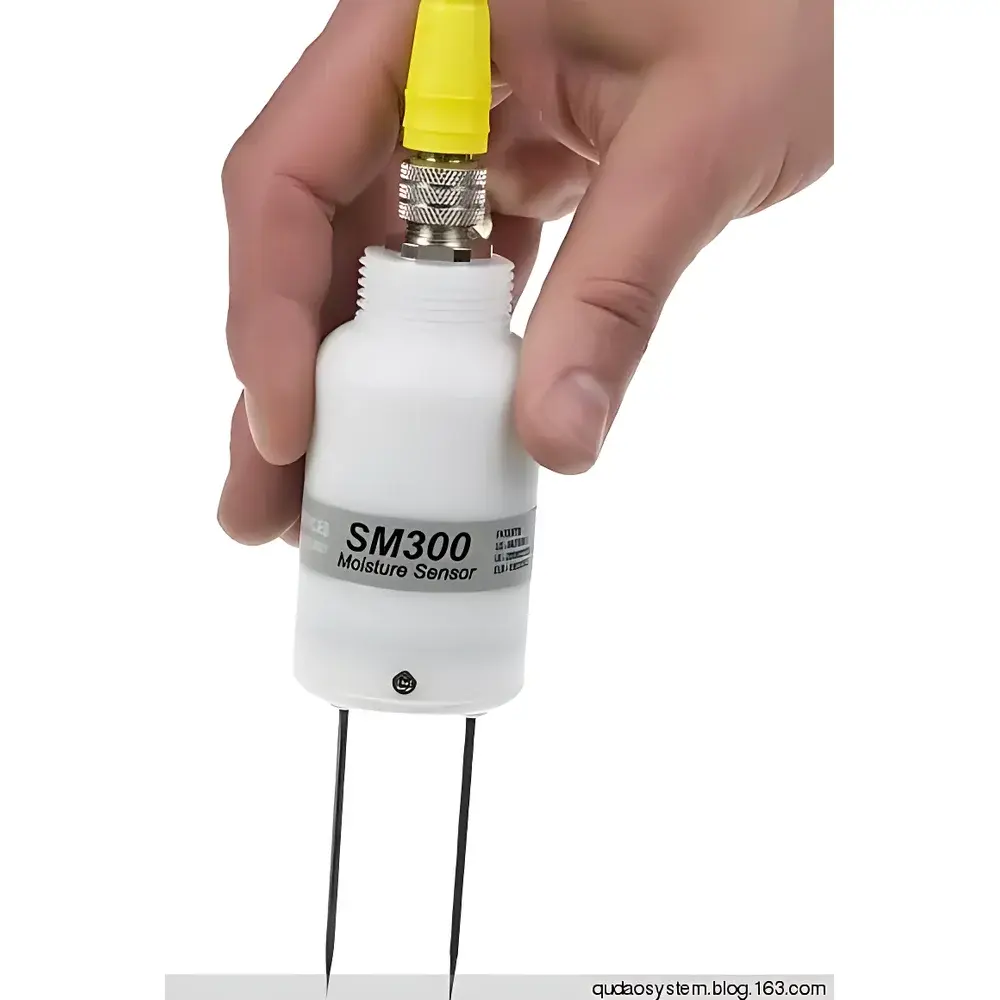
Spectrum Technologies SM300 Soil Moisture and Temperature Sensor
| Brand | Spectrum Technologies |
|---|---|
| Origin | USA |
| Manufacturer Type | Authorized Distributor |
| Origin Category | Imported |
| Model | SM300 |
| Instrument Type | Volumetric Water Content & Soil Temperature Sensor |
| Accuracy | ±2.5% VWC (Volumetric Water Content) |
| Output Signal | Analog Voltage (0–2.5 V) or SDI-12 Digital Interface |
| Operating Temperature Range | –25°C to +50°C |
| Probe Material | Stainless Steel with Epoxy-Coated PCB |
| Probe Dimensions | 12 cm × 1.8 cm × 0.4 cm (L × W × T) |
| Cable Length | Standard 5 m (custom lengths available) |
| Compliance | CE, RoHS, FCC Part 15 Class B |
Overview
The Spectrum Technologies SM300 Soil Moisture and Temperature Sensor is a research-grade, dual-parameter environmental sensor engineered for high-reliability field deployment in agricultural, ecological, hydrological, and climate monitoring applications. It employs time-domain transmission (TDT) technology — a robust, low-power variant of time-domain reflectometry (TDR) — to determine volumetric water content (VWC) by measuring the propagation velocity of an electromagnetic pulse through soil. Simultaneously, it integrates a precision thermistor (±0.5°C accuracy) to deliver co-located soil temperature measurements at the same sensing volume. Unlike capacitive sensors susceptible to salinity-induced drift, the SM300 maintains stable calibration across variable soil electrical conductivity (EC) ranges (up to 8 dS/m), making it suitable for irrigated croplands, saline soils, and long-term eddy covariance or lysimeter networks. Its compact, stainless-steel-shielded probe design ensures mechanical durability during repeated insertion and minimizes thermal lag in dynamic field conditions.
Key Features
- Dual-parameter measurement: simultaneous, spatially coincident VWC and soil temperature output from a single probe
- High salinity tolerance: validated performance across EC levels up to 8 dS/m without recalibration
- Low-power operation: compatible with solar-powered data loggers and battery-operated remote stations (typical current draw: <1 mA in quiescent mode)
- Flexible interface options: analog voltage output (0–2.5 V, scalable to 0–50% VWC) and industry-standard SDI-12 digital protocol for direct integration with Campbell Scientific, Onset HOBO, Decagon (now METER Group), and other Tier-1 data acquisition systems
- Ruggedized construction: corrosion-resistant stainless-steel housing with epoxy-encapsulated electronics; IP68-rated for continuous burial
- Field-deployable versatility: optimized for both permanent installation (e.g., profile monitoring at multiple depths) and portable use with handheld soil augers or direct push rods
Sample Compatibility & Compliance
The SM300 is validated for mineral soils (sand, loam, clay) and organic-rich substrates including peat and composted media, provided bulk density remains within typical field ranges (1.0–1.6 g/cm³). It is not recommended for saturated gravels or highly heterogeneous rocky soils where air gaps may compromise dielectric contact. The sensor complies with ISO 11277:2019 (soil physical analysis — determination of particle size distribution) for representative sampling context and meets IEC 60529 (IP68) for ingress protection. All electronic components adhere to RoHS Directive 2011/65/EU and FCC Part 15 Subpart B for electromagnetic compatibility in unlicensed bands. While not certified under FDA 21 CFR Part 11, its deterministic analog/digital outputs support ALCOA+ (Attributable, Legible, Contemporaneous, Original, Accurate, Complete, Consistent, Enduring, Available) data integrity principles when paired with compliant data loggers and metadata documentation.
Software & Data Management
The SM300 requires no proprietary software — raw voltage or SDI-12 responses are interpreted using standard calibration equations published in Spectrum Technologies’ technical documentation (e.g., VWC = 0.0004 × V² + 0.023 × V + 0.012, where V = output voltage in volts). These coefficients are traceable to NIST-traceable gravimetric validation across 12 soil textural classes. When integrated into larger monitoring platforms (e.g., Campbell CR1000X or METER ZL6), data streams automatically populate time-series databases supporting automated irrigation scheduling, evapotranspiration modeling (FAO-56), and FAO’s Water Productivity Assessment Framework. Export formats include CSV, NetCDF, and JSON-LD for interoperability with USDA’s SCAN network, NASA’s SMAP Level 4 soil moisture products, and cloud-based dashboards such as ThingSpeak or Azure IoT Central.
Applications
- Precision irrigation management: real-time root-zone VWC feedback for drip and pivot systems
- Crop water stress indexing in drought-prone regions (e.g., California Central Valley, Australian Murray-Darling Basin)
- Long-term soil carbon sequestration studies requiring multi-depth VWC–temperature covariance
- Validation of satellite-derived soil moisture products (e.g., Sentinel-1 SAR, SMOS L-band radiometry)
- Educational field labs in agronomy, environmental science, and geoscience curricula
- Green infrastructure monitoring (bioswales, rain gardens, permeable pavements)
FAQ
What is the recommended installation method for optimal accuracy?
For permanent installations, use a pilot hole slightly larger than the probe width and backfill with native soil slurry to eliminate air gaps. For portable use, insert directly into undisturbed soil using a calibrated soil auger; avoid hammering or twisting that may damage the PCB traces.
Does the SM300 require factory recalibration over time?
No — the TDT-based measurement principle exhibits negligible long-term drift. Field verification against gravimetric samples every 12–24 months is recommended for QA/QC compliance in regulated research programs.
Can multiple SM300 sensors share one SDI-12 bus?
Yes — up to 62 sensors can be addressed on a single SDI-12 line using unique address assignment; polling intervals must be staggered to prevent signal collision.
Is the cable shielded against EMI in high-noise environments (e.g., near pumps or inverters)?
Standard cables include foil + braid shielding per MIL-STD-2000A; optional double-shielded variants are available for industrial-scale irrigation control cabinets.
How does temperature compensation work internally?
The integrated thermistor continuously corrects the TDT propagation time for thermal expansion effects on the probe’s dielectric path length, ensuring VWC stability across the full –25°C to +50°C operating range.
Related Products







