
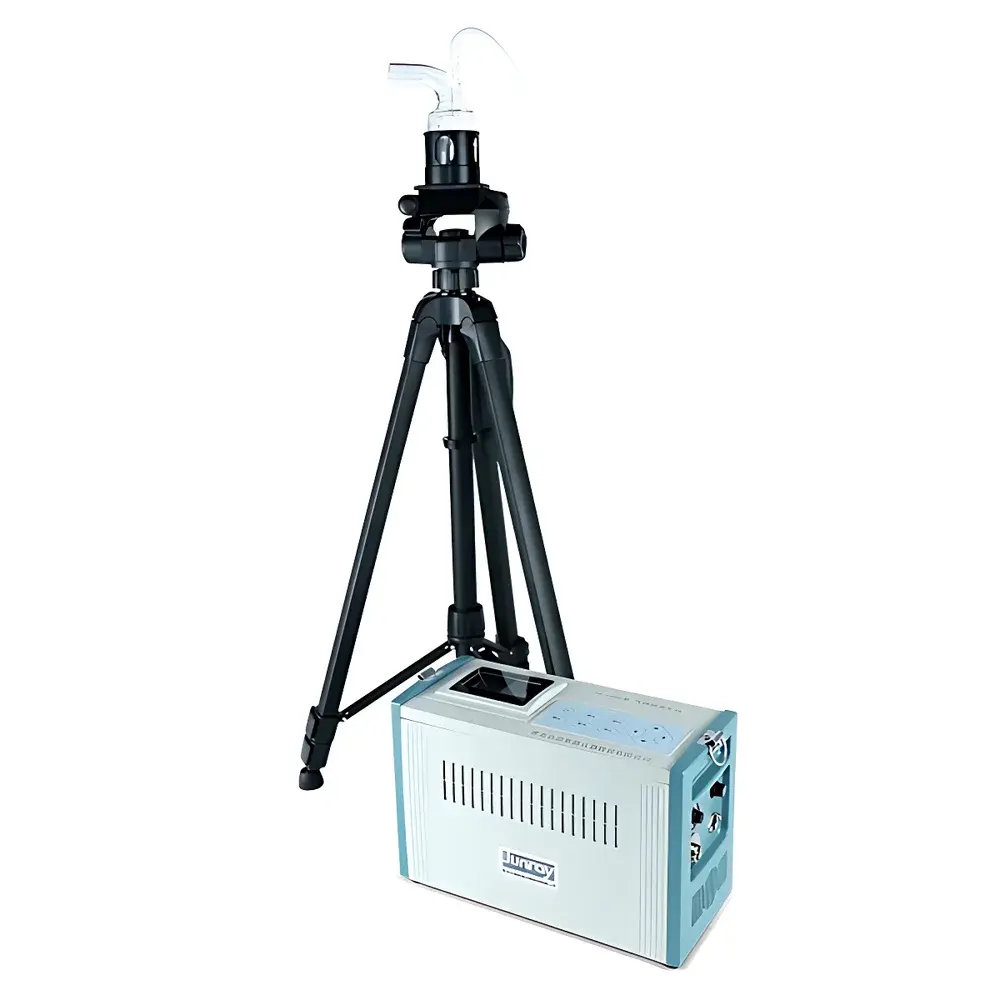
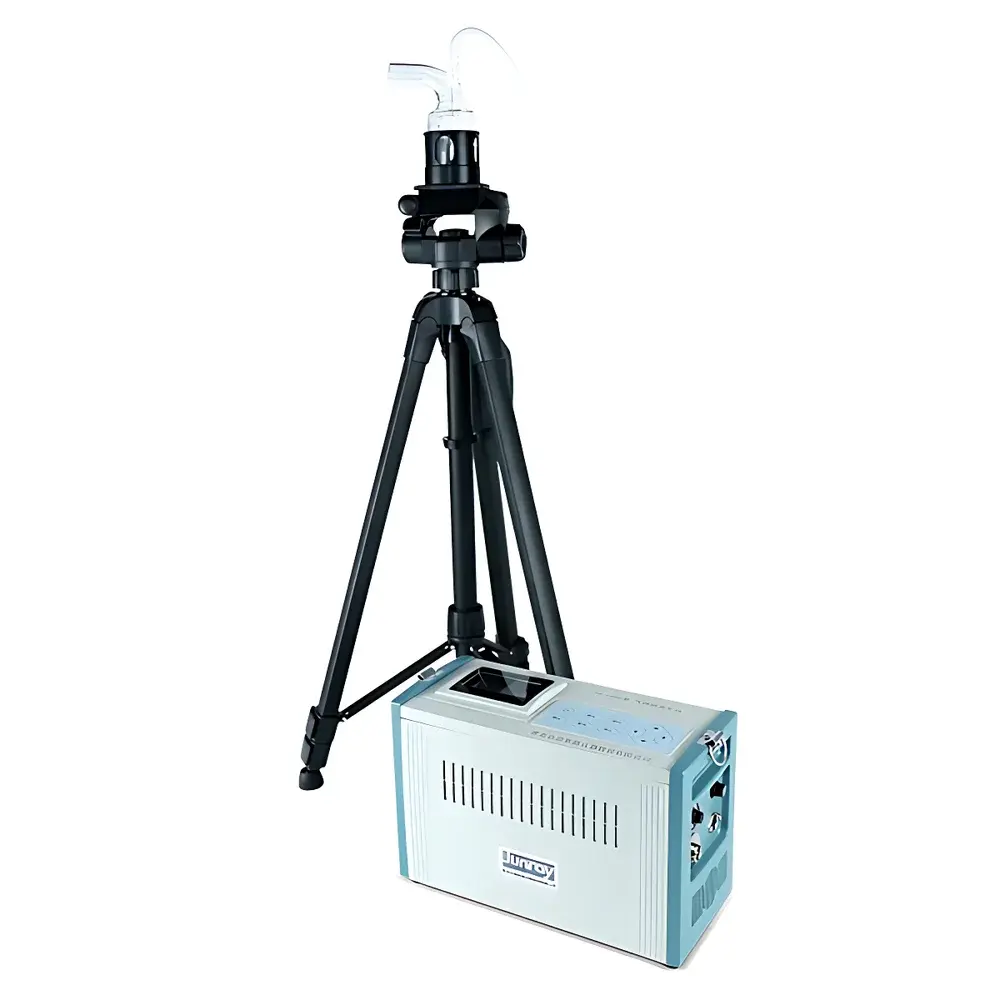
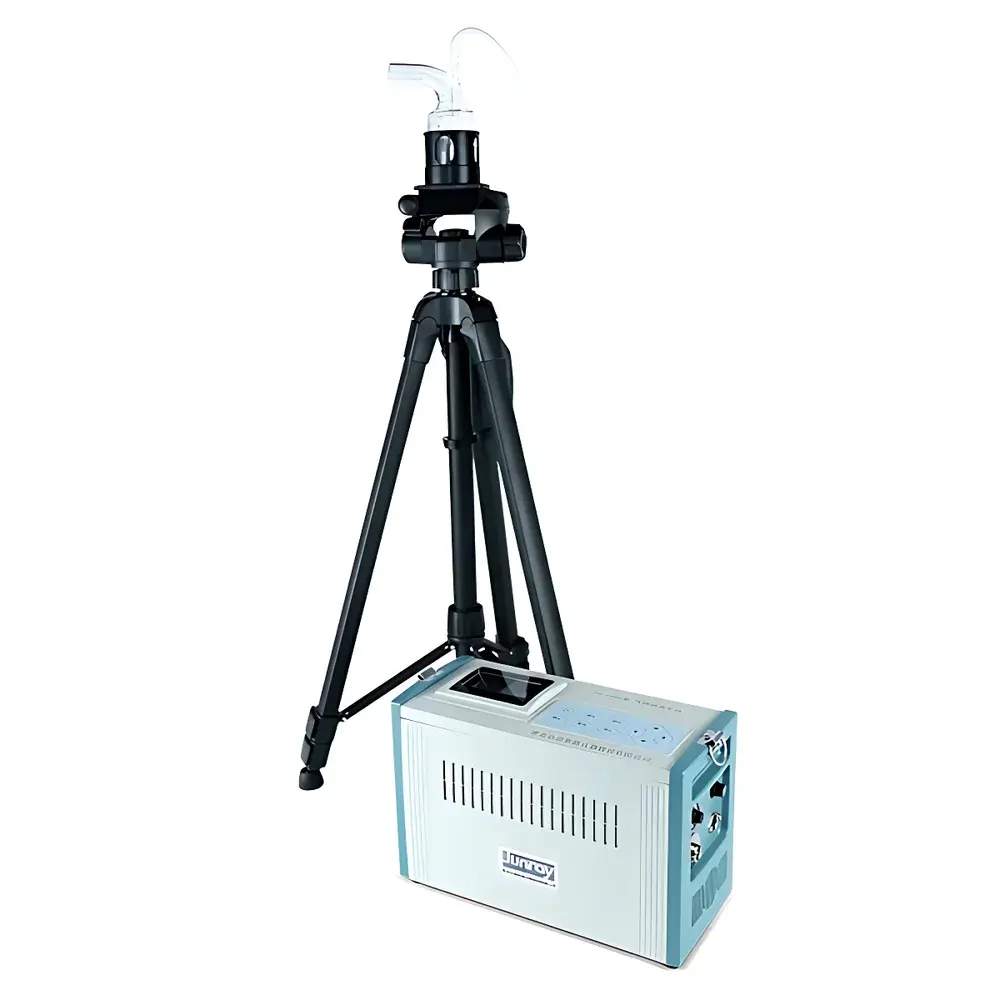
Junray ZR-1050 Aerosol Generator
| Brand | Junray |
|---|---|
| Origin | Shandong, China |
| Manufacturer Type | Direct Manufacturer |
| Country of Origin | China |
| Model | ZR-1050 |
| Pricing | Available Upon Request |
Overview
The Junray ZR-1050 Aerosol Generator is a precision-engineered device designed for the controlled generation of monodisperse or polydisperse aerosol particles in laboratory and industrial validation environments. It operates on the principle of pneumatic nebulization—utilizing high-velocity compressed gas flow to induce pressure differential at the tip of a vertically oriented liquid delivery tube. This Venturi-driven mechanism draws liquid (e.g., bacterial suspensions, sodium chloride solution, or polystyrene latex spheres) from the reservoir into the nozzle, where shear forces fragment the liquid into fine droplets. These droplets rapidly evaporate (in the case of volatile solvents) or remain as solid/liquid-phase aerosols, forming a stable, reproducible aerosol cloud suitable for challenge testing of air filtration systems and inhalation exposure studies.
Unlike thermal or ultrasonic generators, the ZR-1050 employs cold nebulization—preserving biological viability of microbial agents and avoiding thermal degradation of sensitive test materials. Its design prioritizes metrological traceability, mechanical robustness, and operational repeatability across extended duty cycles—making it particularly suited for GLP-compliant filter integrity verification and regulatory-grade bioaerosol challenge protocols.
Key Features
- High-precision electronic mass flow controller (MFC) with ±1% full-scale accuracy for consistent aerosol output rate regulation
- Optimized laminar gas-path architecture minimizing turbulence and pulsation—ensuring uniform particle size distribution and temporal stability over 30+ minute continuous operation
- Dedicated adjustable nebulizer head with calibrated capillary geometry, supporting programmable liquid flow rates from 0.1 to 3.0 mL/min
- Integrated OLED display with wide viewing angle and low-temperature operational capability (–10 °C to +50 °C), enabling use in cold-room or field-deployable settings
- Onboard non-volatile memory storing ≥10,000 timestamped parameter sets—including flow rate, run duration, ambient temperature/humidity (when interfaced with optional sensors)
- Firmware-based calibration routine accessible via password-protected interface, supporting NIST-traceable adjustment of flow and timing parameters
- Real-time fault diagnostics with automatic shutdown on overpressure, low liquid level, or thermal overload conditions
Sample Compatibility & Compliance
The ZR-1050 accommodates aqueous suspensions (e.g., Bacillus atrophaeus, MS2 bacteriophage, PSL standards), saline solutions, and organic solvent-based formulations (with compatible wetted materials). All fluid-contact components are constructed from chemically inert 316 stainless steel, borosilicate glass, and PTFE—ensuring compatibility with ISO 8573-1 Class 2 compressed air and preventing catalytic decomposition or adsorption artifacts.
The instrument supports validation workflows aligned with YY 0569–2011 (Class II Biological Safety Cabinets), GB/T 13554–2008 (High-Efficiency Particulate Air Filters), and GB 50591–2010 (Cleanroom Construction and Acceptance). While not certified to IEC 61000 or ATEX, its electrical design complies with GB 4793.1–2007 (Safety Requirements for Electrical Equipment for Measurement, Control, and Laboratory Use).
Software & Data Management
The ZR-1050 features embedded firmware with audit-trail-capable parameter logging. All user-initiated actions—including calibration events, password changes, and runtime modifications—are time-stamped and stored locally. Optional USB-C interface enables export of CSV-formatted logs for integration into LIMS or statistical process control platforms. Firmware updates are performed via signed binary files to prevent unauthorized modification—supporting basic 21 CFR Part 11 readiness when deployed within validated computerized systems under documented SOPs.
Applications
- Challenge testing of HEPA and ULPA filters per ISO 14644-3 and EN 1822
- Performance evaluation of biological safety cabinets (BSCs) and fume hoods per NSF/ANSI 49 and YY 0569
- Aerosol deposition studies in inhalation toxicology chambers and whole-body exposure systems
- Calibration and verification of optical particle counters (OPCs) and condensation particle counters (CPCs)
- Development and qualification of decontamination protocols using spore-based simulants
- Validation of cleanroom HVAC system containment integrity during pharmaceutical manufacturing
FAQ
What types of test agents can be used with the ZR-1050?
Aqueous microbial suspensions (e.g., B. atrophaeus spores), sodium chloride, dioctyl phthalate (DOP), polyalphaolefin (PAO), and polystyrene latex (PSL) standards—provided compatibility with wetted materials is verified.
Is the ZR-1050 compliant with FDA or EU GMP requirements?
The device itself is not CE-marked or FDA-listed; however, its design, documentation, and data handling capabilities support use within GMP-regulated environments when incorporated into a fully validated test method and operated under approved SOPs.
Can the aerosol output concentration be quantified in real time?
No—the ZR-1050 generates aerosol at a defined volumetric flow and liquid feed rate; real-time concentration measurement requires external instrumentation such as an aerodynamic particle sizer (APS) or scanning mobility particle sizer (SMPS).
Does the unit include a built-in air compressor?
No—compressed air or nitrogen (clean, oil-free, dew point ≤ –40 °C) must be supplied externally at 0.4–0.6 MPa.
What maintenance intervals are recommended?
Nebulizer capillaries should be inspected and ultrasonically cleaned after every 20 hours of cumulative operation; O-rings and seals require replacement annually or per usage log assessment.







